


Page 307 - Hematology_ Basic Principles and Practice ( PDFDrive )
P. 307
Chapter 23  Dendritic Cell Biology  255


                                                                     Inhibition of viral replication
                                     Death receptor                  NK cell activation
                                           ligands                   Cross-priming
                                                                     Enhancement of primary antibody response
                                        Membrane                     Isotope switching
                                             PRR
                                                         IFN-α                        Naive CD8
                                   Cytoplasmic PRR
                                                                                               Cytotoxicity
                                                            TNF-α
                                                     pDC                      Antigen  Naive CD4
                                       Intemalization
                         Bacteria, viruses,  Infection  Maturation          presentation       Treg
                         “danger signals”
                                        activation
                                                            TNF-α  Mature DC               TGF-β
                                                                                               Th17
                                                  Immature DC
                                                                            IL-6               Th1


                                                                              IL-12            IFN-γ
                                                                                               cytotoxicity
                                                                                       NK cell
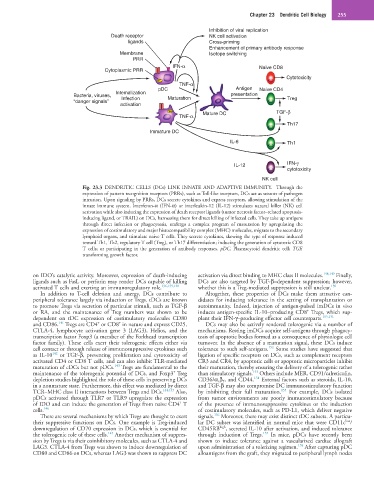
                            Fig.  23.3  DENDRITIC CELLS  (DCs) LINK  INNATE AND ADAPTIVE IMMUNITY.  Through the
                            expression of pattern recognition receptors (PRRs), such as Toll-like receptors, DCs act as sensors of pathogen
                            intrusion. Upon signaling by PRRs, DCs secrete cytokines and express receptors, allowing stimulation of the
                            innate immune system. Interferon-α (IFN-α) or interleukin-12 (IL-12) stimulates natural killer (NK) cell
                            activation while also inducing the expression of death receptor ligands (tumor necrosis factor–related apoptosis-
                            inducing ligand, or TRAIL) on DCs, harnessing them for direct killing of infected cells. They take up antigens
                            through  direct  infection  or  phagocytosis,  undergo  a  complex  program  of  maturation  by  upregulating  the
                            expression of costimulatory and major histocompatibility complex (MHC) molecules, migrate to the secondary
                            lymphoid organs, and stimulate naive T cells. They secrete cytokines, skewing the type of response induced
                            toward Th1, Th2, regulatory T cell (Treg), or Th17 differentiation; inducing the generation of cytotoxic CD8
                            T  cells;  or  participating  in  the  generation  of  antibody  responses.  pDC,  Plasmacytoid  dendritic  cell;  TGF,
                            transforming growth factor.


            on IDO’s catalytic activity. Moreover, expression of death-inducing   activation via direct binding to MHC class II molecules. 148,149  Finally,
            ligands such as FasL or perforin may render DCs capable of killing   DCs are also targeted by TGF-β–dependent suppression; however,
            activated T cells and exerting an immunoregulatory role. 136,139,140  whether this is a Treg-mediated suppression is still unclear. 150
              In  addition  to  T-cell  deletion  and  anergy,  DCs  contribute  to   Altogether,  these  properties  of  DCs  make  them  attractive  can-
            peripheral tolerance largely via induction or Tregs. tDCs are known   didates  for  inducing  tolerance  in  the  setting  of  transplantation  or
            to promote Tregs via secretion of particular stimuli, such as TGF-β   autoimmunity. Indeed, injection of antigen-pulsed imDCs in vivo
                                                                                                     +
            or  RA,  and  the  maintenance  of  Treg  numbers  was  shown  to  be   induces  antigen-specific  IL-10–producing  CD8  Tregs,  which  sup-
            dependent  on  tDC  expression  of  costimulatory  molecules  CD80   plant their IFN-γ–producing effector cell counterparts. 105,151
                                        +
                                 +
                    141
            and CD86.  Tregs are CD4  or CD8  in nature and express CD25,   DCs may also be actively rendered tolerogenic via a number of
            CTLA-4,  lymphocyte  activation  gene  3  (LAG3),  Helios,  and  the   mechanisms. Resting imDCs acquire self-antigens through phagocy-
            transcription factor Foxp3 (a member of the Forkhead transcription   tosis of apoptotic bodies formed as a consequence of physiologic cell
            factor  family). These  cells  exert  their  tolerogenic  effects  either  via   turnover. In the absence of a maturation signal, these DCs induce
                                                                                         152
            cell contact or through release of immunosuppressive cytokines such   tolerance to such self-antigens.  Some studies have suggested that
                  142
            as  IL-10   or TGF-β,  preventing  proliferation  and  cytotoxicity  of   ligation of specific receptors on DCs, such as complement receptors
            activated CD4 or CD8 T cells, and can also inhibit TLR-mediated   CR3 and CR4, by apoptotic cells or apoptotic microparticles inhibit
                                      143
            maturation of cDCs but not pDCs.  Tregs are fundamental to the   their maturation, thereby ensuring the delivery of a tolerogenic rather
                                                          +
                                                                                    153
            maintenance of the tolerogenic potential of DCs, and Foxp3  Treg   than stimulatory signals.  Others include MER, CD91/calreticulin,
                                                                                    154
            depletion studies highlighted the role of these cells in preserving DCs   CD36/α v β 5 , and CD44.  External factors such as steroids, IL-10,
            in a nonmature state. Furthermore, this effect was mediated by direct   and TGF-β may also compromise DC immunostimulatory function
                                                                                             155
            TCR–MHC class II interactions between Tregs and DCs. 144,145  Also,   by  inhibiting  their  full  maturation.   For  example,  DCs  isolated
            pDCs activated through TLR7 or TLR9 upregulate the expression   from  tumor  environments  are  poorly  immunostimulatory  because
                                                            +
            of IDO and can induce the generation of Tregs from naive CD4  T   of  the  presence  of  immunosuppressive  cytokines  or  the  induction
            cells. 146                                            of costimulatory molecules, such as PD-L1, which deliver negative
                                                                       156
              There are several mechanisms by which Tregs are thought to exert   signals.  Moreover, there may exist distinct tDC subsets. A particu-
                                                                                                                  low
            their  suppressive  functions  on  DCs.  One  example  is Treg-induced   lar DC subset was identified in normal mice that were CD11c /
            downregulation of CD70 expression in DCs, which is essential for   CD45RB high , secreted IL-10 after activation, and induced tolerance
                                    147
                                                                                       157
            the tolerogenic role of these cells.  Another mechanism of suppres-  through  induction  of Tregs.   In  mice,  pDCs  have  recently  been
            sion by Tregs is via their coinhibitory molecules, such as CTLA-4 and   shown  to  induce  tolerance  against  a  vascularized  cardiac  allograft
                                                                                                   158
            LAG3. CTLA-4 from Tregs was shown to induce downregulation of   upon administration of a tolerizing regimen.  After capturing pDC
            CD80 and CD86 on DCs, whereas LAG3 was shown to suppress DC   alloantigens from the graft, they migrated to peripheral lymph nodes

