


Page 341 - Hematology_ Basic Principles and Practice ( PDFDrive )
P. 341
Chapter 24  Complement and Immunoglobulin Biology Leading to Clinical Translation  283


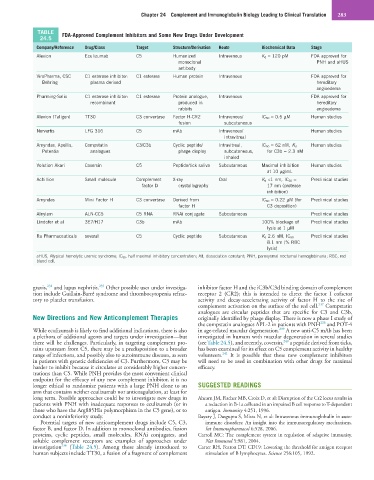
             TABLE   FDA-Approved Complement Inhibitors and Some New Drugs Under Development
              24.5
             Company/Reference  Drug/Class    Target      Structure/Derivation  Route  Biochemical Data  Stage
             Alexion         Eculizumab       C5          Humanized      Intravenous   K d  = 120 pM   FDA approved for
                                                           monoclonal                                    PNH and aHUS
                                                           antibody
             ViroPharma, CSC   C1 esterase inhibitor:   C1 esterase  Human protein  Intravenous        FDA approved for
               Behring         plasma derived                                                            hereditary
                                                                                                         angioedema
             Pharming-Salix  C1 esterase inhibitor:   C1 esterase  Protein analogue,   Intravenous     FDA approved for
                               recombinant                 produced in                                   hereditary
                                                           rabbits                                       angioedema
             Alexion (Taligen)  TT30          C3 convertase  Factor H-CR2   Intravenous/  IC 50  = 0.5 µM  Human studies
                                                           fusion         subcutaneous
             Norvartis       LFG 316          C5          mAb            Intravenous/                  Human studies
                                                                          intravitreal
             Amyndas, Apellis,   Compstatin   C3/C3b      Cyclic peptide/  Intravitreal,   IC 50  = 62 nM, K d    Human studies
               Potentia        analogues                   phage display  subcutaneous,   for C3b = 2.3 nM
                                                                          inhaled
             Volution Akari  Coversin         C5          Peptide/tick saliva  Subcutaneous  Maximal inhibition   Human studies
                                                                                        at 10 µg/mL
             Achillion       Small molecule   Complement   X-ray         Oral          K d  <1 nm, IC 50  =   Preclinical studies
                                               factor D    crystallography              17 nm (protease
                                                                                        inhibition)
             Amyndas         Mini Factor H    C3 convertase  Derived from              IC 50  = 0.22 µM (for   Preclinical studies
                                                           factor H                     C3 deposition)
             Alnylam         ALN-CC5          C5 RNA      RNAi conjugate  Subcutaneous                 Preclinical studies
             Lindofer et al  3E7/H17          C3b         mAb                          100% blockage of   Preclinical studies
                                                                                        lysis at 1 µM
             Ra Pharmaceuticals  several      C5          Cyclic peptide  Subcutaneous  K d  2.6 nM, IC 50    Preclinical studies
                                                                                        8.1 nm (% RBC
                                                                                        lysis)
             aHUS, Atypical hemolytic uremic syndrome; IC 50 , half maximal inhibitory concentration; Kd, dissociation constant; PNH, paroxysmal nocturnal hemoglobinuria; RBC, red
             blood cell.


                                 235
                234
            gravis,  and lupus nephritis.  Other possible uses under investiga-  inhibitor factor H and the iC3b/C3d binding domain of complement
            tion include Guillain-Barré syndrome and thrombocytopenia refrac-  receptor  2  (CR2);  this  is  intended  to  direct  the  factor  I  cofactor
            tory to platelet transfusion.                         activity  and  decay-accelerating  activity  of  factor  H  to  the  site  of
                                                                                                         237
                                                                  complement activation on the surface of the red cell.  Compstatin
                                                                  analogues  are  circular  peptides  that  are  specific  for  C3  and  C3b,
            New Directions and New Anticomplement Therapies       originally identified by phage display. There is now a phase I study of
                                                                                                          238
                                                                  the compstatin analogues APL-2 in patients with PNH  and POT-4
                                                                                            239
            While eculizumab is likely to find additional indications, there is also   in age-related macular degeneration.  A new anti-C5 mAb has been
            a plethora of additional agents and targets under investigation—but   investigated in humans with macular degeneration in several studies
                                                                                              240
            there will be challenges. Particularly, in targeting complement pro-  (see Table 24.5), and recently, coversin,  a peptide derived from ticks,
            teins upstream from C5, there may be a predisposition to a broader   has been examined for its effect on C5 complement activity in healthy
                                                                          241
            range of infections, and possibly also to autoimmune diseases, as seen   volunteers.   It  is  possible  that  these  new  complement  inhibitors
            in patients with genetic deficiencies of C3. Furthermore, C3 may be   will need to be used in combination with other drugs for maximal
            harder to inhibit because it circulates at considerably higher concen-  efficacy.
            trations than C5. While PNH provides the most convenient clinical
            endpoint for the efficacy of any new complement inhibitor, it is no
            longer ethical to randomize patients with a large PNH clone to an   SUGGESTED READINGS
            arm that contains neither eculizumab nor anticoagulation, at least for
            long term. Possible approaches could be to investigate new drugs in   Ahearn JM, Fischer MB, Croix D, et al: Disruption of the Cr2 locus results in
            patients with PNH with inadequate responses to eculizumab (or in   a reduction in B-1a cells and in an impaired B cell response to T-dependent
            those who have the Arg885His polymorphism in the C5 gene), or to   antigen. Immunity 4:251, 1996.
            conduct a noninferiority study.                       Bayary J, Dasgupta S, Misra N, et al: Intravenous immunoglobulin in auto-
              Potential targets of new anticomplement drugs include C5, C3,   immune disorders: An insight into the immunoregulatory mechanisms.
            factor B, and factor D. In addition to monoclonal antibodies, fusion   Int Immunopharmacol 6:528, 2006.
            proteins,  cyclic  peptides,  small  molecules,  RNAi  conjugates,  and   Carroll MC: The complement system in regulation of adaptive immunity.
            soluble  complement  receptors  are  examples  of  approaches  under   Nat Immunol 5:981, 2004.
                     236
            investigation   (Table  24.5).  Among  those  already  introduced  to   Carter RH, Fearon DT: CD19: Lowering the threshold for antigen receptor
            human subjects include TT30, a fusion of a fragment of complement   stimulation of B lymphocytes. Science 256:105, 1992.

