


Page 336 - Hematology_ Basic Principles and Practice ( PDFDrive )
P. 336
278    Part III  Immunologic Basis of Hematology


                         SS       SS         SS       SS          SS      SS          SS      SS
                             SS                   SS                  SS                  SS


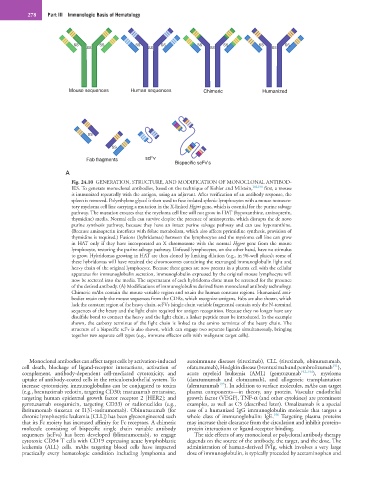
                        Mouse sequences     Human sequences         Chimeric           Humanized


                              SS

                                      SS
                             Fab fragments       scFv
                                                          Bispecific scFv’s
                      A
                        Fig. 24.10  GENERATION, STRUCTURE, AND MODIFICATION OF MONOCLONAL ANTIBOD-
                        IES. To generate monoclonal antibodies, based on the technique of Kohler and Milstein, 182,190  first, a mouse
                        is immunized repeatedly with the antigen, using an adjuvant. After verification of an antibody response, the
                        spleen is removed. Polyethylene glycol is then used to fuse isolated splenic lymphocytes with a mouse nonsecre-
                        tory myeloma cell line carrying a mutation in the X-linked Hgprt gene, which is essential for the purine salvage
                        pathway. The mutation ensures that the myeloma cell line will not grow in HAT (hypoxanthine, aminopterin,
                        thymidine) media. Normal cells can survive despite the presence of aminopterin, which disrupts the de novo
                        purine synthesis  pathway, because  they  have an  intact purine salvage  pathway and can use hypoxanthine.
                        (Because aminopterin interferes with folate metabolism, which also affects pyrimidine synthesis, provision of
                        thymidine is required.) Fusions (hybridomas) between the lymphocytes and the myeloma cell line can grow
                        in  HAT  only  if  they  have  incorporated  an  X  chromosome  with  the  normal  Hgprt  gene  from  the  mouse
                        lymphocyte, restoring the purine salvage pathway. Unfused lymphocytes, on the other hand, have no stimulus
                        to grow. Hybridomas growing in HAT are then cloned by limiting dilution (e.g., in 96-well plates); some of
                        these hybridomas will have retained the chromosomes containing the rearranged immunoglobulin light and
                        heavy chain of the original lymphocyte. Because these genes are now present in a plasma cell with the cellular
                        apparatus for immunoglobulin secretion, immunoglobulin expressed by the original mouse lymphocyte will
                        now be secreted into the media. The supernatant of each hybridoma clone must be screened for the presence
                        of the desired antibody. (A) Modifications of immunoglobulins derived from monoclonal antibody technology.
                        Chimeric mAbs contain the mouse variable region and retain the human constant regions. Humanized anti-
                        bodies retain only the mouse sequences from the CDRs, which recognize antigens. Fabs are also shown, which
                        lack the constant region of the heavy chain. scFVs (single chain variable fragments) contain only the N-terminal
                        sequences of the heavy and the light chain required for antigen recognition. Because they no longer have any
                        disulfide bond to connect the heavy and the light chain, a linker peptide must be introduced. In the example
                        shown, the carboxy terminus of the light chain is linked to the amino terminus of the heavy chain. The
                        structure of a bispecific scFv is also shown, which can engage two separate ligands simultaneously, bringing
                        together two separate cell types (e.g., immune effector cells with malignant target cells).


           Monoclonal antibodies can affect target cells by activation-induced   autoimmune diseases (rituximab), CLL (rituximab, obinutuzumab,
                                                                                                              191
        cell  death,  blockage  of  ligand-receptor  interactions,  activation  of   ofatumumab), Hodgkin disease (brentuximab and pembrolizumab ),
        complement,  antibody-dependent  cell-mediated  cytotoxicity,  and   acute  myeloid  leukemia  (AML)  (gemtuzumab 192–194 ),  myeloma
        uptake of antibody-coated cells in the reticuloendothelial system. To   (daratumumab  and  elotuzumab),  and  allogeneic  transplantation
                                                                         195
        increase cytotoxicity, immunoglobulins can be conjugated to toxins   (alemtuzumab ). In addition to surface molecules, mAbs can target
        (e.g., brentuximab vedotin, targeting CD30; trastuzumab emtansine,   plasma  components—in  theory,  any  protein.  Vascular  endothelial
        targeting human epidermal growth factor receptor 2 [HER2]; and   growth factor (VEGF), TNF-α (and other cytokines) are prominent
        gemtuzumab  ozogamicin,  targeting  CD33)  or  radionuclides  (e.g.,   examples, as well as C5 (described later). Omalizumab is a special
        ibritumomab  tiuxetan  or  I131-tositumomab).  Obinutuzumab  (for   case of a humanized IgG immunoglobulin molecule that targets a
                                                                                           196
        chronic lymphocytic leukemia [CLL]) has been glycoengineered such   whole  class  of  immunoglobulin:  IgE.  Targeting  plasma  proteins
        that its Fc moiety has increased affinity for Fc receptors. A chimeric   may increase their clearance from the circulation and inhibit protein–
        molecule  consisting  of  bispecific  single  chain  variable  antibody   protein interactions or ligand-receptor binding.
        sequences  (scFvs)  has  been  developed  (blinatumomab),  to  engage   The side effects of any monoclonal or polyclonal antibody therapy
        cytotoxic CD3+ T cells with CD19 expressing acute lymphoblastic   depends on the source of the antibody, the target, and the dose. The
        leukemia  (ALL)  cells.  mAbs  targeting  blood  cells  have  impacted   administration of human-derived IVIg, which involves a very large
        practically  every  hematologic  condition  including  lymphoma  and   dose of immunoglobulin, is typically preceded by acetaminophen and

