


Page 409 - Hematology_ Basic Principles and Practice ( PDFDrive )
P. 409
Chapter 27  Granulocytopoiesis and Monocytopoiesis  331


             A                     B                    C                    D                      E
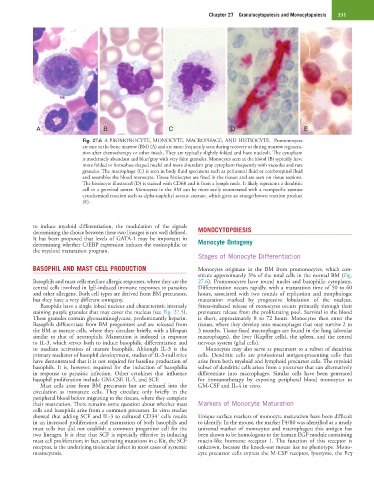
                            Fig. 27.6  A PROMONOCYTE, MONOCYTE, MACROPHAGE, AND HISTIOCYTE.  Promonocytes
                            are rare in the bone marrow (BM) (A) and are more frequently seen during recovery or during marrow regenera-
                            tion after chemotherapy or other insult. They are typically slightly folded and have nucleoli. The cytoplasm
                            is moderately abundant and blue/gray with very faint granules. Monocytes seen in the blood (B) typically have
                            more folded or horseshoe-shaped nuclei and more abundant gray cytoplasm frequently with vacuoles and rare
                            granules. The macrophage (C) is seen in body fluid specimens such as peritoneal fluid or cerebrospinal fluid
                            and resembles the blood monocyte. Tissue histiocytes are fixed in the tissues and are seen on tissue sections.
                            The histiocyte illustrated (D) is stained with CD68 and is from a lymph node. It likely represents a dendritic
                            cell in a germinal center. Monocytes in the BM can be more easily enumerated with a nonspecific esterase
                            cytochemical reaction such as alpha-naphthyl acetate esterase, which gives an orange/brown reaction product
                            (E).


            to  induce  myeloid  differentiation,  the  modulation  of  the  signals
            determining the choice between these two lineages is not well defined.   MONOCYTOPOIESIS
            It has  been proposed that  levels  of  GATA-1  may be important  in
            determining whether C/EBP expression induces the eosinophilic or   Monocyte Ontogeny
            the myeloid maturation program.
                                                                  Stages of Monocyte Differentiation

            BASOPHIL AND MAST CELL PRODUCTION                     Monocytes  originate  in  the  BM  from  promonocytes,  which  con-
                                                                  stitute approximately 3% of the total cells in the normal BM (Fig.
            Basophils and mast cells mediate allergic responses, where they are the   27.6).  Promonocytes  have  round  nuclei  and  basophilic  cytoplasm.
            central cells involved in IgE-induced immune responses to parasites   Differentiation occurs rapidly, with a maturation time of 50 to 60
            and other allergens. Both cell types are derived from BM precursors,   hours, associated with two rounds of replication and morphologic
            but they have a very different ontogeny.              maturation  marked  by  progressive  lobulation  of  the  nucleus.
              Basophils have a single lobed nucleus and characteristic intensely   Stress-induced release of monocytes occurs primarily through their
            staining purple granules that may cover the nucleus (see Fig. 27.5).   premature release from the proliferating pool. Survival in the blood
            These granules contain glycosaminoglycans, predominantly heparin.   is  short,  approximately  8  to  72  hours.  Monocytes  then  enter  the
            Basophils differentiate from BM progenitors and are released from   tissues, where they develop into macrophages that may survive 2 to
            the BM as mature cells, where they circulate briefly, with a lifespan   3 months. Tissue-fixed macrophages are found in the lung (alveolar
            similar  to  that  of  neutrophils.  Maturation  is  induced  in  response   macrophages), the liver (Kupffer cells), the spleen, and the central
            to IL-3, which serves both to induce basophilic differentiation and   nervous system (glial cells).
            to  mediate  activation  of  mature  basophils.  Although  IL-3  is  the   Monocytes may also serve as precursors to a subset of dendritic
            primary mediator of basophil development, studies of IL-3-null mice   cells.  Dendritic  cells  are  professional  antigen-presenting  cells  that
            have demonstrated that it is not required for baseline production of   arise from both myeloid and lymphoid precursor cells. The myeloid
            basophils.  It  is,  however,  required  for  the  induction  of  basophilia   subset of dendritic cells arises from a precursor that can alternatively
            in  response  to  parasitic  infection.  Other  cytokines  that  influence   differentiate  into  macrophages.  Similar  cells  have  been  generated
            basophil proliferation include GM-CSF, IL-5, and SCF.  for  immunotherapy  by  exposing  peripheral  blood  monocytes  to
              Mast  cells  arise  from  BM  precursors  but  are  released  into  the   GM-CSF and IL-4 in vitro.
            circulation  as  immature  cells.  They  circulate  only  briefly  in  the
            peripheral blood before migrating to the tissues, where they complete
            their maturation. There remains some question about whether mast   Markers of Monocyte Maturation
            cells and basophils arise from a common precursor. In vitro studies
                                                    +
            showed that adding SCF and IL-3 to cultured CD34  cells results   Unique surface markers of monocyte maturation have been difficult
            in an increased proliferation and maturation of both basophils and   to identify. In the mouse, the marker F4/80 was identified as a nearly
            mast cells but did not establish a common progenitor cell for the   universal  marker  of  monocytes  and  macrophages;  this  antigen  has
            two lineages. It is clear that SCF is especially effective in inducing   been shown to be homologous to the human EGF module containing
            mast cell proliferation; in fact, activating mutations in c-Kit, the SCF   mucin-like  hormone  receptor  1.  The  function  of  this  receptor  is
            receptor, is the underlying molecular defect in most cases of systemic   unknown, because the knock-out mouse has no phenotype. Mono-
            mastocytosis.                                         cyte precursor cells express the M-CSF receptor, lysozyme, the Fcγ

