


Page 406 - Hematology_ Basic Principles and Practice ( PDFDrive )
P. 406
328    Part IV  Disorders of Hematopoietic Cell Development

                                         −/−
           Abrogation of PU.1 expression in PU.1  mice results in peri-  exhibit  high  DNA-binding  affinity.  It  has  further  been  suggested
        natal  lethality  accompanied  by  the  absence  of  mature  monocytes/  that  CDP-binding  activity  is  restricted  to  proliferating  cells,  in
        macrophages  and  B  cells  and  delayed  and  reduced  granulopoiesis.   which CDP target genes are repressed. These targets are upregulated
        Following in vitro differentiation, embryonic stem (ES) cells derived   as  cells  undergo  cell  cycle  arrest  and  terminal  differentiation,  in
                −/−
        from PU.1  blastocysts fail to express mature myeloid cell markers,   association with a decrease in CDP binding. Target genes of CDP
        suggesting that PU.1 is not essential for the initial events associated   include  c-myc,  c-mos,  and  the  thymidine  kinase  (TK),  cdk  inhibi-
        with myeloid lineage commitment but is necessary for the later stages   tor  p21(WAF1/CIP1),  cystic  fibrosis  transmembrane  conductance
        of development.                                       regulator  (CFTR),  transforming  growth  factor-β  (TGF-β)  type  II
                                                              receptor, gp91 phox, major histocompatibility complex (MHC) class
        Growth Factor Independence-1 (Gfi-1)                  I locus, and neutrophil SGP genes.
        The Gfi-1 gene was first identified as a target of proviral insertion   During  myeloid  differentiation,  CDP  binding  has  been  shown
        following infection with Moloney murine leukemia virus (MoMuLV)   to  regulate  genes  that  are  expressed  at  widely  disparate  stages  of
        resulting in interleukin-2 (IL-2) factor independence in a rat lym-  differentiation. For example, it represses the gp91 phox gene, which
                                            20
        phoma cell line (reviewed by van der Meer et al ). Gfi-1 is a highly   is expressed at a much earlier time in myelopoiesis than is the case
        conserved gene that encodes a 55-kDa nuclear proto-oncogene that   for the LF gene. The mechanism by which CDP mediates repression,
        harbors six C 2H 2 type zinc finger domains at the C-terminus and   and  the  means  by  which  it  modulates  stage-specific  gene  expres-
        a  20–amino  acid  stretch  at  the  N-terminus  known  as  the  SNAG   sion at different stages of differentiation within a single lineage, are
                                        20
        domain  (reviewed  by  van  der  Meer  et  al ).  The  SNAG  domain   not  fully  understood.  CDP  is  reported  to  have  repressive  activity
        that  appears  to  be  conserved  in  the  Snail/Slug  family  of  proteins,   associated with its ability to be displaced by a positive trans-acting
        has been shown to confer transcriptional repressor activity on Gfi-1.   factor  involving  the  CR1  and  CR2  cut  repeats.  However,  other
        The  human  Gfi-1  gene  is  located  on  chromosome  1p22  and  its   modes  of  repressive  activity  involving  the  two  active  repression
        closely related paralog Gfi1b maps to chromosome 9q34. Gfi-1 is   domains  within  the  C  terminus  of  CDP  have  also  been  reported.
        expressed at high levels in the thymus and BM while Gfi1B expres-  CDP has been shown to function as a repressor of transcription via
        sion is confined to the BM and spleen. Homozygous knockout of   chromatin modification through recruitment of histone deacetylases
        Gfi-1B results in embryonic lethality at day E15, despite the fact that   (HDACs), consistent with the hypothesis that transcriptional silenc-
        myelopoiesis is normal. Death in these mice has been attributed to a   ing is associated with hypoacetylated histones. Both acetylation and
        failure of erythropoiesis and megakaryopoiesis.       phosphorylation of CDP are posttranscriptional modifications that
           The essential role of Gfi-1 in neutrophil differentiation became   have  been  postulated  to  regulate  CDP  function. Thus  differential
        apparent following two reports of gene disruption in mice. Gfi-1-null   modification,  by  phosphorylation  or  acetylation,  of  CDP-DNA
        mice are severely neutropenic and eventually succumb to bacterial   complexes binding the promoters of target genes could result in the
        infections.  In  addition,  these  mice  lack  mature  neutrophils  and   observed differential repression exerted by CDP during neutrophil
        their granulocyte precursors are unable to differentiate into mature   development.
        neutrophils upon induction with G-CSF. These cells also lack SGP
                                 −/−
                                                 −/−
        expression reminiscent of C/EBP  granulocytes. Gfi-1  BM con-
                        +
                            +
        tains an atypical Gr1 Mac1  myeloid precursor cell that appeared to   ROLE OF DEVELOPMENTALLY IMPORTANT
        share characteristics of both granulocyte and macrophage precursors.   NEUTROPHIL-SPECIFIC GENES IN DISEASE
                                             −/−
        Ectopic expression of Gfi-1 in ex vivo sorted Gfi1  progenitor cells
        restores G-CSF–mediated neutrophil maturation to these cells. These   Our understanding of the role of neutrophil-specific genes has been
        observations  provide  evidence  for  the  critical  role  of  Gfi-1  in  the   enhanced  by  the  study  of  mice  in  which  targeted  disruption  of
        neutrophil maturation program. Other studies have further demon-  a  gene  results  in  phenotypically  important  defects  in  neutrophil
        strated that Gfi-1 together with C/EBPε synergize to transactivate   differentiation  and  function.  Similarly,  the  importance  of  these
        the promoters of late myeloid genes. This synergy is lost in a patient   genes  has  been  underscored  by  the  analysis  of  naturally  occurring
        with SGD, who has a heterozygous substitution mutation in the C/  genetic  events  within  these  genes  that  result  in  human  disease.
        EBPε gene and decreased levels of Gfi-1 in the BM.    The  links  between  some  genes  and  the  diseases  induced  by  their
           Heterozygous  dominant  negative  mutations  in  the  Gfi-1  gene   dysfunction  may  be  anticipated  by  their  important  roles  in  neu-
        have  been  described  in  two  patients  with  SCN,  underscoring  the   trophil  differentiation  and  function,  whereas  the  pathophysiologic
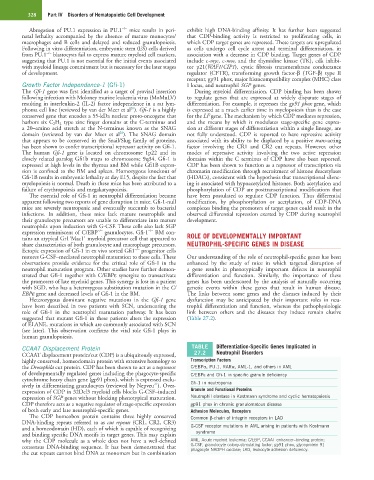
        role  of  Gfi-1  in  the  neutrophil  maturation  pathway.  It  has  been   link  between  others  and  the  diseases  they  induce  remain  elusive
        suggested that mutant Gfi-1 in these patients alters the expression   (Table 27.2).
        of ELANE, mutations in which are commonly associated with SCN
        (see  later). This  observation  confirms  the  vital  role  Gfi-1  plays  in
        human granulopoiesis.
        CCAAT Displacement Protein                              TABLE   Differentiation-Specific Genes Implicated in
        CCAAT displacement protein/cut (CDP) is a ubiquitously expressed,   27.2  Neutrophil Disorders
        highly conserved, homeodomain protein with extensive homology to   Transcription Factors
        the Drosophila cut protein. CDP has been shown to act as a repressor   C/EBPα, PU.1, RARα, AML-1, and others in AML
        of developmentally regulated genes including the phagocyte-specific   C/EBPε and Gfi-1 in specific granule deficiency
        cytochrome heavy chain gene (gp91 phox), which is expressed exclu-
                                                   21
        sively in differentiating granulocytes (reviewed by Nepveu ). Over-  Gfi-1 in neutropenia
        expression of CDP in 32Dcl3 myeloid cells blocks G-CSF–induced   Granule and Functional Proteins
        expression of SGP genes without blocking phenotypical maturation.   Neutrophil elastase in Kostmann syndrome and cyclic hematopoiesis
        CDP therefore acts as a negative regulator of stage-specific expression   gp91 phox in chronic granulomatous disease
        of both early and late neutrophil-specific genes.      Adhesion Molecules, Receptors
           The  CDP  homeobox  protein  contains  three  highly  conserved   Common β-chain of integrin receptors in LAD
        DNA-binding  repeats  referred  to  as  cut  repeats  (CR1,  CR2,  CR3)
        and a homeodomain (HD), each of which is capable of recognizing   G-CSF receptor mutations in AML arising in patients with Kostmann
        and binding specific DNA motifs in target genes. This may explain   syndrome
        why  the  CDP  molecule  as  a  whole  does  not  have  a  well-defined   AML, Acute myeloid leukemia; C/EBP, CCAAT enhancer–binding protein;
        consensus  DNA-binding  sequence.  It  has  been  demonstrated  that   G-CSF, granulocyte colony-stimulating factor; gp91 phox, glycoprotein 91
                                                               phagocyte NADPH oxidase; LAD, leukocyte adhesion deficiency.
        the cut repeats cannot bind DNA as monomers but in combination

