


Page 414 - Hematology_ Basic Principles and Practice ( PDFDrive )
P. 414
Chapter 28  Thrombocytopoiesis  335

                                                                  Mature Megakaryocytes

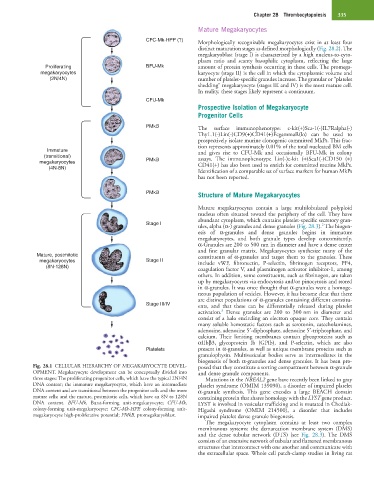
                                                 CFC-Mk-HPP (?)   Morphologically  recognizable  megakaryocytes  exist  in  at  least  four
                                                                  distinct maturation stages as defined morphologically (Fig. 28.2). The
                                                                  megakaryoblast (stage I) is characterized by a high nucleus-to-cyto-
                                                                  plasm  ratio  and  scanty  basophilic  cytoplasm,  reflecting  the  large
                Proliferating                    BFU-Mk           amount of protein synthesis occurring in these cells. The promega-
              megakaryocytes                                      karyocyte (stage II) is the cell in which the cytoplasmic volume and
                 (2N/4N)                                          number of platelet-specific granules increase. The granular or “platelet
                                                                  shedding” megakaryocyte (stages III and IV) is the most mature cell.
                                                                  In reality, these stages likely represent a continuum.
                                                 CFU-Mk
                                                                  Prospective Isolation of Megakaryocyte
                                                                  Progenitor Cells
                                                 PMkB             The  surface  immunophenotype:  c-kit(+)Sca-1(-)IL7Ralpha(-)
                                                                  Thy1.1(-)Lin(-)CD9(+)CD41(+)FcgammaR(lo)  can  be  used  to
                                                                  prospectively isolate murine clonogenic committed MkPs. This frac-
                                                                  tion represents approximately 0.01% of the total nucleated BM cells
                Immature                                          and  gives  rise  to  CFU-Mk  and  occasionally  BFU-Mk  in  colony
               (transitional)                                     assays.  The  immunophenotype  Lin(-)c-kit  (+)Sca1(-)CD150  (+)
              megakaryocytes                     PMkB             CD41(+) has also been used to enrich for committed murine MkPs.
                 (4N-8N)
                                                                  Identification of a comparable set of surface markers for human MkPs
                                                                  has not been reported.

                                                 PMkB
                                                                  Structure of Mature Megakaryocytes
                                                                  Mature  megakaryocytes  contain  a  large  multilobulated  polyploid
                                                                  nucleus often situated toward the periphery of the cell. They have
                                                                  abundant cytoplasm, which contains platelet-specific secretory gran-
                                                 Stage I                                                  2
                                                                  ules, alpha (α-) granules and dense granules (Fig. 28.3).  The biogen-
                                                                  esis  of  α-granules  and  dense  granules  begins  in  immature
                                                                  megakaryocytes,  and  both  granule  types  develop  concomitantly.
                                                                  α-Granules are 200 to 500 nm in diameter and have a dense center
                                                                  and  fine  granular  matrix.  Megakaryocytes  synthesize  many  of  the
             Mature, postmitotic                                  constituents  of  α-granules  and  target  them  to  the  granules. These
              megakaryocytes                     Stage II         include  vWF,  fibronectin,  P-selectin,  fibrinogen  receptors,  PF4,
                (8N-128N)                                         coagulation factor V, and plasminogen activator inhibitor-1, among
                                                                  others. In addition, some constituents, such as fibrinogen, are taken
                                                                  up by megakaryocytes via endocytosis and/or pinocytosis and stored
                                                                  in α-granules. It was once thought that α-granules were a homoge-
                                                                  neous population of vesicles. However, it has become clear that there
                                                                  are distinct populations of α-granules containing different constitu-
                                                 Stage III/IV     ents,  and  that  these  can  be  differentially  released  during  platelet
                                                                         3
                                                                  activation.   Dense  granules  are  200  to  300 nm  in  diameter  and
                                                                  consist of a halo encircling an electron opaque core. They contain
                                                                  many soluble hemostatic factors such as serotonin, catecholamines,
                                                                  adenosine, adenosine 5′-diphosphate, adenosine 5′-triphosphate, and
                                                                  calcium. Their  limiting  membranes  contain  glycoproteins  such  as
                                                                  αIIbβ3,  glycoprotein  Ib  (GPIb),  and  P-selectin,  which  are  also
                                                 Platelets        present in α-granules, as well as unique membrane proteins such as
                                                                  granulophysin.  Multivesicular  bodies  serve  as  intermediates  in  the
                                                                  biogenesis of both α-granules and dense granules. It has been pro-
            Fig. 28.1  CELLULAR HIERARCHY OF MEGAKARYOCYTE DEVEL-  posed that they constitute a sorting compartment between α-granule
            OPMENT.  Megakaryocyte  development  can  be  conceptually  divided  into   and dense granule components.
            three stages: The proliferating progenitor cells, which have the typical 2N/4N   Mutations in the NBEAL2 gene have recently been linked to gray
            DNA content; the immature megakaryocytes, which have an intermediate   platelet syndrome (OMIM 139090), a disorder of impaired platelet
            DNA content and are transitional between the progenitor cells and the more   α-granule  synthesis.  This  gene  encodes  a  large  BEACH  domain
            mature cells; and the mature, postmitotic cells, which have an 8N to 128N   containing protein that shares homology with the LYST gene product.
            DNA  content.  BFU-Mk,  Burst-forming  unit-megakaryocyte;  CFU-Mk,   LYST is involved in vesicular trafficking and is mutated in Chediak-
            colony-forming  unit-megakaryocyte;  CFC-Mk-HPP,  colony-forming  unit-  Higashi  syndrome  (OMIM  214500),  a  disorder  that  includes
            megakaryocyte high-proliferative potential; PMkB, promegakaryoblast.   impaired platelet dense granule biogenesis.
                                                                    The  megakaryocyte  cytoplasm  contains  at  least  two  complex
                                                                  membranous  systems:  the  demarcation  membrane  system  (DMS)
                                                                  and  the  dense  tubular  network  (DTS)  (see  Fig.  28.3). The  DMS
                                                                  consists of an extensive network of tubular and flattened membranous
                                                                  structures that interconnect with one another and communicate with
                                                                  the extracellular space. Whole cell patch-clamp studies in living rat

