


Page 467 - Hematology_ Basic Principles and Practice ( PDFDrive )
P. 467
388    Part IV  Disorders of Hematopoietic Cell Development


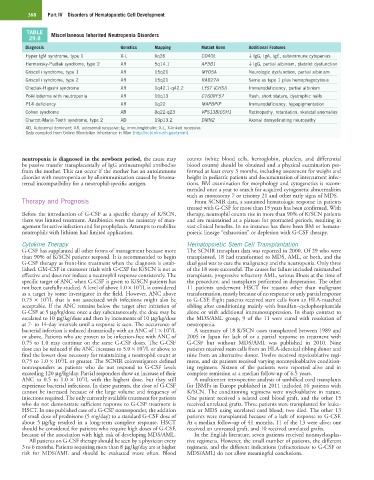
          TABLE   Miscellaneous Inherited Neutropenia Disorders
          29.8
         Diagnosis                      Genetics    Mapping        Mutant Gene    Additional Features
         Hyper IgM syndrome, type 1     X-L         Xq26           CD4OL          ↓ IgG, IgA, IgE, autoimmune cytopenias
         Hermansky-Pudlak syndrome, type 2  AR      5q14.1         AP3B1          ↓ IgG, partial albinism, platelet dysfunction
         Griscelli syndrome, type 1     AR          15q21          MYO5A          Neurologic dysfunction, partial albinism
         Griscelli syndrome, type 2     AR          15q21          RAB27A         Same as type 1 plus hemophagocytosis
         Chediak-Higashi syndrome       AR          1q42.1-q42.2   LYST (CHSI)    Immunodeficiency, partial albinism
         Poikiloderma with neutropenia  AR          16q13          C160RF57       Rash, short stature, dystrophic nails
         P14 deficiency                 AR          1q22           MAPBPIP        Immunodeficiency, hypopigmentation
         Cohen syndrome                 AR          8q22-q23       VPS13B/COH1    Retinopathy, retardation, skeletal anomalies
         Charcot-Marie-Tooth syndrome, type 2  AD   19p13.2        DMN2           Axonal demyelinating neuropathy
         AD, Autosomal dominant; AR, autosomal recessive; Ig, immunoglobulin; X-L, X-linked recessive.
         Data compiled from Online Mendelian Inheritance in Man (http://ncbi.nlm.nih.gov/omim).


        neutropenia is diagnosed in the newborn period, the cause may   counts  (white  blood  cells,  hemoglobin,  platelets,  and  differential
        be passive transfer transplacentally of IgG antineutrophil antibodies   blood counts) should be obtained and a physical examination per-
        from the mother. This can occur if the mother has an autoimmune   formed at least every 3 months, including assessment for weight and
        disorder with neutropenia or by alloimmunization caused by fetoma-  height in pediatric patients and documentation of intercurrent infec-
        ternal incompatibility for a neutrophil-specific antigen.  tions. BM examination for morphology and cytogenetics is recom-
                                                              mended once a year to search for acquired cytogenetic abnormalities
                                                              such as monosomy 7 or trisomy 21 and other early signs of MDS.
        Therapy and Prognosis                                    From SCNIR data, a sustained hematologic response in patients
                                                              treated with G-CSF for more than 15 years has been confirmed. With
        Before the introduction of G-CSF as a specific therapy of K/SCN,   therapy, neutrophil counts rise in more than 90% of K/SCN patients
        there was limited treatment. Antibiotics were the mainstay of man-  and are maintained at a plateau for protracted periods, resulting in
        agement for active infection and for prophylaxis. Attempts to mobilize   vast clinical benefits. In no instance has there been BM or hemato-
        neutrophils with lithium had limited application.     poietic lineage “exhaustion” or depletion with G-CSF therapy.
        Cytokine Therapy                                      Hematopoietic Stem Cell Transplantation
        G-CSF has supplanted all other forms of management because more   The SCNIR transplant data was reported in 2000. Of 29 who were
        than 90% of K/SCN patients respond. It is recommended to begin   transplanted, 18 had transformed to MDS, AML, or both, and the
        G-CSF therapy as front-line treatment when the diagnosis is estab-  dual goal was to cure the malignancy and the neutropenia. Only three
        lished. GM-CSF in crossover trials with G-CSF for K/SCN is not as   of the 18 were successful. The causes for failure included mismatched
        effective and does not induce a neutrophil response consistently. The   transplants, progressive refractory AML, serious illness at the time of
        specific target of ANC when G-CSF is given to K/SCN patients has   the procedure, and transplants performed in desperation. The other
                                              9
        not been carefully studied. A level of above 1.0 × 10 /L is considered   11  patients  underwent  HSCT  for  reasons  other  than  malignant
        as a target by some investigator in the field. However, ANC above   transformation, mostly because of no response or only partial response
                9
        0.75  ×  10 /L  that  is  not  associated  with  infections  might  also  be   to G-CSF. Eight patients received stem cells from an HLA-matched
        acceptable. If the ANC remains below the target after initiation of   sibling after conditioning mainly with busulfan–cyclophosphamide
        G-CSF at 5 µg/kg/dose once a day subcutaneously, the dose may be   alone or with additional immunosuppression. In sharp contrast to
        escalated to 10 µg/kg/dose and then by increments of 10 µg/kg/dose   the  MDS/AML  group,  9  of  the  11  were  cured  with  resolution  of
        at 7- to 14-day intervals until a response is seen. The occurrence of   neutropenia.
                                                        9
        bacterial infection is reduced dramatically with an ANC of 1 × 10 /L   A summary of 18 K/SCN cases transplanted between 1989 and
        or above. Patients who are proven to be infection-free with ANC of   2005  in  Japan  for  lack  of  or  a  partial  response  to  treatment  with
        0.75 to 1.0 may continue on the same G-CSF doses. The G-CSF   G-CSF  but  without  MDS/AML  was  published  in  2010.  Nine
                                                9
        dose can be reduced if the ANC increases to 5.0 × 10 /L or above to   patients received stem cells from an HLA-identical sibling donor and
        find the lowest dose necessary for maintaining a neutrophil count at   nine from an alternative donor. Twelve received myeloablative regi-
                     9
        0.75 to 1.0 × 10 /L or greater. The SCNIR coinvestigators defined   mens, and six patients received varying nonmyeloablative condition-
        nonresponders  as  patients  who  do  not  respond  to  G-CSF  levels   ing  regimens.  Sixteen  of  the  patients  were  reported  alive  and  in
        exceeding 120 µg/kg/day. Partial responders show an increase of their   complete remission at a median follow-up of 6.5 years.
                            9
        ANC  to  0.5  to  1.0  ×  10 /L  with  the  highest  dose,  but  they  still   A multicenter retrospective analysis of umbilical cord transplants
        experience bacterial infections. In these patients, the dose of G-CSF   for IBMFs in Europe published in 2011 included 16 patients with
        cannot be increased because of the large volume and frequency of   K/SCN. The conditioning regimens were myeloablative in nature.
        injections required. The only currently available treatment for patients   One patient received a related cord blood graft, and the other 15
        who do not demonstrate sufficient response to G-CSF treatment is   received unrelated grafts. Three patients were transplanted for leuke-
        HSCT. In one published case of a G-CSF nonresponder, the addition   mia or MDS using unrelated cord blood; two died. The other 13
        of small dose of prednisone (5 mg/day) to a standard G-CSF dose of   patients were transplanted because of a lack of response to G-CSF.
        about  5 µg/kg  resulted  in  a  long-term  complete  response.  HSCT   At a median follow-up of 41 months, 11 of the 13 were alive; one
        should be considered for patients who require high doses of G-CSF,   received an untreated graft, and 10 received unrelated grafts.
        because of the association with high risk of developing MDS/AML.  In the English literature, seven patients received nonmyeloaplas-
           All patients on G-CSF therapy should be seen by a physician every   tive regimens. However, the small number of patients, the different
        3 to 6 months. Patients requiring more than 8 µg/kg/day are at higher   regimens, and the different indications (refractoriness to G-CSF or
        risk  for  MDS/AML  and  should  be  evaluated  more  often.  Blood   MDS/AML) do not allow meaningful conclusions.

