


Page 465 - Hematology_ Basic Principles and Practice ( PDFDrive )
P. 465
386    Part IV  Disorders of Hematopoietic Cell Development


        cells such as CSF1. Patient-related mutations also disable the GFI1   number of reports of short stature, cataracts, microcephaly, seizures,
        repressor activity on ELANE expression, which leads to accumulation   developmental delay, and mental retardation. As mentioned earlier,
        of  neutrophil  elastase  in  all  subcellular  compartments  and  might   neurologic manifestations are part of a small group of patients with
        underlie the mechanism for premature apoptosis. Another potential   HAX1 mutations. Data from the SCNIR indicate that some patients
        mechanism for neutropenia when GFI1 is deficient might be related   with K/SCN develop bone demineralization that may be an intrinsic
        to loss of GFI1-mediated regulation of the expression of the microR-  component of the disorder; it has been observed before and during
        NAs miR-21 and miR-196b, which regulate myeloid maturation.  G-CSF therapy. The underlying pathogenesis is unclear, but patients
           A constitutive point mutation was discovered in the extracellular   can develop bone pain and unusual fractures. Osteopenia is a common
        domain of the G-CSF receptor (GCSFR or CSF3R) in a patient with   theme with the IBMFSs.
        K/SCN who also had a mutant ELANE gene. The receptor mutation
        affected ligand–receptor complex formation with severe consequences
        for intracellular signal transduction; the patient was totally unrespon-  Laboratory Findings
        sive to G-CSF therapy. As demonstrated in vitro and then clinically,
        corticosteroids combined with G-CSF produced a corrective action   Peripheral Blood and Bone Marrow
        through synergistic activation of STAT5, and the patient responded
        to G-CSF therapy. Subsequently additional patients with cell-surface   Neutropenia is profound and persistent in K/SCN, usually less than
        GCSFR mutations who did not refractory to G-CSF therapy were   200/µL. A small number of patients have intermittent cycling pat-
        published, suggesting that this may be a common finding in cases   terns  with  regular  periodicity  that  ranges  in  a  low  to  severely  low
        unresponsive to treatment. Importantly, four K/SCN patients from   neutrophil count range. A compensatory two- to fourfold increase in
        two different families who did not respond to G-CSF treatment were   monocytes  is  seen,  sometimes  accompanied  by  eosinophilia.  At
        found to have biallelic mutations in GCSFR.           diagnosis, platelet numbers are normal or increased, and hemoglobin
           Regarding  the  cellular  pathology  of  K/SCN,  many  cell  culture   values are usually normal. In survivors in the precytokine era, anemia
        studies performed in the 1970s and 1980s provided clonogenic data   of chronic disease associated with recurrent infections and inflamma-
        that  pointed  to  intrinsically  defective  granulocytic  progenitors.   tion  was  common.  Aside  from  neutropenia,  humoral  and  cellular
        Further reports confirmed this and excluded other possible pathoge-  immunity is completely normal.
        netic factors. To summarize: (1) K/SCN BM myeloid colony growth   Bone marrow specimens are usually normocellular. The striking
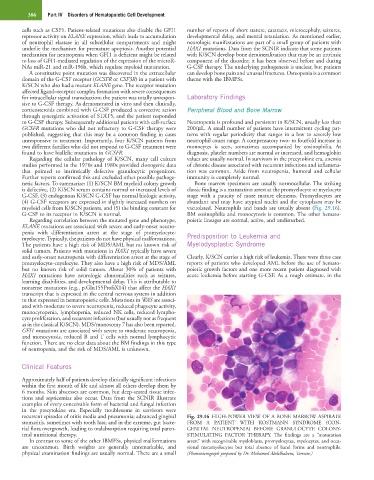
        is defective, (2) K/SCN serum contains normal or increased levels of   classic finding is a maturation arrest at the promyelocyte or myelocyte
        G-CSF, (3) endogenous K/SCN G-CSF has normal biologic activity,   stage  with  a  paucity  of  more  mature  elements.  Promyelocytes  are
        (4) G-CSF receptors are expressed in slightly increased numbers on   abundant and may have atypical nuclei and the cytoplasm may be
        myeloid cells from K/SCN patients, and (5) the binding constant for   vacuolated. Neutrophils and bands are usually absent (Fig. 29.16).
        G-CSF to its receptor in K/SCN is normal.             BM eosinophilia and monocytosis is common. The other hemato-
           Regarding correlation between the mutated gene and phenotype,   poietic lineages are normal, active, and undisturbed.
        ELANE mutations are associated with severe and early-onset neutro-
        penia  with  differentiation  arrest  at  the  stage  of  promyelocyte-
        myelocyte. Typically, the patients do not have physical malformations.   Predisposition to Leukemia and
        The patients have a high risk of MDS/AML but no known risk of   Myelodysplastic Syndrome
        solid tumors. Patients with mutations in HAX1 typically have severe
        and early-onset neutropenia with differentiation arrest at the stage of   Clearly, K/SCN carries a high risk of leukemia. There were three case
        promyelocyte–myelocyte. They also have a high risk of MDS/AML   reports of patients who developed AML before the use of hemato-
        but  no  known  risk  of  solid  tumors.  About  30%  of  patients  with   poietic growth factors and one more recent patient diagnosed with
        HAX1  mutations  have  neurologic  abnormalities  such  as  seizures,   acute leukemia before starting G-CSF. As a rough estimate, in the
        learning disabilities, and developmental delay. This is attributable to
        nonsense mutations (e.g., p.Gln155ProfsX14) that affect the HAX1
        transcript that is expressed in the central nervous system in addition
        to that expressed in hematopoietic cells. Mutations in WAS are associ-
        ated with moderate to severe neutropenia, reduced phagocyte activity,
        monocytopenia, lymphopenia, reduced NK cells, reduced lympho-
        cyte proliferation, and recurrent infections (but usually not as frequent
        as in the classical K/SCN). MDS/monosomy 7 has also been reported.
        GFI1 mutations are associated with severe to moderate neutropenia,
        and monocytosis, reduced B and T cells with normal lymphocytic
        function. There are no clear data about the BM findings in this type
        of neutropenia, and the risk of MDS/AML is unknown.


        Clinical Features

        Approximately half of patients develop clinically significant infections
        within the first month of life and almost all others develop them by
        6 months. Skin abscesses are common, but deep-seated tissue infec-
        tions  and  septicemias  also  occur.  Data  from  the  SCNIR  illustrate
        examples of every conceivable form of bacterial and fungal infection
        in  the  precytokine  era.  Especially  troublesome  in  survivors  were
        recurrent episodes of otitis media and pneumonia; advanced gingival   Fig. 29.16  HIGH-POWER VIEW OF A BONE MARROW ASPIRATE
        stomatitis, sometimes with tooth loss; and in the extreme, gut bacte-  FROM  A  PATIENT  WITH  KOSTMANN  SYNDROME  (CON-
        rial flora overgrowth, leading to malabsorption requiring total paren-  GENITAL  NEUTROPENIA)  BEFORE  GRANULOCYTE  COLONY-
        teral nutritional therapy.                            STIMULATING  FACTOR  THERAPY.  The  findings  are  a  “maturation
           In contrast to some of the other IBMFSs, physical malformations   arrest” with recognizable myeloblasts, promyelocytes, myelocytes, and occa-
        are  uncommon.  Birth  weights  are  generally  unremarkable,  and   sional  metamyelocytes  but  total  absence  of  band  forms  and  neutrophils.
        physical examination findings are usually normal. There are a small   (Photomicrograph prepared by Dr. Mohamed Abdelhaleem, Toronto.)

