


Page 462 - Hematology_ Basic Principles and Practice ( PDFDrive )
P. 462
Chapter 29  Inherited Bone Marrow Failure Syndromes  383


                                                                  contrast to the other two forms, CDA III is inherited as an autosomal
                                                                  dominant disorder. The responsible gene is KIF23, which encodes
                                                                  mitotic kinesin-like protein 1 (MKLP1) that localizes to the midbody
                                                                  ring. In vitro studies showed that the mutations in the genes result
                                                                  in cytokinesis failure. It has also been shown that ubiquitination of
                                                                  MKLP1  is  required  for  midbody  ring  degradation  by  autophagy;
                                                                  thus  abrogation  of  this  process  may  cause  cytokinesis  failure  and
                                                                  multinuclearity.
                                                                    In  a  Swedish  family  with  31  cases  inherited  in  an  autosomal
                                                                  dominant mode, an excess number of cases with a monoclonal gam-
                                                                  mopathy and myeloma have occurred. Also, an adult patient with
                                                                  CDA III was described with T-cell non-Hodgkin lymphoma. These
                                                                  cases,  plus  a  case  of  Hodgkin  disease  occurring  in  an  additional
                                                                  patient, may indicate an increased incidence of lymphoproliferative
                                                                  diseases in CDA III.

                                                                  Laboratory  Abnormalities.  In  CDA  III,  splenomegaly  is  usually
                                                                  minimal  or  absent. The  anemia  is  usually  mild  to  moderate,  but
                                                                  transfusion-dependent patients have been observed. The circulating
                                                                  RBCs can be normal or mildly macrocytic. BM examination shows
                                                                  erythroid hyperplasia. Giant erythroblasts with up to 12 nuclei are
                                                                  the most distinctive feature of CDA III observed on light microscopic
                                                                  examination of the BM. These may appear similar to some of the
                                                                  large multinucleated cells seen in CDA II (see Fig. 29.14). Abnor-
                                                                  mally large lobulated nuclei and discordance in nuclear maturation
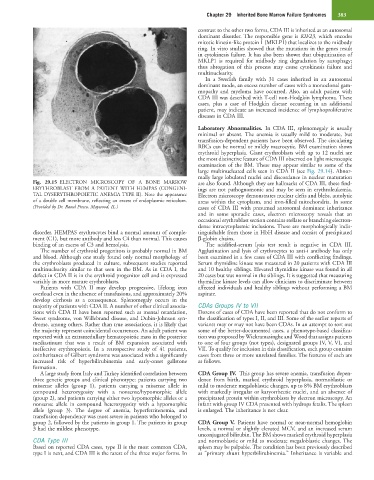
            Fig.  29.15  ELECTRON  MICROSCOPY  OF  A  BONE  MARROW   are also found. Although they are hallmarks of CDA III, these find-
            ERYTHROBLAST  FROM  A  PATIENT WITH  HEMPAS  (CONGENI-  ings are not pathognomonic and may be seen in erythroleukemia.
            TAL DYSERYTHROPOIETIC ANEMIA TYPE II). Note the appearance   Electron microscopy demonstrates nuclear clefts and blebs, autolytic
            of a double cell membrane, reflecting an excess of endoplasmic reticulum.   areas within the cytoplasm, and iron-filled mitochondria. In some
            (Provided by Dr. Raoul Fresco, Maywood, IL.)          cases  of  CDA  III  with  presumed  autosomal  dominant  inheritance
                                                                  and  in  some  sporadic  cases,  electron  microscopy  reveals  that  an
                                                                  occasional erythroblast section contains stellate or branching electron-
                                                                  dense intracytoplasmic inclusions. These are morphologically indis-
            disorder. HEMPAS erythrocytes bind a normal amount of comple-  tinguishable from those in HbH disease and consist of precipitated
            ment (C1), but more antibody and less C4 than normal. This causes   β-globin chains.
            binding of an excess of C3 and hemolysis.               The  acidified-serum  lysis  test  result  is  negative  in  CDA  III.
              The number of erythroid progenitors is probably normal in BM   Agglutination and lysis of erythrocytes to anti-i antibody has only
            and blood. Although one study found only normal morphology of   been examined in a few cases of CDA III with conflicting findings.
            the  erythroblasts  produced  in  culture,  subsequent  studies  reported   Serum thymidine kinase was measured in 20 patients with CDA III
            multinuclearity similar to that seen in the BM. As in CDA I, the   and 10 healthy siblings. Elevated thymidine kinase was found in all
            defect in CDA II is in the erythroid progenitor cell and is expressed   20 cases but was normal in the siblings. It is suggested that measuring
            variably in more mature erythroblasts.                thymidine kinase levels can allow clinicians to discriminate between
              Patients  with  CDA  II  may  develop  progressive,  lifelong  iron   affected individuals and healthy siblings without performing a BM
            overload even in the absence of transfusions, and approximately 20%   aspirate.
            develop  cirrhosis  as  a  consequence.  Splenomegaly  occurs  in  the
            majority of patients with CDA II. A number of other clinical associa-  CDAs Groups IV to VII
            tions with CDA II have been reported such as mental retardation,   Dozens of cases of CDA have been reported that do not conform to
            Sweet syndrome, von Willebrand disease, and Dubin-Johnson syn-  the classification of types I, II, and III. Some of the earlier reports of
            drome, among others. Rather than true associations, it is likely that   variants may or may not have been CDAs. In an attempt to sort out
            the majority represent coincidental occurrences. An adult patient was   some of the better-documented cases, a phenotype-based classifica-
            reported with an extramedullary hematopoietic mass in the posterior   tion was proposed by Wickramasinghe and Wood that assigns patients
            mediastinum  that  was  a  result  of  BM  expansion  associated  with   to one of four groups (not types), designated groups IV, V, VI, and
            ineffective  erythropoiesis.  In  a  retrospective  study  of  41  patients,   VII. To qualify for inclusion in this classification, each group contains
            coinheritance of Gilbert syndrome was associated with a significantly   cases from three or more unrelated families. The features of each are
            increased  risk  of  hyperbilirubinemia  and  early-onset  gallstone   as follows.
            formation.
              A large study from Italy and Turkey identified correlation between   CDA Group IV.  This group has severe anemia, transfusion depen-
            three genetic groups and clinical phenotype: patients carrying two   dence  from  birth,  marked  erythroid  hyperplasia,  normoblastic  or
            missense  alleles  (group  1),  patients  carrying  a  missense  allele  in   mild to moderate megaloblastic changes, up to 8% BM erythroblasts
            compound  heterozygosity  with  a  nonsense/hypomorphic  allele   with markedly irregular or karyorrhectic nuclei, and an absence of
            (group 2), and patients carrying either two hypomorphic alleles or a   precipitated protein within erythroblasts by electron microscopy. An
            nonsense  allele  in  compound  heterozygosity  with  a  hypomorphic   infant with group IV CDA presented with hydrops fetalis. The spleen
            allele  (group  3).  The  degree  of  anemia,  hyperferritenemia,  and   is enlarged. The inheritance is not clear.
            transfusion dependency was most severe in patients who belonged to
            group 2, followed by the patients in group 1. The patients in group   CDA Group V.  Patients have normal or near-normal hemoglobin
            3 had the mildest phenotype.                          levels, a normal or slightly elevated MCV, and an increased serum
                                                                  unconjugated bilirubin. The BM shows marked erythroid hyperplasia
            CDA Type III                                          and normoblastic or mild to moderate megaloblastic changes. The
            Based on reported CDA cases, type II is the most common CDA,   spleen may be palpable. The condition has been previously described
            type I is next, and CDA III is the rarest of the three major forms. In   as “primary shunt hyperbilirubinemia.” Inheritance is variable and

