


Page 470 - Hematology_ Basic Principles and Practice ( PDFDrive )
P. 470
Chapter 29  Inherited Bone Marrow Failure Syndromes  391

            Etiology and Pathophysiology

            Thrombocytopenia  in  TAR  syndrome  is  the  result  of  a  defect  in
            megakaryocytopoiesis  and  thrombocytopoiesis.  It  was  previously
            shown  that  patients  with  TAR  have  submicroscopic  deletions  at
            1q21.1 in one allele of RBMA8 in 100% of cases. The allele carries
            one of two low-frequency SNPs in the regulatory regions of RBM8A.
            RBM8A encodes the Y14 subunit of exon-junction complex, which
            processes mRNA. The mutations caused reduced expression of the
            protein in platelets from affected individuals.
              Thrombopoietin levels in plasma or serum are consistently elevated
            in TAR syndrome, thereby excluding a cytokine production defect as
            a cause for thrombocytopenia in this disorder. BM CFU-MK pro-
            genitors are either absent or are present in low to normal frequencies
            but  produce  small  colonies  in  vitro  with  abnormal  morphology.
            CFU-GM and BFU-E colony growth is often increased.
                                   +
              In a detailed study of CD34  cells, the thrombocytopenia of TAR
            syndrome was associated with a dysmegakaryocytopoiesis character-
            ized  by  cells  remaining  at  an  early  stage  of  differentiation.  Cells
            expressing CD41 without CD42 accumulated behind the block, and
            there  was  a  decrease  in  c-mpl  transcripts  and  mpl  protein.  The
            response of platelets to adenosine diphosphate or to the thrombin
            receptor agonist peptide SFLLRN (TRAP) is normal in patients with
            TAR.  However,  in  contrast  to  control  participants,  platelets  from
            patients with TAR do not undergo activation in vitro in response to
            recombinant thrombopoietin as measured by testing thrombopoietin
            synergism  to  adenosine  diphosphate  and TRAP. Thrombopoietin-
            induced tyrosine phosphorylation of platelet proteins in this setting
            is completely absent or markedly decreased. The results indicate that
            there is a lack of response to thrombopoietin downstream the c-mpl
            signal transduction pathway.
              No recurrent chromosomal changes are seen in TAR syndrome.
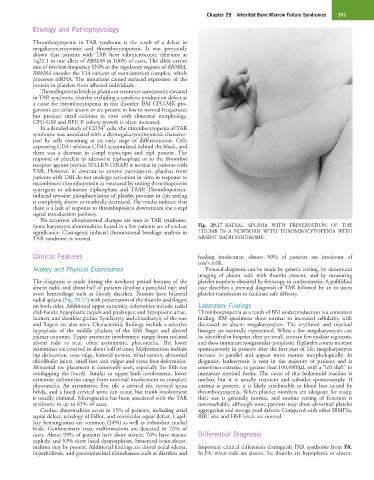
            Some karyotypic abnormalities found in a few patients are of unclear   Fig.  29.17  RADIAL  APLASIA  WITH  PRESERVATION  OF  THE
            significance. Clastogenic induced chromosomal breakage analysis in   THUMB  IN  A  NEWBORN  WITH  THROMBOCYTOPENIA  WITH
            TAR syndrome is normal.                               ABSENT RADII SYNDROME.

            Clinical Features                                     feeding  intolerance;  almost  50%  of  patients  are  intolerant  of
                                                                  cow’s milk.
            History and Physical Examination                        Prenatal diagnosis can be made by genetic testing, by ultrasound
                                                                  imaging  of  absent  radii  with  thumbs  present,  and  by  measuring
            The  diagnosis  is  made  during  the  newborn  period  because  of  the   platelet numbers obtained by fetoscopy or cordocentesis. A published
            absent radii, and about half of patients develop a petechial rash and   case describes a prenatal diagnosis of TAR followed by an in utero
            overt  hemorrhage  such  as  bloody  diarrhea.  Patients  have  bilateral   platelet transfusion to facilitate safe delivery.
            radial aplasia (Fig. 29.17) with preservation of the thumbs and fingers
            on both sides. Additional upper extremity deformities include radial   Laboratory Findings
            club hands; hypoplastic carpals and phalanges; and hypoplastic ulnae,   Thrombocytopenia as a result of BM underproduction is a consistent
            humeri, and shoulder girdles. Syndactyly and clinodactyly of the toes   finding.  BM  specimens  show  normal  to  increased  cellularity  with
            and fingers are also seen. Characteristic findings include a selective   decreased  to  absent  megakaryocytes.  The  erythroid  and  myeloid
            hypoplasia  of  the  middle  phalanx  of  the  fifth  finger  and  altered   lineages are normally represented. When a few megakaryocytes can
            palmar contours. Upper extremity involvement ranges from isolated   be identified in biopsies, they are small, contain few nuclear segments,
            absent  radii  to  true,  often  asymmetric,  phocomelia.  The  lower   and show immature nongranular cytoplasm. If platelet counts increase
            extremities are involved in about half of cases. Malformations include   spontaneously in patients after the first year of life, megakaryocytes
            hip dislocation, coxa valga, femoral torsion, tibial torsion, abnormal   increase  in  parallel  and  appear  more  mature  morphologically.  At
            tibiofibular joints, small feet, and valgus and varus foot deformities.   diagnosis,  leukocytosis  is  seen  in  the  majority  of  patients  and  is
            Abnormal toe placement is commonly seen, especially the fifth toe   sometimes extreme, to greater than 100,000/µL with a “left shift” to
            overlapping  the  fourth.  Similar  to  upper  limb  involvement,  lower   immature  myeloid  forms. The  cause  of  this  leukemoid  reaction  is
            extremity deformities range from minimal involvement to complete   unclear,  but  it  is  usually  transient  and  subsides  spontaneously.  If
            phocomelia.  An  asymmetric  first  rib,  a  cervical  rib,  cervical  spina   anemia  is  present,  it  is  likely  attributable  to  blood  loss  caused  by
            bifida, and a fused cervical spine can occur, but trunk involvement   thrombocytopenia. When platelet numbers are adequate for study,
            is usually minimal. Micrognathia has been associated with the TAR   their  size  is  generally  normal,  and  routine  testing  of  function  is
            syndrome in up to 65% of cases.                       unremarkable, although some patients may show abnormal platelet
              Cardiac abnormalities occur in 15% of patients, including atrial   aggregation and storage pool defects. Compared with other IBMFSs,
            septal defect, tetralogy of Fallot, and ventricular septal defect. Capil-  RBC size and HbF levels are normal.
            lary hemangiomas are common (24%) as well as redundant nuchal
            folds.  Genitourinary  tract  malformations  are  detected  in  23%  of
            cases. About 95% of patients have short stature, 76% have macro-  Differential Diagnosis
            cephaly, and 53% show facial dysmorphism. Structural brain abnor-
            malities may be present. Additional findings are dorsal pedal edema,   Important clinical differences distinguish TAR syndrome from FA.
            hyperhidrosis, and gastrointestinal disturbances such as diarrhea and   In FA, when radii are absent, the thumbs are hypoplastic or absent.

