


Page 489 - Hematology_ Basic Principles and Practice ( PDFDrive )
P. 489
410    Part IV  Disorders of Hematopoietic Cell Development


         Therapy for Aplastic Anemia
          After  the  diagnosis  of  acquired  aplastic  anemia  (AA)  has  been  estab-  6 months at a dose of 12 mg/kg. Corticosteroids are added in moderate
          lished,  treatment  options  must  be  identified,  considered  carefully,   doses (1 mg/kg of prednisone or methylprednisolone) during the first 2
          and  chosen  with  alacrity  (see  box  on  Treatment  Algorithm  in  Aplastic   weeks to ameliorate serum sickness. Improvement should be expected
          Anemia). For patients with moderate disease, an expectant approach can   within  6  months.  This  regimen  has  produced  hematologic  responses
          be chosen based on a stable course and adequate blood counts, or for   in approximately 65% of treated patients, who then have an excellent
          patients dependent on transfusion support, horse antithymocyte globulin   5-year survival rate.
          (ATG; 40 mg/kg/day for 4 days) can be given. After assessment of the   Although  immunosuppressive  therapy  is  generally  well  tolerated,
          response,  patients  who  improve  should  be  monitored  for  hematologic   patients  frequently  relapse  and  require  further  treatment;  however,
          signs of relapse, and nonresponders can be offered alternative therapy,   relapse is not associated with a poor prognosis. More serious is the devel-
          such  as  androgens  or  cyclosporine.  In  severe  disease  for  which  the   opment of late-onset hematologic clonal diseases, paroxysmal nocturnal
          prognosis  with  blood  transfusion  and  antibiotic  support  alone  is  poor,   hemoglobinuria (which may not be clinically significant), myelodysplastic
          bone  marrow  (BM)  transplantation  from  a  histocompatible  sibling  or   syndrome, and acute myeloid leukemia.
          immunosuppression  are  accepted  and  effective  therapies.  Although   For  patients  in  whom  immunosuppressive  therapy  fails,  there  are  a
          large,  retrospective  analyses  have  shown  that  long-term  survival  rates   number  of  options.  For  children,  alternative  donor  BM  transplantation
          from  transplantation  or  immune  therapy  are  equivalent,  each  has  its   should be considered early; at the best centers, survival rates now are
          own  advantages  and  disadvantages.  For  children,  BM  transplantation   almost  as  good  as  with  sibling  donors.  In  children  and  adults,  well
          remains the treatment of choice if an appropriate family donor is avail-  matched unrelated donor stem cells provide similar long-term survival as
          able, because these patients have a low rate of graft-versus-host disease   do matched sibling donors, but the rate of chronic and severe chronic
          (GVHD), and the BM disease is cured by stem cell replacement. The   GVHD is higher. Patients with AA and telomere disease can respond to
          risk of therapy-related cancers can be increased, especially in children,   androgen therapy. Repeated immunosuppression in a patient in whom a
          after  BM  transplantation,  and  is  ameliorated  by  avoiding  radiation  in   first course of ATG and cyclosporine has failed is successful in about 30%
          the  conditioning  regimen.  Adults  with  AA  also  successfully  receive   of cases. Eltrombopag is approved for use in patients with refractory AA.
          transplants, although the risk and severity of chronic GVHD and other   Patients with severe AA should not be subjected to useless early trials of
          treatment-related  complications  increase  with  age.  BM  transplantation   corticosteroids or hematopoietic growth factors as the primary treatment.
          has been performed in patients older than 50 years of age, and it is a   For the occasional patient who must decide between BM transplantation
          reasonable approach in a younger adult, less than 40 years old, espe-  and immunosuppression, the advice of experts familiar with this disease
          cially with more severe degrees of neutropenia. Most studies show that   and careful counseling of the patient are advisable. Age and severity of
          transplant early in the course of disease, within 6 months of diagnosis, is     neutropenia are decisive factors. A limited number of transfusions can
          desirable.                                          be necessary to optimize the patient’s condition before definitive therapy
           Most patients with AA do not have a human leukocyte antigen (HLA)–  and are acceptable. Single-donor platelets should be given and can be
          matched  sibling  donor,  and  immunosuppression  is  the  treatment  of   obtained from HLA-compatible donors. In severely neutropenic patients,
          choice in these cases. Patients with severe disease should receive a com-  granulocyte  colony-stimulating  factor  therapy  can  decrease  the  risk  of
          bination of ATG and cyclosporine. We recommend a regimen consisting   life-threatening  infections.  In  the  absence  of  overt  bleeding,  platelet
          of 40 mg/kg/day of horse ATG on days 1–4, followed by cyclosporine for   counts as low as 5000 cells/µL appear to be safe.


                             A                                B

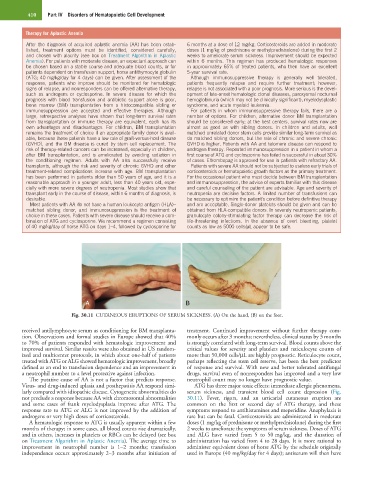
                        Fig. 30.11  CUTANEOUS ERUPTIONS OF SERUM SICKNESS. (A) On the hand, (B) on the foot.

        received antilymphocyte serum as conditioning for BM transplanta-  treatment.  Continued  improvement  without  further  therapy  com-
        tion. Observations and formal studies in Europe showed that 40%   monly occurs after 3 months; nevertheless, clinical status by 3 months
        to 70% of patients responded with hematologic improvement and   is strongly correlated with long-term survival. Blood counts above the
        improved survival. Similar results were also obtained in US random-  critical  values  for  severity  and  platelets  and  reticulocyte  counts  of
        ized and multicenter protocols, in which about one-half of patients   more than 50,000 cells/µL are highly prognostic. Reticulocyte count,
        treated with ATG or ALG showed hematologic improvement, broadly   perhaps reflecting the stem cell reserve, has been the best predictor
        defined as an end to transfusion dependence and an improvement in   of response and survival. With new and better tolerated antifungal
        a neutrophil number to a level protective against infection.  drugs, survival even of nonresponders has improved and a very low
           The putative cause of AA is not a factor that predicts response.   neutrophil count may no longer have prognostic value.
        Virus- and drug-induced aplasia and posthepatitis AA respond simi-  ATG has three major toxic effects: immediate allergic phenomena,
        larly compared with idiopathic disease. Cytogenetic abnormalities do   serum  sickness,  and  transient  blood  cell  count  depression  (Fig.
        not preclude a response because AA with chromosomal abnormalities   30.11).  Fever,  rigors,  and  an  urticarial  cutaneous  eruption  are
        and  some  cases  of  frank  myelodysplasia  improve  after  ATG.  The   common  on  the  first  or  second  day  of  ATG  therapy,  and  these
        response rate to ATG or ALG is not improved by the addition of   symptoms respond to antihistamines and meperidine. Anaphylaxis is
        androgens or very high doses of corticosteroids.      rare but can be fatal. Corticosteroids are administered in moderate
           A hematologic response to ATG is usually apparent within a few   doses (1 mg/kg of prednisone or methylprednisolone) during the first
        months of therapy; in some cases, all blood counts rise dramatically,   2 weeks to ameliorate the symptoms of serum sickness. Doses of ATG
        and in others, increases in platelets or RBCs can be delayed (see box   and  ALG  have  varied  from  5  to  50 mg/kg,  and  the  duration  of
        on Treatment Algorithm in Aplastic Anemia). The average time to   administration has varied from 4 to 28 days. It is more rational to
        improvement  in  neutrophil  number  is  1–2  months;  transfusion   administer equivalent doses of horse ATG by the schedule originally
        independence occurs approximately 2–3 months after initiation of   used in Europe (40 mg/kg/day for 4 days); antiserum will then have

