


Page 491 - Hematology_ Basic Principles and Practice ( PDFDrive )
P. 491
412    Part IV  Disorders of Hematopoietic Cell Development


        Immunosuppression Versus Bone                         expense and availability of transplantation, and risk factors such as active
                                                              infections,  advanced  age,  or  a  heavy  transfusion  burden  lead  most
        Marrow Transplantation                                patients to automatically undergo treatment with ATG/CSA. For a few
                                                              patients  with  AA,  a  choice  does  exist  between  transplantation  and
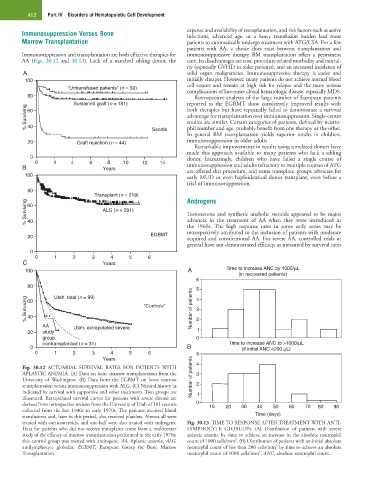
        Immunosuppression and transplantation are both effective therapies for   immunosuppressive  therapy.  BM  transplantation  offers  a  permanent
        AA  (Figs.  30.12  and  30.13).  Lack  of  a  matched  sibling  donor,  the   cure. Its disadvantages are cost, procedure-related morbidity and mortal-
                                                              ity (especially GVHD in older patients), and an increased incidence of
         A                                                    solid  organ  malignancies.  Immunosuppressive  therapy  is  easier  and
         100                                                  initially cheaper. However, many patients do not achieve normal blood
                       “Untransfused patients” (n = 50)       cell counts and remain at high risk for relapse and the more serious
                                                              complications of late-onset clonal hematologic disease, especially MDS.
          80                                                     Retrospective analyses of the large number of European patients
                         Sustained graft (n = 181)            reported  to  the  EGBMT  show  consistently  improved  results  with
          % Surviving  60                                     advantage for transplantation over immunosuppression. Single-center
                                                              both therapies but have repeatedly failed to demonstrate a survival
                                                              studies are similar. Certain categories of patients, defined by neutro-
          40
                                                              phil number and age, probably benefit from one therapy or the other.
                                                   Seattle
                                                              In  general  BM  transplantation  yields  superior  results  in  children,
          20              Graft rejection (n = 44)            immunosuppression in older adults
                                                                 Remarkable improvements in results using unrelated donors have
                                                              made  this  approach  available  to  many  patients  who  lack  a  sibling
           0                                                  donor.  Increasingly,  children  who  have  failed  a  single  course  of
             0     2    4     6     8    10    12    14
        B                          Years                      immunosuppression and adults refractory to multiple courses of ATG
                                                              are offered this procedure, and some transplant groups advocate for
         100                                                  early MUD or even haploidentical donor transplant, even before a
                                                              trial of immunosuppression.
          80
                                Transplant (n = 218)          Androgens
          % Surviving  60          ALG (n = 291)              Testosterone  and  synthetic  anabolic  steroids  appeared  to  be  major

                                                              advances  in  the  treatment  of  AA  when  they  were  introduced  in
          40
                                                              the  1960s.  The  high  response  rates  in  some  early  series  may  be
          20                                      EGBMT       retrospectively attributed to the inclusion of patients with moderate
                                                              acquired and constitutional AA. For severe AA, controlled trials in
                                                              general have not demonstrated efficacy, as measured by survival rates
           0
             0     1     2     3     4     5     6
        C                          Years
         100                                                  A            Time to increase ANC by 1000/µL
                                                                               (in recovered patients)
                                                                 6
          80       Utah, total (n = 99)                          5
          % Surviving  60                       “Controls”      Number of patients  4
                                                                 3
          40
               AA         Utah, extrapolated severe              2
          20   study                                             1
               group,                                            0
               nontransplanted (n = 31)                                     Time to increase ANC to >1000/µL
           0                                                  B                 (if initial ANC <200 µL)
             0     1     2     3     4     5     6
                                   Years
        Fig.  30.12  ACTUARIAL  SURVIVAL  RATES  FOR  PATIENTS  WITH   4
        APLASTIC ANEMIA. (A) Data on bone marrow transplantation from the   Number of patients 5
                                                                 3
        University  of  Washington.  (B)  Data  from  the  EGBMT  on  bone  marrow
        transplantation versus immunosuppression with ALG. (C) Natural history as   2
        indicated by survival with supportive and other treatments. Two groups are   1
        illustrated. Extrapolated survival curves for patients with severe disease are
        derived from retrospective reviews from the University of Utah of 101 records   0  10  20  30  40  50  60  70  80  90
        collected  from  the  late  1940s  to  early  1970s. The  patients  received  blood
        transfusions and, later in this period, also received platelets. Almost all were   Time (days)
        treated with corticosteroids, and one-half were also treated with androgens.   Fig. 30.13  TIME TO RESPONSE AFTER TREATMENT WITH ANTI-
        Data for patients who did not receive transplants come from a multicenter   LYMPHOCYTE  GLOBULIN.  (A)  Distribution  of  patients  with  severe
        study of the efficacy of marrow transplantation performed in the early 1970s;   aplastic  anemia  by  time  to  achieve  an  increase  in  the  absolute  neutrophil
                                                                              3
        this control group was treated with androgens. AA, Aplastic anemia; ALG,   count of 1000 cells/mm . (B) Distribution of patients with an initial absolute
                                                                                           3
        antilymphocyte  globulin;  EGBMT,  European  Group  for  Bone  Marrow   neutrophil count of less than 200 cells/mm  by time to achieve an absolute
                                                                                      3
        Transplantation.                                      neutrophil count of 1000 cells/mm . ANC, absolute neutrophil count.

