


Page 487 - Hematology_ Basic Principles and Practice ( PDFDrive )
P. 487
408    Part IV  Disorders of Hematopoietic Cell Development


           A                                 B                                 C
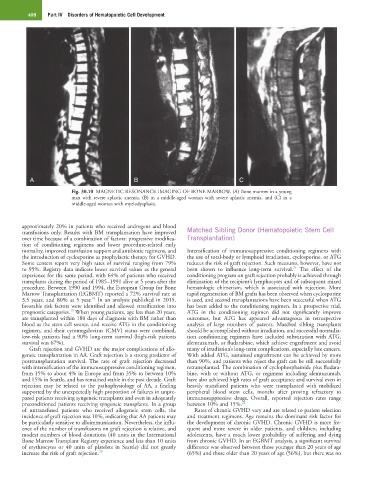
                        Fig. 30.10  MAGNETIC RESONANCE IMAGING OF BONE MARROW. (A) Bone marrow in a young
                        man  with  severe  aplastic  anemia,  (B)  in  a  middle-aged  woman  with  severe  aplastic  anemia,  and  (C)  in  a
                        middle-aged woman with myelodysplasia.


        approximately 20% in patients who received androgens and blood
        transfusions only. Results with BM transplantation have improved   Matched Sibling Donor (Hematopoietic Stem Cell
        over time because of a combination of factors: progressive modifica-  Transplantation)
        tion  of  conditioning  regimens  and  lower  procedure-related  early
        mortality, improved transfusion support and antibiotic regimens, and   Intensification  of  immunosuppressive  conditioning  regimens  with
        the introduction of cyclosporine as prophylactic therapy for GVHD.   the use of total-body or lymphoid irradiation, cyclosporine, or ATG
        Some centers report very high rates of survival ranging from 79%   reduces the risk of graft rejection. Such measures, however, have not
                                                                                                 21
        to 95%. Registry data indicate lower survival values as the general   been  shown  to  influence  long-term  survival.   The  effect  of  the
        experience for the same period, with 64% of patients who received   conditioning program on graft rejection probably is achieved through
        transplants during the period of 1985–1991 alive at 5 years after the   elimination of the recipient’s lymphocytes and of subsequent mixed
        procedure. Between 1990 and 1994, the European Group for Bone   hematologic  chimerism,  which  is  associated  with  rejection.  More
        Marrow Transplantation (EGBMT) reported a 72% survival rate at   rapid regeneration of BM grafts has been observed when cyclosporine
                               18
        3.5 years, and 80% at 5 year.  In an analysis published in 2015,   is used, and second transplantations have been successful when ATG
        favorable risk factors were identified and allowed stratification into   has been added to the conditioning regimen. In a prospective trial,
                        19
        prognostic categories.  When young patients, age less than 20 years,   ATG  in  the  conditioning  regimen  did  not  significantly  improve
        are transplanted within 180 days of diagnosis with BM rather than   outcomes,  but  ATG  has  appeared  advantageous  in  retrospective
        blood as the stem cell source, and receive ATG in the conditioning   analysis  of  large  numbers  of  patents.  Matched  sibling  transplants
        regimen, and their cytomegalovirus (CMV) status were combined,   should be accomplished without irradiation, and successful nonradia-
        low-risk patients had a 90% long-term survival (high-risk patients   tion  conditioning  regimens  have  included  substitution  with  ATG,
        survival was 67%).                                    alemtuzumab, or fludarabine, which achieve engraftment and avoid
           Graft rejection and GVHD are the major complications of allo-  many of irradiation’s long-term complications, especially late cancers.
        geneic transplantation in AA. Graft rejection is a strong predictor of   With added ATG, sustained engraftment can be achieved by more
        posttransplantation  survival.  The  rate  of  graft  rejection  decreased   than 90%, and patients who reject the graft can be still successfully
        with intensification of the immunosuppressive conditioning regimen,   retransplanted. The combination of cyclophosphamide plus fludara-
        from 15% to about 4% in Europe and from 35% to between 10%   bine,  with  or  without  ATG,  or  regimens  including  alemtuzumab,
        and 15% in Seattle, and has remained stable in the past decade. Graft   have also achieved high rates of graft acceptance and survival even in
        rejection  may  be  related  to  the  pathophysiology  of  AA,  a  finding   heavily  transfused  patients  who  were  transplanted  with  mobilized
        supported by the unexpectedly high proportion of failures in unpre-  peripheral  blood  stem  cells,  months  after  proving  refractory  to
        pared patients receiving syngeneic transplants and even in adequately   immunosuppressive  drugs.  Overall,  reported  rejection  rates  range
        preconditioned patients receiving syngeneic transplants. In a group   between 10% and 15%. 22
        of  untransfused  patients  who  received  allogeneic  stem  cells,  the   Rates of chronic GVHD vary and are related to patient selection
        incidence of graft rejection was 10%, indicating that AA patients may   and treatment regimens. Age remains the dominant risk factor for
        be particularly sensitive to alloimmunization. Nevertheless, the influ-  the development of chronic GVHD. Chronic GVHD is more fre-
        ence of the number of transfusions on graft rejection is relative, and   quent  and  more  severe  in  older  patients,  and  children,  including
        modest numbers of blood donations (40 units in the International   adolescents, have a much lower probability of suffering and dying
        Bone Marrow Transplant Registry experience and less than 10 units   from chronic GVHD. In an EGBMT analysis, a significant survival
        of  erythrocytes  or  40  units  of  platelets  in  Seattle)  did  not  greatly   difference was observed between those younger than 20 years of age
        increase the risk of graft rejection. 20              (65%) and those older than 20 years of age (56%), but there was no

