


Page 484 - Hematology_ Basic Principles and Practice ( PDFDrive )
P. 484
Chapter 30  Aplastic Anemia  405


                          A                 B           C                 DD                 E

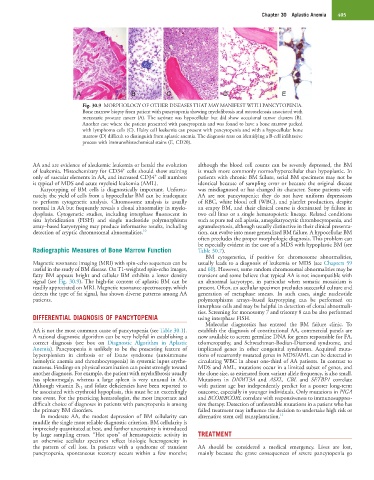
                            Fig. 30.9  MORPHOLOGY OF OTHER DISEASES THAT MAY MANIFEST WITH PANCYTOPENIA.
                            Bone marrow biopsy from patient with pancytopenia showing myelofibrosis and osteosclerosis associated with
                            metastatic  prostate  cancer  (A). The aspirate was hypocellular but  did show  occasional  tumor  clusters (B).
                            Another case where the patient presented with pancytopenia and was found to have a bone marrow packed
                            with lymphoma cells (C). Hairy cell leukemia can present with pancytopenia and with a hypocellular bone
                            marrow (D) difficult to distinguish from aplastic anemia. The diagnosis rests on identifying a B-cell infiltrative
                            process with immunohistochemical stains (E, CD20).


            AA and are evidence of aleukemic leukemia or herald the evolution   although the blood cell counts can be severely depressed, the BM
                                         +
            of leukemia. Histochemistry for CD34  cells should show staining   is much more commonly normo/hypercellular than hypoplastic. In
                                                    +
            only of vascular elements in AA, and increased CD34  cell numbers   patients with chronic BM failure, serial BM specimens may not be
            is typical of MDS and acute myeloid leukemia (AML).   identical  because  of  sampling  error  or  because  the  original  disease
              Karyotyping  of  BM  cells  is  diagnostically  important.  Unfortu-  was misdiagnosed or has changed its character. Some patients with
            nately, the yield of cells from a hypocellular BM can be inadequate   AA  are  not  pancytopenic;  they  do  not  have  uniform  depressions
            to  perform  cytogenetic  analysis.  Chromosome  analysis  is  usually   of RBC, white blood cell (WBC), and platelet production, despite
            normal in AA but frequently reveals a clonal abnormality in myelo-  an empty BM, and their clinical course is dominated by failure in
            dysplasia.  Cytogenetic  studies,  including  interphase  fluorescent  in   two cell lines or a single hematopoietic lineage. Related conditions
            situ  hybridization  (FISH)  and  single  nucleotide  polymorphisms   such as pure red cell aplasia, amegakaryocytic thrombocytopenia, and
            array–based karyotyping may produce informative results, including   agranulocytosis, although usually distinctive in their clinical presenta-
            detection of cryptic chromosomal abnormalities. 10    tion, can evolve into more generalized BM failure. A hypocellular BM
                                                                  often precludes the proper morphologic diagnosis. This problem can
                                                                  be especially evident in the case of a MDS with hypoplastic BM (see
            Radiographic Measures of Bone Marrow Function         Table 30.7).
                                                                    BM  cytogenetics,  if  positive  for  chromosome  abnormalities,
            Magnetic resonance imaging (MRI) with spin-echo sequences can be   usually leads to a diagnosis of leukemia or MDS (see Chapters 59
            useful in the study of BM disease. On T1-weighted spin-echo images,   and 60). However, some random chromosomal abnormalities may be
            fatty  BM  appears  bright  and  cellular  BM  exhibits  a  lower  density   transient and some believe that typical AA is not incompatible with
            signal (see Fig. 30.9). The high-fat content of aplastic BM can be   an  abnormal  karyotype,  in  particular  when  somatic  mosaicism  is
            readily appreciated on MRI. Magnetic resonance spectroscopy, which   present. Often, an acellular specimen precludes successful culture and
            detects the type of fat signal, has shown diverse patterns among AA   generation  of  metaphase  smears.  In  such  cases,  single  nucleotide
            patients.                                             polymorphisms  arrays–based  karyotyping  can  be  performed  on
                                                                  interphase cells and may be helpful in detection of clonal abnormali-
                                                                  ties. Screening for monosomy 7 and trisomy 8 can be also performed
            DIFFERENTIAL DIAGNOSIS OF PANCYTOPENIA                using interphase FISH.
                                                                    Molecular  diagnostics  has  entered  the  BM  failure  clinic.  To
            AA is not the most common cause of pancytopenia (see Table 30.1).   establish the diagnosis of constitutional AA, commercial panels are
            A rational diagnostic algorithm can be very helpful in establishing a   now available to screen germline DNA for genes responsible for FA,
            correct  diagnosis  (see  box  on  Diagnostic  Algorithm  in  Aplastic   telomeropathy, and Schwachman-Bodian-Diamond syndrome, and
            Anemia).  Pancytopenia  is  unlikely  to  be  the  presenting  feature  of   implicated  genes  in  other  congenital  syndromes.  Acquired  muta-
            hypersplenism  in  cirrhosis  or  of  Evans  syndrome  (autoimmune   tions of recurrently mutated genes in MDS/AML can be detected in
            hemolytic anemia and thrombocytopenia) in systemic lupus erythe-  circulating WBC in about one-third of AA patients. In contrast to
            matosus. Findings on physical examination can point strongly toward   MDS and AML, mutations occur in a limited subset of genes, and
            another diagnosis. For example, the patient with myelofibrosis usually   the clone size, as estimated from variant allele frequency, is also small.
            has  splenomegaly,  whereas  a  large  spleen  is  very  unusual  in  AA.   Mutations  in  DNMT3A  and  ASXL,  CBL  and  SETBP1  correlate
            Although vitamin B 12  and folate deficiencies have been reported to   with patient age but independently predict for a poorer long-term
            be associated with erythroid hypoplasia, this must be an exceedingly   outcome, especially in younger individuals. Only mutations in PIGA
            rare event. For the practicing hematologist, the most important and   and BCOR/BCORL correlate with responsiveness to immunosuppres-
            difficult choice of diagnoses in patients with pancytopenia is among   sive therapy. Detection of unfavorable mutations in a patient who has
            the primary BM disorders.                             failed treatment may influence the decision to undertake high risk or
              In  moderate  AA,  the  modest  depression  of  BM  cellularity  can   alternative stem cell transplantation. 11
            muddle the single most reliable diagnostic criterion. BM cellularity is
            imprecisely quantitated at best, and further uncertainty is introduced
            by  large  sampling  errors.  “Hot  spots”  of  hematopoietic  activity  in   TREATMENT
            an  otherwise  acellular  specimen  reflect  biologic  heterogeneity  in
            the  pattern  of  cell  loss.  In  patients  with  a  syndrome  of  transient   AA  should  be  considered  a  medical  emergency.  Lives  are  lost,
            pancytopenia,  spontaneous  recovery  occurs  within  a  few  months;   mainly  because  the  grave  consequences  of  severe  pancytopenia  go

