


Page 497 - Hematology_ Basic Principles and Practice ( PDFDrive )
P. 497
Chapter 31  Paroxysmal Nocturnal Hemoglobinuria  417


              180                                                 Exon 1      2         3   4     5            6
              160
              120                                                 BP 23      777       133 133    207
                                                                                                          2316
             Counts  90                                           Fig. 31.3  STRUCTURE OF THE HUMAN PIGA GENE. Boxes represent
               60                                                 exons;  intervening  lines  represent  introns.  Shaded  areas  show  noncoding
                                                                  regions.
               30
                0                                                 Paroxysmal Nocturnal Hemoglobinuria Stem Cell
                  0      200      400      600     800     1000
                A                CD59 FITC (normal)
               90                                                 PNH is a clonal hematopoietic disorder. The first evidence to support
               80         III       II     I                      the notion that PNH arises through the mutation of an abnormal
               70                                                 multipotent  hematopoietic  stem  cell  was  derived  from  glucose
                                                                  6-phosphate dehydrogenase studies on the red cells of women with
             Counts  60                                           PNH.   Subsequently,  flow  cytometric  analyses  revealed  that  all
                                                                      7
               50
                                                                  hematopoietic  lineages—myeloid,  erythroid,  and  lymphoid—were
               40
               30                                                 involved. Furthermore, PIGA mutations found in granulocytes match
                                                                                                       −
                                                                                                  +
               20                                                 those  found  in  other  lineages,  and  CD34 CD38   stem/progenitor
               10                                                 cells have been shown to be missing GPI-anchored proteins in PNH
                0                                                 patients.  Thus  the  “hit”  in  PNH  clearly  involves  a  multipotent
                  0      200      400      600     800     1000   hematopoietic stem cell. In PNH, both B cells and T cells have been
                B                CD59 FITC (patient)              shown to be derived from the malignant clone.
               90
               80                                                 Paroxysmal Nocturnal Hemoglobinuria Red Cells
               70
               60
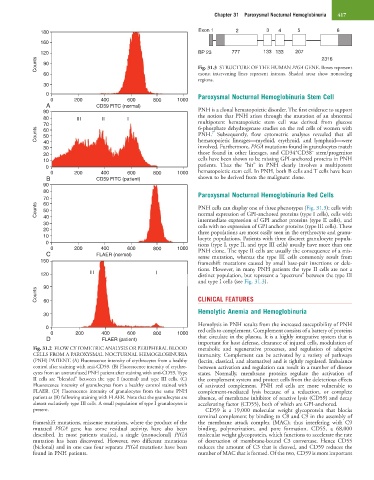
             Counts  50                                           PNH cells can display one of three phenotypes (Fig. 31.3): cells with
                                                                  normal expression of GPI-anchored proteins (type I cells), cells with
               40
               30                                                 intermediate expression of GPI anchor proteins (type II cells), and
                                                                  cells with no expression of GPI anchor proteins (type III cells). These
               20                                                 three populations are most easily seen in the erythrocyte and granu-
               10                                                 locyte populations. Patients with three discreet granulocyte popula-
                0                                                 tions (type I, type II, and type III cells) usually have more than one
                  0      200      400      600     800     1000   PNH clone. The type II cells are usually the consequence of a mis-
                C                FLAER (normal)                   sense  mutation,  whereas  the  type  III  cells  commonly  result  from
              150                                                 frameshift  mutations  caused  by  small  base-pair  insertions  or  dele-
                                                                  tions. However, in many PNH patients the type II cells are not a
              120             III                   I             distinct population, but represent a “spectrum” between the type III
                                                                  and type I cells (see Fig. 31.3).
               90
             Counts  60                                           CLINICAL FEATURES


                                                                  Hemolytic Anemia and Hemoglobinuria
               30
                                                                  Hemolysis in PNH results from the increased susceptibility of PNH
                0                                                 red cells to complement. Complement consists of a battery of proteins
                  0       200     400      600     800     1000
                D                 FLAER (patient)                 that circulate in the plasma. It is a highly integrative system that is
                                                                  important for host defense, clearance of injured cells, modulation of
            Fig. 31.2  FLOW CYTOMETRIC ANALYSIS OR PERIPHERAL BLOOD   metabolic  and  regenerative  processes,  and  regulation  of  adaptive
            CELLS FROM A PAROXYSMAL NOCTURNAL HEMOGLOBINURIA      immunity. Complement can be activated by a variety of pathways
            (PNH) PATIENT. (A) Fluorescence intensity of erythrocytes from a healthy   (lectin, classical, and alternative) and is tightly regulated. Imbalance
            control after staining with anti-CD59. (B) Fluorescence intensity of erythro-  between activation and regulation can result in a number of disease
            cytes from an untransfused PNH patient after staining with anti-CD59. Type   states.  Normally,  membrane  proteins  regulate  the  activation  of
            II  cells  are  “blended”  between  the  type  I  (normal)  and  type  III  cells.  (C)   the complement system and protect cells from the deleterious effects
            Fluorescence intensity of granulocytes from a healthy control stained with   of  activated  complement.  PNH  red  cells  are  more  vulnerable  to
            FLAER.  (D)  Fluorescence  intensity  of  granulocytes  from  the  same  PNH   complement-mediated  lysis  because  of  a  reduction,  or  complete
            patient as (B) following staining with FLAER. Note that the granulocytes are   absence, of membrane inhibitor of reactive lysis (CD59) and decay
            almost exclusively type III cells. A small population of type I granulocytes is   accelerating factor (CD55), both of which are GPI-anchored.
            present.                                                CD59  is  a  19,000  molecular  weight  glycoprotein  that  blocks
                                                                  terminal complement by binding to C8 and C9 in the assembly of
            frameshift mutations, missense mutations, where the product of the   the  membrane  attack  complex  (MAC);  thus  interfering  with  C9
            mutated  PIGA  gene  has  some  residual  activity,  have  also  been   binding,  polymerization,  and  pore  formation.  CD55,  a  68,000
            described.  In  most  patients  studied,  a  single  (monoclonal)  PIGA   molecular weight glycoprotein, which functions to accelerate the rate
            mutation  has  been  discovered.  However,  two  different  mutations   of  destruction  of  membrane-bound  C3  convertase.  Hence  CD55
            (biclonal) and in one case four separate PIGA mutations have been   reduces the amount of C3 that is cleaved, and CD59 reduces the
            found in PNH patients.                                number of MAC that is formed. Of the two, CD59 is more important

