


Page 501 - Hematology_ Basic Principles and Practice ( PDFDrive )
P. 501
Chapter 31  Paroxysmal Nocturnal Hemoglobinuria  421


            to  immunosuppressive  therapy. The  response  rate  in  this  group  is                       Alternate
            more than 50%. In fact, finding a minor population of PNH-like   Lectin pathway  Classical pathway  pathway
            cells in severe aplastic anemia may predict for response to immuno-
            suppressive  therapy.  The  impaired  hematopoiesis  that  occurs  in   MBL, MASP,  C1q, C1r, C1s  C3
            hypoplastic  PNH  may  respond  to  antithymocyte  globulin  and/or   C4 + C2  C4 + C2        factor B + D
            cyclosporine, but the PNH clone is usually not eradicated. Expansion
            of the PNH clone ultimately leading to classical PNH may occur
            several  months  to  years  after  treatment  with  immunosuppression;    C3 convertases
            thus patients should be monitored for signs and symptoms of PNH.          C4b2a, C3bBb
            Immunosuppressive therapy does not benefit patients with classical
            PNH.                                                                         C3b

            Management of Anemia                                                     C5 convertases
                                                                                    C4b2a3b, C3bBb3b
            The cause of anemia in PNH is often multifactorial. In patients with
            hypoplastic PNH, bone marrow failure is the major etiologic factor                       C5a
            for anemia. Patients with hypoplastic PNH may respond to immu-             C5
            nosuppressive  therapy.  However,  in  patients  with  cellular  bone
            marrow,  elevated  reticulocyte  counts,  and  a  high  LDH  (classical   C6, C7, C8, C9
            PNH), intravascular hemolysis is the major mechanism of anemia.
            Terminal  complement  inhibition  is  highly  effective  for  decreasing   C5b      Eculizumab
            intravascular  hemolysis.  Iron  deficiency  caused  by  intravascular
            hemolysis can also contribute to the anemia of PNH; thus, in patients          Membrane attack
            with absent iron stores, iron replacement therapy is indicated. Folic          complex (MAC)
            acid supplementation is also recommended in PNH because of the
            high red cell turnover. Erythropoietin is rarely beneficial in PNH.
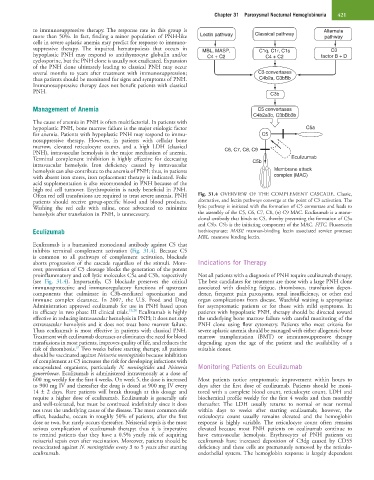
            Often red cell transfusions are required to treat severe anemia. PNH   Fig.  31.4  OVERVIEW  OF THE  COMPLEMENT  CASCADE.  Classic,
            patients  should  receive  group-specific  blood  and  blood  products.   alternative, and lectin pathways converge at the point of C3 activation. The
            Washing  the  red  cells  with  saline,  once  advocated  to  minimize   lytic pathway is initiated with the formation of C5 convertase and leads to
            hemolysis after transfusion in PNH, is unnecessary.   the assembly of the C5, C6, C7, C8, (n) C9 MAC. Eculizumab is a mono-
                                                                  clonal antibody that binds to C5, thereby preventing the formation of C5a
                                                                  and C5b. C5b is the initiating component of the MAC. FITC, Fluorescein
            Eculizumab                                            isothiocyanate;  MASP,  mannan-binding  lectin  associated  service  protease;
                                                                  MBL, mannose binding lectin.
            Eculizumab  is  a  humanized  monoclonal  antibody  against  C5  that
            inhibits  terminal  complement  activation  (Fig.  31.4).  Because  C5
            is  common  to  all  pathways  of  complement  activation,  blockade
            aborts  progression  of  the  cascade  regardless  of  the  stimuli.  More-  Indications for Therapy
            over, prevention of C5 cleavage blocks the generation of the potent
            proinflammatory and cell lytic molecules C5a and C5b, respectively   Not all patients with a diagnosis of PNH require eculizumab therapy.
            (see  Fig.  31.4).  Importantly,  C5  blockade  preserves  the  critical   The best candidates for treatment are those with a large PNH clone
            immunoprotective  and  immunoregulatory  functions  of  upstream   associated  with  disabling  fatigue,  thromboses,  transfusion  depen-
            components  that  culminate  in  C3b-mediated  opsonization  and   dence,  frequent  pain  paroxysms,  renal  insufficiency,  or  other  end
            immune  complex  clearance.  In  2007,  the  U.S.  Food  and  Drug   organ  complications  from  disease. Watchful  waiting is  appropriate
            Administration  approved  eculizumab  for  use  in  PNH  based  upon   for  asymptomatic  patients  or  for  those  with  mild  symptoms.  In
            its efficacy in two phase III clinical trials. 19,20  Eculizumab is highly   patients with hypoplastic PNH, therapy should be directed toward
            effective in reducing intravascular hemolysis in PNH; it does not stop   the underlying bone marrow failure with careful monitoring of the
            extravascular hemolysis and it does not treat bone marrow failure.   PNH  clone  using  flow  cytometry.  Patients  who  meet  criteria  for
            Thus eculizumab is most effective in patients with classical PNH.   severe aplastic anemia should be managed with either allogeneic bone
            Treatment with eculizumab decreases or eliminates the need for blood   marrow  transplantation  (BMT)  or  immunosuppressive  therapy
            transfusions in most patients, improves quality of life, and reduces the   depending  upon  the  age  of  the  patient  and  the  availability  of  a
                          21
            risk of thrombosis.  Two weeks before starting therapy, all patients   suitable donor.
            should be vaccinated against Neisseria meningitides because inhibition
            of complement at C5 increases the risk for developing infections with
            encapsulated  organisms,  particularly  N.  meningitides  and  Neisseria   Monitoring Patients on Eculizumab
            gonorrhoeae. Eculizumab is administered intravenously at a dose of
            600 mg weekly for the first 4 weeks. On week 5, the dose is increased   Most  patients  notice  symptomatic  improvement  within  hours  to
            to 900 mg IV and thereafter the drug is dosed at 900 mg IV every   days  after  the  first  dose  of  eculizumab.  Patients  should  be  moni-
            14  ±  2  days.  Rare  patients  will  break  through  at  this  dosage  and   tored  with  a  complete  blood  count,  reticulocyte  count,  LDH and
            require  a  higher  dose  of  eculizumab.  Eculizumab  is  generally  safe   biochemical profile weekly for the first 4 weeks and then monthly
            and well-tolerated, but must be continued indefinitely since it does   thereafter.  The  LDH  usually  returns  to  normal  or  near  normal
            not treat the underlying cause of the disease. The most common side   within  days  to  weeks  after  starting  eculizumab;  however,  the
            effect, headache, occurs in roughly 50% of patients, after the first   reticulocyte  count  usually  remains  elevated  and  the  hemoglobin
            dose or two, but rarely occurs thereafter. Neisserial sepsis is the most   response  is  highly  variable.  The  reticulocyte  count  often  remains
            serious  complication  of  eculizumab  therapy;  thus  it  is  imperative   elevated  because  most  PNH  patients  on  eculizumab  continue  to
            to  remind  patients  that  they  have  a  0.5%  yearly  risk  of  acquiring   have  extravascular  hemolysis.  Erythrocytes  of  PNH  patients  on
            neisserial sepsis even after vaccination. Moreover, patients should be   eculizumab  have  increased  deposition  of  C3dg  caused  by  CD55
            revaccinated against N. meningitides every 3 to 5 years after starting   deficiency and these cells are prematurely removed by the reticulo-
            eculizumab.                                           endothelial  system. The  hemoglobin  response  is  largely  dependent

