


Page 502 - Hematology_ Basic Principles and Practice ( PDFDrive )
P. 502
422    Part IV  Disorders of Hematopoietic Cell Development


            100                                               of severe thrombocytopenia. Terminal complement blockade appears
                                   Transfusion dependent
             90                    Transfusion independent    to be the most effective way to prevent further thrombotic events
                                                              and in many patients may allow for the discontinuation of antico-
             80                                               agulation. Pregnancy, surgery, or the use of oral contraceptives can
           Percentage of patients  60                         Stem Cell Transplantation
                                                              increase the risk for thrombosis in PNH and should be considered
             70
                                                              high risk.
             50
             40
             30
                                                              therapy for PNH, but is associated with significant morbidity and
             20                                               Allogeneic  stem  cell  transplantation  (ASCT)  is  the  only  curative
                                                                     25
                                                              mortality.   The  International  Bone  Marrow  Transplant  Registry
             10                                               (IBMTR)  reported  a  two-year  survival  probability  of  56%  in  48
              0                                               recipients  of  HLA-identical  sibling  transplants  between  1978  and
                Baseline 0 6  6 12  12 18  18 24  24 30  30-36  1995. The median age was 28 years. The majority of the deaths in
                             Time interval (months)           this study occurred within one year of transplantation. One of seven
                                                              recipients of alternative donor allogeneic transplants reported to the
        Patients(n)  195  195  192  187   179   134    78     IBMTR  during  this  period  was  alive  5  years  after  transplant. The
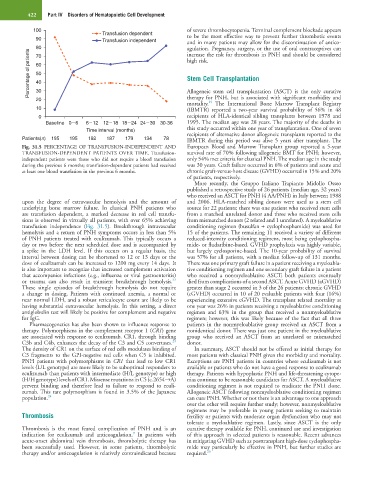
        Fig. 31.5  PERCENTAGE OF TRANSFUSION-INDEPENDENT AND   European  Blood  and  Marrow  Transplant  group  reported  a  5-year
        TRANSFUSION-DEPENDENT  PATIENTS  OVER TIME. Transfusion-  survival rate of 70% following allogeneic BMT for PNH; however,
        independent  patients  were  those  who  did  not  require  a  blood  transfusion   only 54% met criteria for classical PNH. The median age in the study
        during the previous 6 months; transfusion-dependent patients had received   was 30 years. Graft failure occurred in 6% of patients and acute and
        at least one blood transfusion in the previous 6 months.   chronic graft-versus-host disease (GVHD) occurred in 15% and 20%
                                                              of patients, respectively.
                                                                 More  recently,  the  Gruppo  Italiano  Trapianto  Midollo  Osseo
                                                              published a retrospective study of 26 patients (median age, 32 years)
                                                              who received an ASCT for PNH (4 AA/PNH) in Italy between 1988
        upon  the  degree  of  extravascular  hemolysis  and  the  amount  of   and  2006.  HLA-matched  sibling  donors  were  used  as  a  stem  cell
        underlying  bone  marrow  failure.  In  classical  PNH  patients  who   source for 22 patients; there was one patient who received stem cells
        are  transfusion  dependent,  a  marked  decrease  in  red  cell  transfu-  from a matched unrelated donor and three who received stem cells
        sions is observed in virtually all patients, with over 65% achieving   from mismatched donors (2 related and 1 unrelated). A myeloablative
        transfusion  independence  (Fig.  31.5).  Breakthrough  intravascular   conditioning regimen (busulfan + cyclophosphamide) was used for
        hemolysis and a return of PNH symptoms occurs in less than 5%   15 of the patients. The remaining 11 received a variety of different
        of  PNH  patients  treated  with  eculizumab. This  typically  occurs  a   reduced-intensity conditioning regimens, most being cyclophospha-
        day or two before the next scheduled dose and is accompanied by   mide- or fludaribine-based. GVHD prophylaxis was highly variable,
        a  spike  in  the  LDH  level.  If  this  occurs  on  a  regular  basis,  the   but  largely  cyclosporine-based. The  10-year  probability  of  survival
        interval between dosing can be shortened to 12 or 13 days or the   was 57% for all patients, with a median follow-up of 131 months.
        dose of eculizumab can be increased to 1200 mg every 14 days. It   There was one primary graft failure in a patient receiving a myeloabla-
        is also important to recognize that increased complement activation   tive conditioning regimen and one secondary graft failure in a patient
        that accompanies infections (e.g., influenza or viral gastroenteritis)   who  received  a  nonmyeloablative  ASCT;  both  patients  eventually
                                                         22
        or  trauma  can  also  result  in  transient  breakthrough  hemolysis.    died from complications of a second ASCT. Acute GVHD (aGVHD)
        These  single  episodes  of  breakthrough  hemolysis  do  not  require   greater than stage 2 occurred in 3 of the 26 patients; chronic GVHD
        a  change  in  dosing.  Patients  with  continued  anemia,  a  normal  or   (cGVHD) occurred in 10 of 20 evaluable patients with four (16%)
        near normal LDH, and a robust reticulocyte count are likely to be   experiencing extensive cGVHD. The transplant related mortality at
        having  substantial  extravascular  hemolysis.  In  this  setting,  a  direct   one year was 26% in patients receiving a myeloablative conditioning
        antiglobulin test will likely be positive for complement and negative     regimen  and  63%  in  the  group  that  received  a  nonmyeloablative
        for IgG.                                              regimen; however, this was likely because of the fact that all three
           Pharmacogenetics has also been shown to influence response to   patients  in  the  nonmyeloablative  group  received  an  ASCT  from  a
        therapy. Polymorphisms in the complement receptor 1 (CR1) gene   nonidentical donor. There was just one patient in the myeloablative
        are associated with response to eculizumab. CR1, through binding   group  who  received  an  ASCT  from  an  unrelated  or  mismatched
                                                         23
        C3b and C4b, enhances the decay of the C3 and C5 convertases.    donor.
        The density of CR1 on the surface of red cells modulates binding of   In summary, ASCT should not be offered as initial therapy for
        C3 fragments to the GPI-negative red cells when C5 is inhibited.   most patients with classical PNH given the morbidity and mortality.
        PNH  patients  with  polymorphisms  in  CR1  that  lead  to  low  CR1   Exceptions are PNH patients in countries where eculizumab is not
        levels (L/L genotype) are more likely to be suboptimal responders to   available or patients who do not have a good response to eculizumab
        eculizumab than patients with intermediate (H/L genotype) or high   therapy. Patients with hypoplastic PNH and life-threatening cytope-
        (H/H genotype) levels of CR1. Missense mutations in C5 (c.2654→A)   nias continue to be reasonable candidates for ASCT. A myeloablative
        prevent  binding  and  therefore  lead  to  failure  to  respond  to  eculi-  conditioning regimen is not required to eradicate the PNH clone.
        zumab. This rare polymorphism is found in 3.5% of the Japanese   Allogeneic ASCT following nonmyeloablative conditioning regimen
        population. 24                                        can cure PNH. Whether or not there is an advantage to one approach
                                                              over the other will require further study; however, nonmyeloablative
                                                              regimens may be preferable in young patients seeking to maintain
        Thrombosis                                            fertility or patients with moderate organ dysfunction who may not
                                                              tolerate  a  myeloablative  regimen.  Lastly,  since  ASCT  is  the  only
        Thrombosis  is  the  most  feared  complication  of  PNH  and  is  an   curative therapy available for PNH, continued use and investigation
                                            9
        indication  for  eculizumab  and  anticoagulation.   In  patients  with   of this approach in selected patients is reasonable. Recent advances
        acute-onset  abdominal  vein  thrombosis,  thrombolytic  therapy  has   in mitigating GVHD such as posttransplant high-dose cyclophospha-
        been  successfully  used.  However,  in  some  patients,  thrombolytic   mide may particularly be effective in PNH, but further studies are
        therapy and/or anticoagulation is relatively contraindicated because   required. 26

