


Page 645 - Hematology_ Basic Principles and Practice ( PDFDrive )
P. 645
Chapter 40  Thalassemia Syndromes  547


            either highly insoluble or form homotetramers (Hb H and Hb Bart)   β-thalassemia  alleles,  one  on  each  copy  of  chromosome  11.  As  a
            that are incapable of releasing oxygen normally, and because they are   consequence of diminished Hb A synthesis, the circulating RBCs are
            relatively unstable, will precipitate as the cell ages. For poorly under-  very hypochromic, abnormal in shape, and they contain markedly
            stood reasons, no compensatory regulatory mechanism exists whereby   reduced amounts of Hb. Accumulation of free α-globin chains leads
            impaired  synthesis  of  one  globin  subunit  leads  to  a  compensatory   to  the  deposition  of  precipitated  aggregates  of  these  chains  to  the
            downward adjustment in the production of the other (partner) globin   detriment  of  the  erythrocyte  and  its  precursor  cells  in  the  bone
            chain  of  the  Hb  tetramer.  Thus,  whereas  useless  excess  α-globin   marrow  (BM). The  anemia  of  thalassemia  major  is  so  severe  that
            chains  continue  to  accumulate  and  precipitate  in  β-thalassemia,   long-term blood transfusions are usually required for survival.
            excess β-globin chains form Hb H in α-thalassemia. The abnormal   The term β-thalassemia intermedia is applied to a less severe clini-
            solubility  or  oxygen-carrying  properties  of  these  chains  lead  to  a   cal phenotype in which significant anemia occurs but chronic transfu-
            variety of physiologic derangements. Indeed, in the severe forms of   sion therapy is not absolutely required. It usually results from the
            thalassemia, it is the behavior of the unpaired globin chains accumu-  inheritance of two β-thalassemia mutations, one mild and one severe;
            lating in relative excess that dominates the pathophysiology of the   the inheritance of two mild mutations; or, occasionally, the inheri-
            syndrome rather than the mere underproduction of functioning Hb   tance of complex combinations, such as a single β-thalassemia defect
            tetramers. The precise complications of this pathophysiologic phe-  and an excess of normal α-globin genes, or two β-thalassemia muta-
            nomenon are diverse and depend on the amount and the identity of   tions coinherited with heterozygous α-thalassemia (in this last form,
            the globin chain accumulating in excess. The fundamental principle   known as αβ-thalassemia, the α-thalassemia allele reduces the burden
            that  must  be  appreciated  is  that  thalassemias  cause  symptoms  by   of unpaired α-chains). 12–14  Simple heterozygosity for certain forms of
            underproduction  of  Hb  and  by  accumulation  of  unpaired  globin   β-thalassemic  hemoglobinopathies  can  also  be  associated  with  a
            subunits. The  unpaired  subunits  are  usually  the  major  sources  of   thalassemia  intermedia  phenotype,  sometimes  called  dominant
            morbidity and mortality.                              β-thalassemia. 15,16
              The predominant circulating Hb at the moment of birth is fetal   Thalassemia minor, also known as β-thalassemia trait or hetero-
            hemoglobin (Hb F α2γ2 ) (see Chapter 33). Although the switch from   zygous  β-thalassemia,  is  caused  by  the  presence  of  a  single
            γ- to β-globin biosynthesis begins before birth, the composition of   β-thalassemia  mutation  and  a  normal  β-globin  gene  on  the  other
            Hb in the peripheral blood changes much later because of the long-  chromosome.  It  is  characterized  by  profound  microcytosis  with
            life span of normal circulating red blood cells (RBCs) (approximately   hypochromia but mild or minimal anemia. In general, thalassemia
            120 days). Hb F is thus slowly replaced by Hb A so that infants do   minor has no associated symptoms, although cholelithiasis has been
            not depend heavily on normal amounts and function of Hb A until   reported from the accumulation of pigmented gallstones as a result
            they are between 4 and 6 months old. The pathophysiologic conse-  of hemolysis in this population. 17
            quences of these considerations are that whereas α-chain hemoglo-
            binopathies tend to be symptomatic in utero and at birth, individuals
            with β-chain abnormalities are asymptomatic until 4 to 6 months of   Molecular Pathology
            age. These  differences  in  the  onset  of  phenotypic  expression  arise
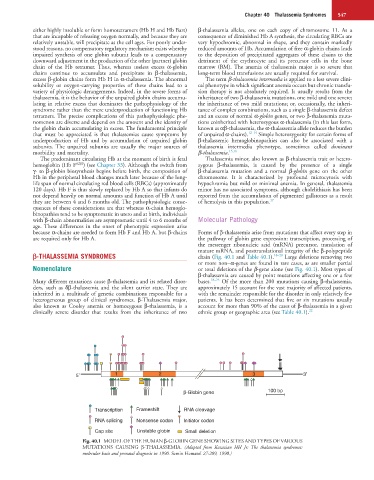
            because α-chains are needed to form Hb F and Hb A, but β-chains   Forms of β-thalassemia arise from mutations that affect every step in
            are required only for Hb A.                           the pathway of globin gene expression: transcription, processing of
                                                                  the  messenger  ribonucleic  acid  (mRNA)  precursor,  translation  of
                                                                  mature mRNA, and posttranslational integrity of the β-polypeptide
            β-THALASSEMIA SYNDROMES                               chain (Fig. 40.1 and Table 40.1). 18–20  Large deletions removing two
                                                                  or more non–α-genes are found in rare cases, as are smaller partial
            Nomenclature                                          or total deletions of the β-gene alone (see Fig. 40.1). Most types of
                                                                  β-thalassemia are caused by point mutations affecting one or a few
            Many different mutations cause β-thalassemia and its related disor-  bases. 18–25  Of the more than 200 mutations causing β-thalassemia,
            ders,  such  as  δβ-thalassemia  and  the  silent  carrier  state. They  are   approximately 15 account for the vast majority of affected patients,
            inherited in a multitude of genetic combinations responsible for a   with the remainder responsible for the disorder in only relatively few
            heterogeneous  group  of  clinical  syndromes.  β-Thalassemia  major,   patients. It has been determined that five or six mutations usually
            also  known  as  Cooley  anemia  or  homozygous  β-thalassemia,  is  a   account for more than 90% of the cases of β-thalassemia in a given
            clinically  severe  disorder  that  results  from  the  inheritance  of  two   ethnic group or geographic area (see Table 40.1). 22


                          5 ′          1             2                              3               3 ′

                                                             β-Globin gene               100 bp


                                Transcription  Frameshift    RNA cleavage
                                RNA splicing  Nonsense codon  Initiator codon
                                Cap site      Unstable globin  Small deletion
                            Fig. 40.1  MODEL OF THE HUMAN β-GLOBIN GENE SHOWING SITES AND TYPES OF VARIOUS
                            MUTATIONS  CAUSING  β-THALASSEMIA.  (Adapted  from  Kazazian  HH  Jr:  The  thalassemia  syndromes:
                            molecular basis and prenatal diagnosis in 1990. Semin Hematol 27:209, 1990.)

