


Page 646 - Hematology_ Basic Principles and Practice ( PDFDrive )
P. 646
548    Part V  Red Blood Cells


          TABLE   Common β-Thalassemia Mutations in Different Racial   boundaries for normal splicing and thereby completely block produc-
          40.1    Groups                                      tion of mature functional messenger RNA. Thus, no β-globin can be
                                                              synthesized  (β°-thalassemia).  Other  mutations  alter  the  consensus
         Racial Group   Description                           sequences that surround the GT- and AG-invariant dinucleotides and
         Mediterranean  IVS-1, position 110 (G → A)           decrease the efficiency of normal splicing signals by 70% to 95%,
                                                                        +
                        Codon 39, nonsense (CAG → TAG)        resulting in β -thalassemia; some consensus mutations even abolish
                        IVS-1, position 1 (G → A)             splicing completely, causing β°-thalassemia. A third type of splicing
                        IVS-2, position 745 (C → G)           aberration  results  from  mutations  that  are  not  in  the  immediate
                        IVS-1, position 6 (T → C)             vicinity of a normal splice site. These alter regions within the gene,
                        IVS-2, position 1 (G → A)             called cryptic splice sites, which resemble consensus splicing sites but
                                                              do  not  normally  sustain  splicing  (see  Fig.  40.2).  The  mutations
         African        –34 (A → G)                           activate the site by supplying a critical GT or AG nucleotide or by
                        –88 (C → T)                           creating a sufficiently strong consensus signal to stimulate splicing at
                        Poly(A), (AATAAA → AACAAA)
                                                              that site 60% to 100% of the time. The activated cryptic sites gener-
         Southeast Asian  Codons 41/42, frameshift (-CTTT)    ate an abnormally spliced, untranslatable mRNA species. Only 10%
                        IVS-2, position 654 (C → T)           to 40% of the mRNA precursors are thus spliced at the normal sites,
                                                                           +
                        –28 (A → T)                           which  causes  β -thalassemia  of  variable  severity.  The  mutation
         Asian Indian   IVS-1, position 5 (G → C)             responsible  for  the  most  common  form  of  β-thalassemia  among
                        619-bp deletion                       Greeks and Cypriots (Fig. 40.3) activates a cryptic splice site near the
                                                                                             26,27
                        Codons 8/9, frameshift (++G)          3′ end of the first intron (position 110).   The determinants that
                        Codons 41/42, frameshift (–CTTT)      dictate the degree to which each mutation alters splice site use remain
                        IVS-1, position 1 (G → T)             largely unknown.
         Data from Kazazian HH Jr, Boehm CD: Molecular basis and prenatal diagnosis
         of beta-thalassemia. Blood 72(4):1107, 1988; and Kazazian HH Jr, Boehm CD:
         personal communication, 1993.                        Translation
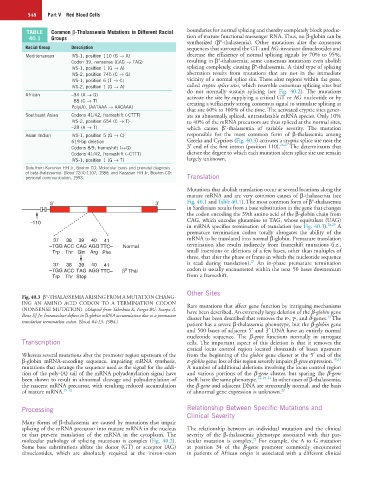
                                                              Mutations that abolish translation occur at several locations along the
                                                              mature mRNA and are very common causes of β-thalassemia (see
                 5 ′                                3 ′       Fig. 40.1 and Table 40.1). The most common form of β°-thalassemia
                                                              in Sardinians results from a base substitution in the gene that changes
                                                              the codon encoding the 39th amino acid of the β-globin chain from
           –110                                               CAG, which encodes glutamine to TAG, whose equivalent (UAG)
                                                                                                            28,29
                                                              in mRNA specifies termination of translation (see Fig. 40.3).   A
                                                              premature  termination  codon  totally  abrogates  the  ability  of  the
                  37   38  39  40  41                         mRNA to be translated into normal β-globin. Premature translation
                 –TGG ACC CAG AGG TTC–   Normal               termination  also  results  indirectly  from  frameshift  mutations  (i.e.,
                  Trp  Thr  Gin  Arg Phe                      small insertions or deletions of a few bases, other than multiples of
                                                              three, that alter the phase or frame in which the nucleotide sequence
                                                                                   29
                  37   38  39  40  41                         is  read  during  translation).   An  in-phase  premature  termination
                                          0
                 –TGG ACC TAG AGG TTC–   β  Thal              codon is usually encountered within the next 50 bases downstream
                  Trp  Thr Stop                               from a frameshift.
                                                              Other Sites
        Fig. 40.3  β°-THALASSEMIA ARISING FROM A MUTATION CHANG-
        ING  AN  AMINO  ACID  CODON  TO  A  TERMINATION  CODON   Rare mutations that affect gene function by intriguing mechanisms
        (NONSENSE MUTATION). (Adapted from Takeshita K, Forget BG, Scarpa A,   have been described. An extremely large deletion of the β-globin gene
        Benz EJ Jr: Intranuclear defects in β-globin mRNA accumulation due to a premature   cluster has been described that removes the ε-, γ-, and δ-genes.  The
                                                                                                            30
        translation termination codon. Blood 64:13, 1984.)
                                                              patient has a severe β-thalassemia phenotype, but the β-globin gene
                                                              and 500 bases of adjacent 5′ and 3′ DNA have an entirely normal
                                                              nucleotide  sequence.  The  β-gene  functions  normally  in  surrogate
        Transcription                                         cells. The  important  aspect  of  this  deletion  is  that  it  removes  the
                                                              critical  locus  control  region  located  thousands  of  bases  upstream
        Whereas several mutations alter the promoter region upstream of the   from the beginning of the globin gene cluster at the 5′ end of the
        β-globin  mRNA-encoding  sequence,  impairing  mRNA  synthesis,   ε-globin gene; loss of this region severely impairs β-gene expression. 18,31
        mutations that derange the sequence used as the signal for the addi-  A number of additional deletions involving the locus control region
        tion of the poly-(A) tail of the mRNA polyadenylation signal have   and  various  portions  of  the  β-gene  cluster,  but  sparing  the  β-gene
        been shown to result in abnormal cleavage and polyadenylation of   itself, have the same phenotype. 1,2,19–21  In other cases of β-thalassemia,
        the nascent mRNA precursor, with resulting reduced accumulation   the β-gene and adjacent DNA are structurally normal, and the basis
        of mature mRNA. 19–21                                 of abnormal gene expression is unknown. 22


        Processing                                            Relationship Between Specific Mutations and
                                                              Clinical Severity
        Many forms of β-thalassemia are caused by mutations that impair
        splicing of the mRNA precursor into mature mRNA in the nucleus   The  relationship  between  an  individual  mutation  and  the  clinical
        or  that  prevent  translation  of  the  mRNA  in  the  cytoplasm.  The   severity  of  the  β-thalassemia  phenotype  associated  with  that  par-
                                                                                    22
        molecular  pathology  of  splicing  mutations  is  complex  (Fig.  40.2).   ticular  mutation  is  complex.   For  example,  the  A  to  G  mutation
        Some  base  substitutions  ablate  the  donor  (GT)  or  acceptor  (AG)   at  position  34  of  the  β-gene  promoter  commonly  encountered
        dinucleotides,  which  are  absolutely  required  at  the  intron–exon   in  patients  of  African  origin  is  associated  with  a  different  clinical

