


Page 648 - Hematology_ Basic Principles and Practice ( PDFDrive )
P. 648
550    Part V  Red Blood Cells


                                 α-Globin            α      Precipitates                  Membrane damage
                                 α α α α            α α α  of α-globin                   Abnormal metabolism
                                                                      Inclusion bodies
         α-Gene     α mRNA       α α α α      α β +  α α α            in RBC precursors
                                               2 2
                                   α α               α
         β-Gene      β mRNA        β β         Hb A  Excess α-globin
                                  β-Globin
                                                       1  Hb per cell produced
                                                            (hypochromia)           Massive death of RBC
                                                       2   Massive  mature RBC     precursors in bone marrow
                                                            production            (inneffective erythropoiesis)
                                                       3   Shortened RBC survival
                                                                                    Few surviving RBCs are
                                                                                      highly abnormal,
                                                                                       carry inclusions
                                                                           Sequestration            Bizarre
                                                                             in spleen            morphology
                                                                                     Splenomegaly hypersplenism
                                                                                       Hb catabolism  bilirubin
                    Erythropoietin      Tissue hypoxia                       High-output heart failure,
                     released by                          Profound anemia   infection, leg ulcers, pallor,
                       kidney                                                  growth retardation
                                                                                                   Jaundice
                                                                                                  Gallstones
                                                                  Transfusion                     Leg ulcers
                                       Bony deformities, fractures,
                   Massive expansion   extramedullary hematopoiesis
                    of bone marrow                                       Iron overload and         Cirrhosis
                                                                          Paryenchymal
                                       Increased gastrointestinal         iron deposition     Endocrine dysfunction
                                       iron absorption                                          Cardiomyopathy
                                                                         (hemochromatosis)
                                       Increased blood volume,
                                       secondary folate deficiency,
                                       pathologic bone fractures


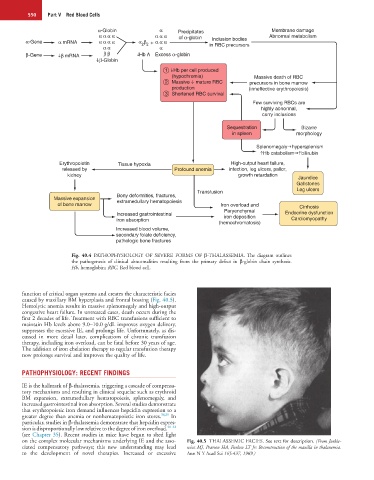
                        Fig.  40.4  PATHOPHYSIOLOGY  OF  SEVERE  FORMS  OF  β-THALASSEMIA. The  diagram  outlines
                        the  pathogenesis  of  clinical  abnormalities  resulting  from  the  primary  defect  in  β-globin  chain  synthesis.
                        Hb, hemoglobin; RBC, Red blood cell.


        function of critical organ systems and creates the characteristic facies
        caused by maxillary BM hyperplasia and frontal bossing (Fig. 40.5).
        Hemolytic anemia results in massive splenomegaly and high-output
        congestive heart failure. In untreated cases, death occurs during the
        first 2 decades of life. Treatment with RBC transfusions sufficient to
        maintain Hb levels above 9.0–10.0 g/dL improves oxygen delivery,
        suppresses the excessive IE, and prolongs life. Unfortunately, as dis-
        cussed  in  more  detail  later,  complications  of  chronic  transfusion
        therapy, including iron overload, can be fatal before 30 years of age.
        The addition of iron chelation therapy to regular transfusion therapy
        now prolongs survival and improves the quality of life.

        PATHOPHYSIOLOGY: RECENT FINDINGS

        IE is the hallmark of β-thalassemia, triggering a cascade of compensa-
        tory mechanisms and resulting in clinical sequelae such as erythroid
        BM  expansion,  extramedullary  hematopoiesis,  splenomegaly,  and
        increased gastrointestinal iron absorption. Several studies demonstrate
        that erythropoietic iron demand influences hepcidin expression to a
        greater degree than anemia or nonhematopoietic iron stores. 38,39  In
        particular, studies in β-thalassemia demonstrate that hepcidin expres-
        sion is disproportionally low relative to the degree of iron overload. 40–42
        (see Chapter 35). Recent studies in mice have begun to shed light
        on the complex molecular mechanisms underlying IE and the asso-  Fig. 40.5  THALASSEMIC FACIES. See text for description. (From Jurkie-
        ciated  compensatory  pathways;  this  new  understanding  may  lead    wicz MJ, Pearson HA, Furlow LT Jr: Reconstruction of the maxilla in thalassemia.
        to  the  development  of  novel  therapies.  Increased  or  excessive   Ann N Y Acad Sci 165:437, 1969.)

