


Page 647 - Hematology_ Basic Principles and Practice ( PDFDrive )
P. 647
Chapter 40  Thalassemia Syndromes  549


            A                                                     mutation  is  inherited.  The  differences  in  physiologically  impor-
            Normal splicing                                       tant  functions  among  haplotypes  that  modulate  severity  remain
                                                                  unknown, but a possible explanation lies in the variable abilities of
                 Splice      Entire IVS-1 removed   Splice        the  γ-globin  genes  on  different  chromosomes  to  respond  to  severe
                                                                  erythroid  stress  by  increased  expression  during  postnatal  life. The
            GGC AG g t .. .. . . . .. . .c ctat t g g tc tattt tc cc a cc ct t ag  G  CTG  β-globin  genes  carried  on  some  haplotypes  differ  in  the  degree  to
             29  30                                        31                                   33
                                                                  which they can respond in this manner.  Because Hb F synthesis
                                                                                                          1
                        ...
                ATG GTG CTG GGC AGG CTG CTG....... CAC  TAA       reduces  the  severity  of  β-chain  hemoglobinopathies,   the  level  of
                 Init VAL  Leu  Gly  Arg Leu  Leu  His  Term      γ-gene expression from a given chromosome can play an important
                      1   28   29  30  31   32    146             modulating role.
             +
            β  - Thal alternative splice  Abnormal  Normal splice
                 Splice            splice          not used       Pathophysiology
            GGC AG g t .. .. . . . .. . .c ctat t a gtc tattt tc cc a cc ct t a g  G  CTG   The biochemical hallmark of β-thalassemia is reduced biosynthesis
             29 30
                                                                  of the β-globin subunit of Hb A (α 2β 2). In β-thalassemia heterozy-
              ATG GTG CTG GGC AGt    cta  ttt  tcc  cac cct tag GCT G   gotes, β-globin synthesis is about half-normal, as described by the
                      ...
               Init VAL  Leu  Gly  Ser  Leu Phe Ser His Pro Term  synthetic ratio of β- to α-chain mRNA (β/α ratio) of 0.5–0.7 (normal
                   1    28   29  30  31  32  33  34  35           =  1.0). This  ratio  has  a  direct  correlation  with  clinical  severity  in
                                                                                   34
                                  IVS-1 remnant retained in mRNA  β-thalassemia  patients.   In  homozygotes  for  β°-thalassemia,  who
                                                                  account for approximately one-third of patients, β-globin synthesis
            B                                                     is absent. β-globin synthesis is reduced to 5% to 30% of normal levels
                                                                                               +
                                                                      +
            Abnormal alternative                β-Globin chain    in  β -thalassemia  homozygotes  or  β /β°-thalassemia  compound
             splicing pathway                   β mRNA            heterozygotes, who together account for approximately two-thirds of
                                                                      1
                                                                  cases.   Alpha  hemoglobin  stabilizing  protein  is  a  chaperone-like
                                                                  protein that assists in binding free α-globin chains, higher levels of
                                       90%
                                                                  alpha hemoglobin stabilizing protein result in a more severe clinical
                                                                  phenotype. 34
                 IVS-1            IVS-2               β pre-mRNA    Because  the  synthesis  of  Hb  A  (α 2 β 2 )  is  markedly  reduced  or
                                                                  absent, the RBCs are hypochromic and microcytic. γ-Chain synthesis
                                                                  is partially reactivated so that the Hb of the patient contains a rela-
                                                                                          1
                                       10%                        tively large proportion of Hb F.  However, these γ-chains are quan-
            Normal splicing pathway                               titatively insufficient to replace β-chain production.
                                               β mRNA               Individuals inheriting two β-thalassemic alleles experience a more
                                               β-Globin chain     profound deficit of β-chain production. Little or no Hb A is pro-
                                                                  duced, and importantly, the imbalance of α- and β-globin production
                    +
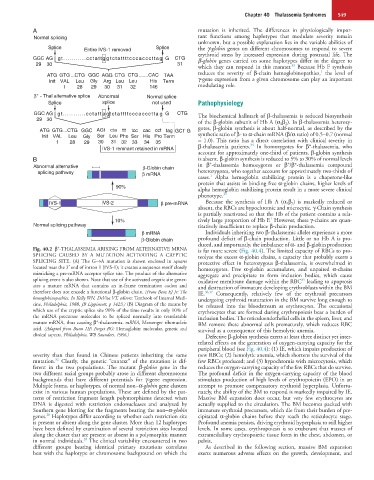
            Fig. 40.2  β -THALASSEMIA ARISING FROM ALTERNATIVE MRNA   is far more severe (Fig. 40.4). The limited capacity of RBCs to pro-
            SPLICING  CAUSED  BY  A  MUTATION  ACTIVATING  A  CRYPTIC   teolyze the excess α-globin chains, a capacity that probably exerts a
            SPLICING  SITE.  (A) The  G→A  mutation  is  shown  enclosed  in  squares   protective  effect  in  heterozygous  β-thalassemia,  is  overwhelmed  in
            located near the 3′ end of intron 1 (IVS-1); it creates a sequence motif closely   homozygotes.  Free  α-globin  accumulates,  and  unpaired  α-chains
            mimicking a pre-mRNA acceptor splice site. The product of the alternative   aggregate  and  precipitate  to  form  inclusion  bodies,  which  cause
            splicing event is also shown. Note that use of the activated cryptic site gener-  oxidative membrane damage within the RBC  leading to apoptosis
                                                                                                    35
            ates  a  mature  mRNA  that  contains  an  in-frame  termination  codon  and   and destruction of immature developing erythroblasts within the BM
            therefore does not encode a functional β-globin chain. (From Benz EJ Jr: The   IE. 36,37   Consequently,  relatively  few  of  the  erythroid  precursors
            hemoglobinopathies. In Kelly WN, DeVita VT, editors: Textbook of Internal Medi-  undergoing erythroid maturation in the BM survive long enough to
            cine, Philadelphia, 1988, JB Lippincott, p 1423.) (B) Diagram of the means by   be  released  into  the  bloodstream  as  erythrocytes.  The  occasional
            which use of the cryptic splice site 90% of the time results in only 10% of   erythrocytes that are formed during erythropoiesis bear a burden of
            the  mRNA  precursor  molecules  to  be  spliced  normally  into  translatable   inclusion bodies. The reticuloendothelial cells in the spleen, liver, and
                                 +
            mature mRNA, thus causing β -thalassemia. mRNA, Messenger ribonucleic   BM remove these abnormal cells prematurely, which reduces RBC
            acid. (Adapted from Bunn HF, Forget BG: Hemoglobin: molecular, genetic and   survival as a consequence of this hemolytic anemia.
            clinical aspects. Philadelphia, WB Saunders, 1986.)     Defective β-globin synthesis exerts at least three distinct yet inter-
                                                                  related effects on the generation of oxygen-carrying capacity for the
                                                                  peripheral blood (see Fig. 40.4): (1) IE, which impairs production of
            severity  than  that  found  in  Chinese  patients  inheriting  the  same   new RBCs; (2) hemolytic anemia, which shortens the survival of the
                   32
            mutation.   Clearly,  the  genetic  “context”  of  the  mutation  is  dif-  few RBCs produced; and (3) hypochromia with microcytosis, which
            ferent  in  the  two  populations.  The  mutant  β-globin  gene  in  the   reduces the oxygen-carrying capacity of the few RBCs that do survive.
            two different racial groups probably arose in different chromosome   The profound deficit in the oxygen-carrying capacity of the blood
            backgrounds  that  have  different  potentials  for  γ-gene  expression.   stimulates production of high levels of erythropoietin (EPO) in an
            Multiple forms, or haplotypes, of normal non–α-globin gene clusters   attempt to promote compensatory erythroid hyperplasia. Unfortu-
            exist in various human populations. These are defined by the pat-  nately, the ability of the BM to respond is markedly impaired by IE.
            terns of restriction fragment length polymorphisms detected when   Massive  BM  expansion  does  occur,  but  very  few  erythrocytes  are
            DNA  is  digested  with  restriction  endonucleases  and  analyzed  by   actually supplied to the circulation. The BM becomes packed with
            Southern gene blotting for the fragments bearing the non–α-globin   immature erythroid precursors, which die from their burden of pre-
                28
            genes.  Haplotypes differ according to whether each restriction site   cipitated  α-globin  chains  before  they  reach  the  reticulocyte  stage.
            is present or absent along the gene cluster. More than 12 haplotypes   Profound anemia persists, driving erythroid hyperplasia to still higher
            have been defined by examination of several restriction sites located   levels. In some cases, erythropoiesis is so exuberant that masses of
            along the cluster that are present or absent in a polymorphic manner   extramedullary erythropoietic tissue form in the chest, abdomen, or
                            28
            in normal individuals.  The clinical variability encountered in two   pelvis.
            different  groups  bearing  identical  primary  mutations  correlates   As  described  in  the  following  section,  massive  BM  expansion
            best with the haplotype or chromosome background on which the   exerts  numerous  adverse  effects  on  the  growth,  development,  and

