


Page 667 - Hematology_ Basic Principles and Practice ( PDFDrive )
P. 667
Chapter 40  Thalassemia Syndromes  569


            no longer persists after transformation of MDS to acute leukemia.   A
            This finding suggests that the Hb H–producing clone does not have   Lepore–anti-Lepore  Gγ Aγ (δβ)
            a selective survival or growth advantage.                Gγ Aγ  δ  β              N           C
              The hematologic phenotype, as reflected by the amount of Hb H   N  C                Lepore
            present in blood, of ATMDS is much more severe than that of the
                          486
            ATR-X  syndrome.   Some  of  this  difference  in  severity  may  be    C
            because of the nature of the ATMDS mutations, some of which are   N  Gγ Aγ  δ  β
            null mutations that are likely to be lethal when present in germline              N           βδ  β  C
            DNA of ATR-X embryos. However, the difference in severity is also                   Gγ Aγ  δ
            observed in the case of mutations found in both syndromes that are   B                  Anti-Lepore
            identical or similar in expected functional consequences. This finding   Kenya      Gγ  (γβ)
            suggests that additional abnormalities in gene expression in ATMDS   Gγ Aγ  δ  β  N        C
            contribute to the severity of the deficit in α-globin gene expression   N  C         Kenya
            observed  in  this  syndrome.  Perhaps  the  responsible  defective
            cofactor(s) is one or more of the proteins that interact with the ATRX   N  C
            protein to produce a fully functional macromolecular complex that   Gγ Aγ  δ  β   N                    C
            can act as a transcriptional cofactor or that can influence the epigen-             Gγ Aγ  δ  (βAγ) δ  β
            etic control of α-globin gene expression.                                                “Anti-Kenya”
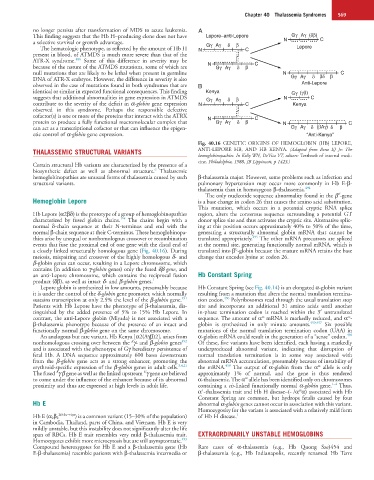
                                                                  Fig.  40.16  GENETIC  ORIGINS  OF  HEMOGLOBIN  (HB)  LEPORE,
            THALASSEMIC STRUCTURAL VARIANTS                       ANTI-LEPORE  HB,  AND  HB  KENYA.  (Adapted  from  Benz  EJ  Jr:  The
                                                                  hemoglobinopathies. In Kelly WN, DeVita VT, editors: Textbook of internal medi-
                                                                  cine, Philadelphia, 1988, JB Lippincott, p 1423.)
            Certain structural Hb variants are characterized by the presence of a
                                                    6
            biosynthetic  defect  as  well  as  abnormal  structure.   Thalassemic
            hemoglobinopathies are unusual forms of thalassemia caused by such   β-thalassemia major. However, some problems such as infection and
            structural variants.                                  pulmonary  hypertension  may  occur  more  commonly  in  Hb  E-β-
                                                                  thalassemia than in homozygous β-thalassemia. 494
                                                                                                                E
                                                                    The only nucleotide sequence abnormality found in the β -gene
            Hemoglobin Lepore                                     is a base change in codon 26 that causes the amino acid substitution.
                                                                  This  mutation,  which  occurs  in  a  potential  cryptic  RNA  splice
            Hb Lepore (α2βδ) is the prototype of a group of hemoglobinopathies   region,  alters  the  consensus  sequence  surrounding  a  potential  GT
                                        1–4
            characterized  by  fused  globin  chains.   The  chains  begin  with  a   donor splice site and thus activates the cryptic site. Alternative splic-
            normal  δ-chain  sequence  at  their  N-terminus  and  end  with  the   ing at this position occurs approximately 40% to 50% of the time,
            normal β-chain sequence at their C-terminus. These hemoglobinopa-  generating  a  structurally  abnormal  globin  mRNA  that  cannot  be
                                                                                    495
            thies arise by unequal or nonhomologous crossover or recombination   translated appropriately.  The other mRNA precursors are spliced
            events that fuse the proximal end of one gene with the distal end of   at the normal site, generating functionally normal mRNA, which is
                                                                              E
            a closely linked structurally homologous gene (Fig. 40.16). During   translated into β -globin because the mature mRNA retains the base
            meiosis, mispairing and crossover of the highly homologous δ- and   change that encodes lysine at codon 26.
            β-globin genes can occur, resulting in a Lepore chromosome, which
            contains (in addition to γ-globin genes) only the fused δβ gene, and
            an  anti-Lepore  chromosome,  which  contains  the  reciprocal  fusion   Hb Constant Spring
            product (δβ), as well as intact δ- and β-globin genes. 1
              Lepore globin is synthesized in low amounts, presumably because   Hb Constant Spring (see Fig. 40.14) is an elongated α-globin variant
            it is under the control of the δ-globin gene promoter, which normally   resulting from a mutation that alters the normal translation termina-
                                                            491
                                                                          496
            sustains transcription at only 2.5% the level of the β-globin gene.    tion codon.  Polyribosomes read through the usual translation stop
            Patients with Hb Lepore have the phenotype of β-thalassemia, dis-  site  and  incorporate  an  additional  31  amino  acids  until  another
            tinguished  by  the  added  presence  of  5%  to  15%  Hb  Lepore.  In   in-phase  termination  codon  is  reached  within  the  3′  untranslated
                                                                                       cs
                                                                                                                   cs
            contrast,  the  anti-Lepore  globin  (Miyada)  is  not  associated  with  a   sequence. The amount of α  mRNA is markedly reduced, and α -
            β-thalassemia  phenotype  because  of  the  presence  of  an  intact  and   globin  is  synthesized  in  only  minute  amounts. 459,497   Six  possible
            functionally normal β-globin gene on the same chromosome.  mutations  of  the  normal  translation  termination  codon  (UAA)  in
                                                                                                                  498
              An analogous but rare variant, Hb Kenya [α2(Aγβ)2], arises from   α-globin mRNA could result in the generation of a “sense” codon.
                                                            492
                                            A
            nonhomologous crossing over between the  γ- and β-globin genes    Of these, five variants have been identified, each having a markedly
            and is associated with the phenotype of Gγ hereditary persistence of   underproduced  abnormal  variant,  indicating  that  disruption  of
            fetal  Hb.  A  DNA  sequence  approximately  600  bases  downstream   normal  translation  termination  is  in  some  way  associated  with
            from  the  β-globin  gene  acts  as  a  strong  enhancer,  promoting  the   abnormal mRNA accumulation, presumably because of instability of
                                                                                                         cs
                                                                           459
            erythroid-specific expression of the β-globin genes in adult cells. 3,4,21    the  mRNA.  The  output  of  α-globin  from  the  α   allele  is  only
                   A
                                                G
            The fused  γ β gene as well as the linked upstream  γ gene are believed   approximately  1%  of  normal,  and  the  gene  is  thus  rendered
                                                                                 cs
            to come under the influence of the enhancer because of its abnormal   α-thalassemic. The α  allele has been identified only on chromosomes
                                                                                                              1–4
            proximity and thus are expressed at high levels in adult life.  containing a cis-linked functionally normal α-globin gene.  Thus,
                                                                   +
                                                                                                   cs
                                                                  α -thalassemia trait and Hb H disease–(- /α α) associated with Hb
                                                                  Constant  Spring  are  common,  but  hydrops  fetalis  caused  by  four
            Hb E                                                  abnormal α-globin genes cannot occur in association with this variant.
                                                                  Homozygosity for the variant is associated with a relatively mild form
                    26Glu→Lys                                                 1
            Hb E (α 2β 2  ) is a common variant (15–30% of the population)   of Hb H disease.
            in Cambodia, Thailand, parts of China, and Vietnam. Hb E is very
            mildly unstable, but this instability does not significantly alter the life
            span of RBCs. Hb E trait resembles very mild β-thalassemia trait.   EXTRAORDINARILY UNSTABLE HEMOGLOBINS
                                                            493
            Homozygotes exhibit more microcytosis but are still asymptomatic.
            Compound heterozygotes for Hb E and a β-thalassemia gene (Hb   Rare  cases  of  α-thalassemia  (e.g.,  Hb  Quong  Sze)454  and
            E-β-thalassemia) resemble patients with β-thalassemia intermedia or   β-thalassemia  (e.g.,  Hb  Indianapolis,  recently  renamed  Hb  Terre

