


Page 663 - Hematology_ Basic Principles and Practice ( PDFDrive )
P. 663
Chapter 40  Thalassemia Syndromes  565


             TABLE   Transfusion-Dependent Thalassemia Screening Recommendations
              40.5
             MRI with T2* liver iron content                 Liver iron                                every 1–2 years
             MRI with T2* cardiac iron content               Cardiac iron                              every 1–2 years
             Ferritin                                        Total body iron                           every 3 months
             History and physical exam                       General health, medication compliance     every 3–4 months
             Echocardiogram                                  Pulmonary hypertension TRV                every 1–2 years
             Liver function panel                            Liver failure, hepatitis                  every 3 months
             Liver ultrasound (if LIC>5/ferritin >800)       Cirrhosis screening                       annually
             AFP (if >40 or presence of clinical cirrhosis)  Hepatocellular carcinoma screening        annually
             Hepatitis B, C serologies (if receiving blood transfusions)  Hepatitis B and C viral infection/exposure  annually
             Tanner stage/Sexual development evaluation      Sexual development                        annually
             Standing and sitting height                     Growth and development                    every 6 months
             Free T4, TSH                                    Thyroid function                          annually
             Calcium, phosphate, vitamin D                   Parathyroid function                      annually
             Fasting blood sugar/oral glucose tolerance test  Diabetes mellitus screening              annually
             ACTH test                                       Adrenal insufficiency screening           annually
             DEXA                                            Bone mineral density                      annually
             NTX, CTX, AP                                    Bone mineral density                      annually
             Dental evaluation                               Maxillofacial disease, periodontal disease, caries  6–12 months
             ACTH, Adrenocorticotropic hormone; AFP, α-fetoprotein; AP, alkaline phosphatase; CTX, collagen type 1 cross-linked C-telopeptide; DEXA, dual-energy x-ray
             absorptiometry; LIC, liver iron concentration; MRI, magnetic resonance imaging; NTX, N-terminal telopeptide; TRV, tricuspic regurgitant velocity; TSH, thyroid stimulating
             hormone.


                    A                                            B
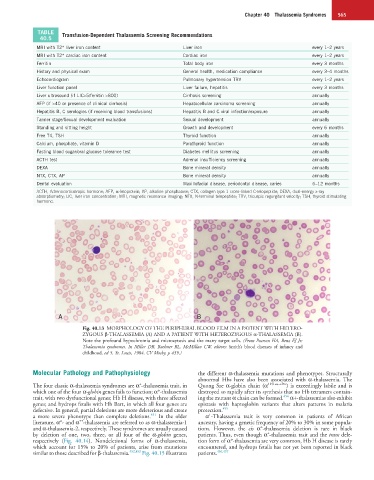
                            Fig. 40.13  MORPHOLOGY OF THE PERIPHERAL BLOOD FILM IN A PATIENT WITH HETERO-
                            ZYGOUS β-THALASSEMIA (A) AND A PATIENT WITH HETEROZYGOUS α-THALASSEMIA (B).
                            Note the profound hypochromia and microcytosis and the many target cells. (From Pearson HA, Benz EJ Jr:
                            Thalassemia  syndromes.  In  Miller  DR,  Baehner  RL,  McMillan  CW,  editors:  Smith’s  blood  diseases  of  infancy  and
                            childhood, ed 5, St. Louis, 1984, CV Mosby, p 439.)


            Molecular Pathology and Pathophysiology               the different α-thalassemia mutations and phenotypes. Structurally
                                                                  abnormal  Hbs  have  also  been  associated  with  α-thalassemia. The
                                               +
            The four classic α-thalassemia syndromes are α -thalassemia trait, in   Quong Sze α-globin chain (α 125Leu→Pro ) is exceedingly labile and is
            which one of the four α-globin genes fails to function; α°-thalassemia   destroyed so rapidly after its synthesis that no Hb tetramers contain-
                                                                                              454
            trait, with two dysfunctional genes; Hb H disease, with three affected   ing the mutant α chain can be formed.  α+-thalassemias also exhibit
            genes; and hydrops fetalis with Hb Bart, in which all four genes are   epistasis  with  haptoglobin  variants  that  alters  patterns  in  malaria
            defective. In general, partial deletions are more deleterious and create   protection. 455
                                                                     +
                                                  451
            a  more  severe  phenotype  than  complete  deletions.   In  the  older   α -Thalassemia  trait  is  very  common  in  patients  of  African
                           ++
            literature, α°- and α -thalassemia are referred to as α-thalassemia-1   ancestry, having a genetic frequency of 20% to 30% in some popula-
            and α-thalassemia-2, respectively. These syndromes are usually caused   tions.  However,  the  cis  α°-thalassemia  deletion  is  rare  in  black
                                                                                         +
            by  deletion  of  one,  two,  three,  or  all  four  of  the  α-globin  genes,   patients. Thus, even though α -thalassemia trait and the trans dele-
            respectively  (Fig.  40.14).  Nondeletional  forms  of  α-thalassemia,   tion form of α°-thalassemia are very common, Hb H disease is rarely
            which account for 15%  to 20%  of patients, arise  from  mutations   encountered, and hydrops fetalis has not yet been reported in black
            similar to those described for β-thalassemia. 452,453  Fig. 40.15 illustrates   patients. 456,457

