


Page 681 - Hematology_ Basic Principles and Practice ( PDFDrive )
P. 681
Chapter 41  Pathobiology of Sickle Cell Disease  573

            Hemoglobin S Charge and Tetramer Assembly
                                                                  Hemoglobin S Solubility and Hemoglobin S
            Formation  of  Hb  tetramers  requires  proximate  assembly  of  stable   Polymerization
            dimers from unlike monomers (e.g., α + β → αβ), an event governed
            by electrostatic attraction. The normal α and β chains are positively   Oxy-HbS, oxy-HbA, and deoxy-HbA have very high solubilities, but
            and  negatively  charged,  respectively.  In  heterozygous  states  for   deoxy-HbS aggregates into densely packed polymers, a process that is
                                                                                            3,4
            β-globin  mutants,  β-chain  competition  for  dimer  assembly  is  a   fully reversible with reoxygenation.  This abnormal property causes
                                                       1
            determinant of the relative proportions of the Hb variants.  Mutant   the  eponymous  RBC  shape  change  from  polymer-mediated  distor-
            β chains with lowered negative charge form αβ dimers more slowly;   tion, the fundamental basis for disease promotion in sickling disorders.
                                                      C
                                             A
                                                             A
                                                 S
            the relative rates for dimer association are αβ  >αβ  >αβ , with αβ
                                             S
            dimers formed about twice as rapidly as αβ  dimers. This explains
            why those with sickle trait typically have only 40% HbS and why the   Polymer Structure
            proportion of HbS exceeds this in HbSC disease. It also explains the
            effect of concurrent α-thalassemia on the proportion of HbS in sickle   Deoxygenation  transforms  soluble  HbS  into  a  highly  viscous  and
            trait; as availability of α chains becomes limiting, the percentage of   semisolid gel that behaves thermodynamically similar to a crystal in
            HbS typically drops from 40% to 35% (one α deletion), 30% (two   equilibrium with a solution of individual tetrameric Hb molecules.
            α deletions), or less than 25% (three α deletions).   Even  complete  deoxygenation  does  not  convert  all  deoxy-HbS  to
                                                                  polymer. The insoluble phase is a collection of domains of aligned
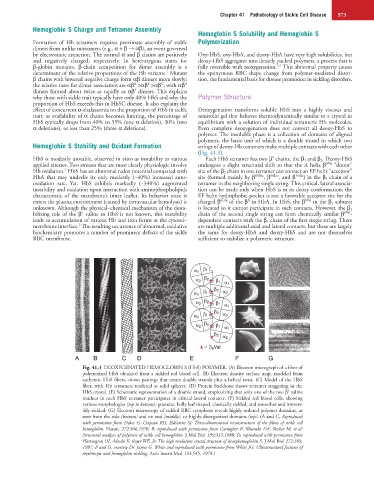
                                                                  polymers, the basic unit of which is a double strand in which two
            Hemoglobin S Stability and Oxidant Formation          strings of deoxy-Hb tetramers make multiple contacts with each other
                                                                  (Fig. 41.3).
                                                                                          S
            HbS is modestly unstable, observed in vitro as instability to various   Each HbS tetramer has two β  chains, the β 1 and β 2 . Deoxy-HbS
            applied stresses. Two stresses that are most clearly physiologic involve   undergoes a slight structural shift so that the A helix β 6Val  “donor”
                      2
            Hb oxidation.  HbS has an abnormal redox potential compared with   site of the β 2  chain in one tetramer can contact an EF helix “acceptor”
            HbA  that  may  underlie  its  only  modestly  (~40%)  increased  auto-  site (formed mainly by β 85Phe , β 88Leu , and β 70Ala ) in the β 1  chain of a
            oxidation  rate.  Yet,  HbS  exhibits  markedly  (~340%)  augmented   tetramer in the neighboring single string. This critical, lateral associa-
            instability and oxidation upon interaction with aminophospholipids   tion can be made only when HbS is in its deoxy conformation; the
            characteristic  of  the  membrane’s  inner  leaflet.  Its  behavior  once  it   EF helix hydrophobic pocket is not a favorable acceptor site for the
                                                                                  A
            enters the plasma environment (caused by intravascular hemolysis) is   charged β 6Glu  of the β  in HbA. In HbS, the β 6Val  in the β 1  subunit
            unknown. Although the physical–chemical mechanism of the desta-  is located so it cannot participate in such contacts. However, the β 2
                            6
            bilizing role of the β  valine in HbS is not known, this instability   chain of the second single string can form chemically similar β 6Val -
            leads to accumulation of various Hb and iron forms at the cytosol–  dependent contacts with the β 1  chain of the first single string. There
                           2
            membrane interface.  The resulting occurrence of abnormal, oxidative   are multiple additional axial and lateral contacts, but these are largely
            biochemistry promotes a number of prominent defects of the sickle   the  same  for  deoxy-HbA  and  deoxy-HbS  and  are  not  themselves
            RBC membrane.                                         sufficient to stabilize a polymeric structure.
                                                                   b 1
                                                                a 1
                                                                    b 2
                                                                 a 2    b 1
                                                                          a 1
                                                                       b 2
                                                                   b 1    a 2
                                                                a 1
                                                                    b 2
                                                                 a 2    b 1
                                                                          a 1
                                                                       b 2
                                                                   b 1    a 2
                                                                a 1
                                                                    b 2
                                                                 a 2    b 1
                                                                          a 1
                                                                       b 2
                                                                          a 2
                                                                   =b 6 Val
                          A     B        C    D                E              F          G
                            Fig. 41.3  DEOXYGENATED HEMOGLOBIN S (HbS) POLYMER. (A) Electron micrograph of a fiber of
                            polymerized HbS obtained from a sickled red blood cell. (B) Electron density surface map, modeled from
                            authentic HbS fibers, shows pairings that create double strands plus a helical twist. (C) Model of the HbS
                            fiber, with Hb tetramers rendered as solid spheres. (D) Protein backbone shows tetramer staggering in the
                                                                                               6
                            HbS crystal. (E) Schematic representation of a double strand, emphasizing that only one of the two β  valine
                            residues in each HbS tetramer participates in critical lateral contacts. (F) Sickled red blood cells, showing
                            various morphologies (top to bottom): granular, holly leaf shaped, classically sickled, and smoother and irrevers-
                            ibly sickled. (G) Electron microscopy of sickled RBC cytoplasm reveals highly ordered polymer domains, as
                            seen from the side (bottom) and on end (middle), or highly disorganized domains (top). (A and C, Reproduced
                            with permission from Dykes G, Crepeau RH, Edelstein SJ: Three-dimensional reconstruction of the fibres of sickle cell
                            hemoglobin. Nature 272:506,1978; B, reproduced with permission from Carragher B, Bluemke DA, Becker M, et al:
                            Structural analysis of polymers of sickle cell hemoglobin. J Mol Biol 199:315,1988; D, reproduced with permission from
                            Harrington DJ, Adachi K, Royer WE, Jr: The high resolution crystal structure of deoxyhemoglobin S. J Mol Biol 272:398,
                            1997; F and G, courtesy Dr. James G. White and reproduced with permission from White JG: Ultrastructural features of
                            erythrocyte and hemoglobin sickling. Arch Intern Med 133:545, 1974.)

