


Page 683 - Hematology_ Basic Principles and Practice ( PDFDrive )
P. 683
Chapter 41  Pathobiology of Sickle Cell Disease  575


                  Concentration (g/dL)                        Fibers    Cells                40
                  20     30   40                                                             30       S/S disease
               5                           [Polymer]                                         20
               4                                                             “Sickle”        10
                                       B    0    150  200                                  Number of cells  20  S/C disease
                                                                                              0
               3
              Log delay time (sec)  2 0 1  C  [Polymer]  0  5  10            “Holly leaf”    10       A/S trait
                                                                                              0
                                                                                             40

                                           [Polymer]                         “Granular”      20 :3  :2  :1  0  1  2  3
                                                                                              0
                  0.5  0.6  0.7  0.8                                                                Log delay time (sec)
                Log [concentration (mM)]    0    0.5   1
            A                          D       Time (sec)                                E

                                                                                      3
                                                                                     Log time to reach 10% (sec)  :1
                               Homogeneous nucleation                                 2

                                                                                                       in 1 sec
                                                     Critical                         1              Deoxygenation
                                                     nucleus
                                                                                      0

                                                                                      :2
                                                                                      :3
                                                                                       0.5      0.6  Instantaneous  0.8
                                                                                                         0.7
             F                    Heterogeneous nucleation                      G             Log concentrtion (mM)
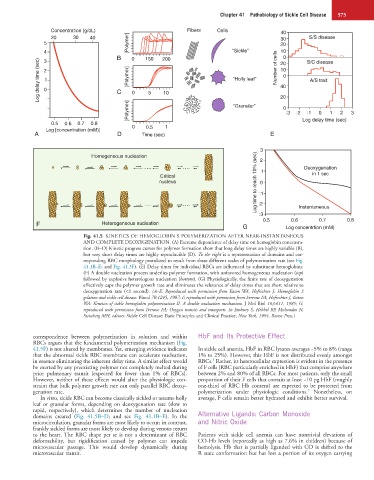
                            Fig. 41.5  KINETICS OF HEMOGLOBIN S POLYMERIZATION AFTER NEAR-INSTANTANEOUS
                            AND COMPLETE DEOXYGENATION. (A) Extreme dependence of delay time on hemoglobin concentra-
                            tion. (B−D) Kinetic progress curves for polymer formation show that long delay times are highly variable (B),
                            but very short delay times are highly reproducible (D). To the right is a representation of domains and cor-
                            responding RBC morphology postulated to result from these different scales of polymerization rate (see Fig.
                            41.1B–E; and Fig. 41.3F). (E) Delay times for individual RBCs are influenced by substituent hemoglobins.
                            (F) A double nucleation process underlies polymer formation, with unfavored homogeneous nucleation (top)
                            followed by explosive heterologous nucleation (bottom). (G) Physiologically, the finite rate of deoxygenation
                            effectively caps the polymer growth rate and eliminates the relevance of delay times that are short relative to
                            deoxygenation  rate  (<1  second).  (A–E,  Reproduced  with  permission  from  Eaton WA,  Hofrichter  J:  Hemoglobin  S
                            gelation and sickle cell disease. Blood 70:1245, 1987; F, reproduced with permission from Ferrone FA, Hofrichter J, Eaton
                            WA: Kinetics of sickle hemoglobin polymerization II. A double nucleation mechanism. J Mol Biol 183:611, 1985; G,
                            reproduced with permission from Ferrone FA: Oxygen transits and transports. In Embury S, Hebbel RP, Mohandas N,
                            Steinberg MH, editors: Sickle Cell Disease: Basic Principles and Clinical Practice, New York, 1994, Raven Press.)


            correspondence  between  polymerization  in  solution  and  within   HbF and Its Protective Effect
            RBCs argues that the fundamental polymerization mechanism (Fig.
            41.5F) is not altered by membranes. Yet, emerging evidence indicates   In sickle cell anemia, HbF in RBC lysates averages ~5% to 8% (range
            that the abnormal sickle RBC membrane can accelerate nucleation,   1% to 25%). However, this HbF is not distributed evenly amongst
                                                                       5
            in essence eliminating the inherent delay time. A similar effect would   RBCs.  Rather, its heterocellular expression is evident in the presence
            be exerted by any preexisting polymer not completely melted during   of F cells (RBC particularly enriched in HbF) that comprise anywhere
            prior  pulmonary  transit  (expected  for  fewer  than  1%  of  RBCs).   between 2% and 80% of all RBCs. For most patients, only the small
            However,  neither  of  these  effects  would  alter  the  physiologic  con-  proportion of their F cells that contain at least ~10 pg HbF (roughly
            straint that bulk polymer growth rate can only parallel RBC deoxy-  one-third of RBC Hb content) are expected to be protected from
                                                                                                      5
            genation rate.                                        polymerization  under  physiologic  conditions.   Nonetheless,  on
              In vitro, sickle RBC can become classically sickled or assume holly   average, F cells remain better hydrated and exhibit better survival.
            leaf  or  granular  forms,  depending  on  deoxygenation  rate  (slow  to
            rapid,  respectively),  which  determines  the  number  of  nucleation
            domains  created  (Fig.  41.5B–D;  and  see  Fig.  41.1B–E).  In  the   Alternative Ligands: Carbon Monoxide
            microcirculation, granular forms are most likely to occur; in contrast,   and Nitric Oxide
            frankly sickled forms are most likely to develop during venous return
            to the heart. The RBC shape per se is not a determinant of RBC   Patients  with  sickle  cell  anemia  can  have  nontrivial  elevations  of
            deformability,  but  rigidification  caused  by  polymer  can  impede   CO-Hb levels (reportedly as high as 7.6% in children) because of
            microvascular  passage.  This  would  develop  dynamically  during   hemolysis. Hb that is partially liganded with CO is shifted to the
            microvascular transit.                                R state conformation but has lost a portion of its oxygen carrying

