


Page 684 - Hematology_ Basic Principles and Practice ( PDFDrive )
P. 684
576    Part V  Red Blood Cells


        capacity. It is difficult to predict whether this produces a net benefit
        or  loss.  RBC  and  Hb  appear  to  participate  in  NO  transport  to
        the  microcirculation,  although  both  magnitude  of  the  effect  and
        mechanisms involved are debated. NO is asserted to improve RBC
        deformability and impair HbS polymerization. Reaction of NO with
        oxy-Hb causes Hb oxidation to met-Hb and reciprocal consumption
        of NO. 6

        ABNORMALITIES OF SICKLE RED BLOOD CELLS

        Even oxygenated sickle RBCs exhibit a variety of cellular and mem-
        brane  abnormalities  that  contribute  directly  to  pathophysiology.   A  B   C    D
        Some are the consequence of proximate polymer formation, while
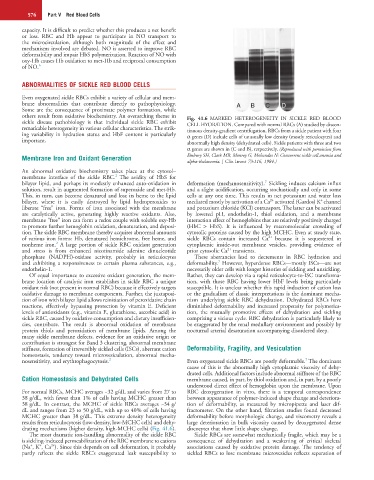
        others result from oxidative biochemistry. An overarching theme in   Fig.  41.6  MARKED  HETEROGENEITY  IN  SICKLE  RED  BLOOD
        sickle  disease  pathobiology  is  that  individual  sickle  RBC  exhibit   CELL HYDRATION. Compared with normal RBCs (A) studied by discon-
        remarkable heterogeneity in various cellular characteristics. The strik-  tinuous density-gradient centrifugation, RBCs from a sickle patient with four
        ing variability in hydration status and HbF content is particularly   α genes (D) include cells of unusually low density (mostly reticulocytes) and
        important.                                            abnormally high density (dehydrated cells). Sickle patients with three and two
                                                              α genes are shown in (C and B), respectively. (Reproduced with permission from
        Membrane Iron and Oxidant Generation                  Embury SH, Clark MR, Monroy G, Mohandas N: Concurrent sickle cell anemia and
                                                              alpha-thalassemia. J Clin Invest 73:116, 1984.)
        An  abnormal  oxidative  biochemistry  takes  place  at  the  cytosol–
                                       2
        membrane  interface  of  the  sickle  RBC.   The  avidity  of  HbS  for
                                                                                        7
        bilayer lipid, and perhaps its modestly enhanced auto-oxidation in   deformation (mechanosensitivity).  Sickling induces calcium influx
        solution, result in augmented formation of superoxide and met-Hb.   and a slight acidification, occurring stochastically and only in some
        This, in turn, can become denatured and lose its heme to the lipid   cells at any one time. This results in net potassium and water loss
                                                                                         2+
                                                                                                          +
        bilayer,  where  it  is  easily  destroyed  by  lipid  hydroperoxides  to   mediated mostly by activation of a Ca  activated (Gardos) K  channel
        liberate  “free”  iron.  Forms  of  iron  associated  with  the  membrane   and potassium chloride (KCl) cotransport. The latter can be activated
        are  catalytically  active,  generating  highly  reactive  oxidants.  Also,   by  lowered  pH,  endothelin-1,  thiol  oxidation,  and  a  membrane
        membrane “free” iron can form a redox couple with soluble oxy-Hb   interaction effect of hemoglobins that are relatively positively charged
        to promote further hemoglobin oxidation, denaturation, and deposi-  (HbC  >  HbS).  It  is  influenced  by  macromolecular  crowding  of
        tion. The sickle RBC membrane thereby acquires abnormal amounts   cytosolic proteins caused by the high MCHC. Even at steady state,
                                                                                         2+
        of various iron forms: Hb, denatured hemichrome, free heme, and   sickle  RBCs  contain  increased  Ca   because  it  is  sequestered  in
                   2
        nonheme iron.  A large portion of sickle RBC oxidant generation   cytoplasmic  inside-out  membrane  vesicles,  providing  evidence  of
                                                                           2+
        and  stress  is  from  enhanced  nicotinamide  adenine  dinucleotide   prior cytosolic Ca  transients.
        phosphate  (NADPH)-oxidase  activity,  probably  in  reticulocytes   These  aberrancies  lead  to  decrements  in  RBC  hydration  and
                                                                        7
        and  exhibiting  a  responsiveness  to  certain  plasma  substances,  e.g.,    deformability.  However, hyperdense RBCs—mostly ISCs—are not
        endothelin-1.                                         necessarily older cells with longer histories of sickling and unsickling.
           Of equal importance to excessive oxidant generation, the mem-  Rather, they can develop via a rapid reticulocyte-to-ISC transforma-
        brane location of catalytic iron establishes in sickle RBC a unique   tion,  with  those  RBC  having  lower  HbF  levels  being  particularly
        oxidant risk (not present in normal RBC) because it effectively targets   susceptible. It is unclear whether this rapid induction of cation loss
        oxidative damage to membrane components. Further, the juxtaposi-  or the gradualism of classic interpretations is the dominant mecha-
        tion of iron with bilayer lipid allows reinitiation of peroxidative chain   nism  underlying  sickle  RBC  dehydration.  Dehydrated  RBCs  have
        reactions,  effectively  bypassing  protection  by  vitamin  E.  Deficient   diminished deformability and increased propensity for polymeriza-
        levels of antioxidants (e.g., vitamin E, glutathione, ascorbic acid) in   tion,  the  mutually  promotive  effects  of  dehydration  and  sickling
        sickle RBC, caused by oxidative consumption and dietary insufficien-  comprising a vicious cycle. RBC dehydration is particularly likely to
        cies,  contribute.  The  result  is  abnormal  oxidation  of  membrane   be exaggerated by the renal medullary environment and possibly by
        protein  thiols  and  peroxidation  of  membrane  lipids.  Among  the   nocturnal arterial desaturation accompanying disordered sleep.
        many sickle membrane defects, evidence for an oxidative origin or
        contribution is strongest for Band 3 clustering, abnormal membrane
        stiffness, formation of irreversibly sickled cells (ISCs), aberrant cation   Deformability, Fragility, and Vesiculation
        homeostasis, tendency toward microvesiculation, abnormal mecha-
                                                                                                     7
        nosensitivity, and erythrophagocytosis. 2             Even oxygenated sickle RBCs are poorly deformable.  The dominant
                                                              cause of this is the abnormally high cytoplasmic viscosity of dehy-
                                                              drated cells. Additional factors include abnormal stiffness of the RBC
        Cation Homeostasis and Dehydrated Cells               membrane caused, in part, by thiol oxidation and, in part, by a poorly
                                                              understood direct effect of hemoglobin upon the membrane. Upon
        For normal RBCs, MCHC averages ~32 g/dL and varies from 27 to   RBC  deoxygenation  in  vitro,  there  is  a  temporal  correspondence
        38 g/dL, with fewer than 1% of cells having MCHC greater than   between appearance of polymer-induced shape change and deteriora-
        38 g/dL.  In  contrast,  the  MCHC  of  sickle  RBCs  averages  ~34 g/  tion  of  deformability,  as  measured  by  micropipette  and  laser  dif-
        dL and ranges from 23 to 50 g/dL, with up to 40% of cells having   fractometer. On the other hand, filtration studies found decreased
        MCHC  greater  than  38 g/dL. This  extreme  density  heterogeneity   deformability before morphologic change, and viscometry reveals a
        results from reticulocytosis (low-density, low-MCHC cells) and dehy-  large deterioration in bulk viscosity caused by deoxygenated dense
        drating mechanisms (higher density, high-MCHC cells) (Fig. 41.6).  discocytes that show little shape change.
           The most dramatic ion-handling abnormality of the sickle RBC   Sickle RBCs are somewhat mechanically fragile, which may be a
        is sickling-induced permeabilization of the RBC membrane to cations   consequence  of  dehydration  and  a  weakening  of  critical  skeletal
           +
              +
                  2+
        (Na , K , Ca ). Since this depends on cell deformation, it probably   associations  caused  by  oxidative  protein  damage. The  tendency  of
        partly  reflects  the  sickle  RBC’s  exaggerated  leak  susceptibility  to   sickled RBCs to lose membrane microvesicles reflects separation of

