


Page 708 - Hematology_ Basic Principles and Practice ( PDFDrive )
P. 708
600    Part V  Red Blood Cells

        Pulmonary Complications                                  60

        Pulmonary  disease  is  the  leading  cause  of  death  in  patients  with   Pain
            16
        SCD.   Both  acute  and  chronic  pulmonary  complications  are   50  Fever
        common.  The  common  acute  complications  are  pneumonia  and
        acute  chest  syndrome,  and  the  common  chronic  complication  is
        pulmonary hypertension.                                  40
        Pneumonia                                                30
        Pneumonia is defined as chest infiltrates on chest radiography or chest   Percentage of patients
        CT scan associated with fever and an identified infectious etiology.
        The risk for and increased frequency of S. pneumoniae infections is   20
        discussed  under  Infections  earlier.  In  addition,  Mycoplasma  pneu-
        moniae, Chlamydia pneumoniae, and Legionella spp. are also relatively
        common  causes  of  pneumonia  in  patients  with  SCD.  Antibiotic   10
        therapy for pneumonia or acute chest syndrome should cover these
        agents in addition to pneumococcus and H. influenzae. When anti-
        biotics are used to treat the acute chest syndrome, they should cover   0
        S. pneumoniae, H. influenzae type b, M. pneumoniae, and C. pneu-  0  <2  2–4      5–9    10–19     20+
        moniae.  The  combination  of  cefuroxime  and  erythromycin  is               Age (yr)
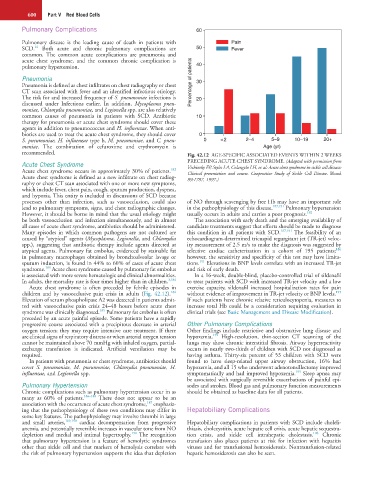
        recommended.                                          Fig. 42.12  AGE-SPECIFIC ASSOCIATED EVENTS WITHIN 2 WEEKS

        Acute Chest Syndrome                                  PRECEDING ACUTE CHEST SYNDROME. (Adapted with permission from
                                                              Vichinsky EP, Styles LA, Colangelo LH, et al: Acute chest syndrome in sickle cell disease:
                                                         182
        Acute chest syndrome occurs in approximately 30% of patients.    Clinical  presentation  and  course.  Cooperative  Study  of  Sickle  Cell  Disease.  Blood
        Acute chest syndrome is defined as a new infiltrate on chest radiog-  89:1787, 1997.)
        raphy or chest CT scan associated with one or more new symptoms,
        which include fever, chest pain, cough, sputum production, dyspnea,
        and hypoxia. This entity is included in discussions of SCD because
        processes  other  than  infection,  such  as  vasoocclusion,  could  also   of NO through scavenging by free Hb may have an important role
        lead to pulmonary symptoms, signs, and chest radiographic changes.   in the pathophysiology of this disease. 187,191  Pulmonary hypertension
        However, it should be borne in mind that the usual etiology might   usually occurs in adults and carries a poor prognosis. 192
        be both vasoocclusion and infection simultaneously, and in almost   The association with early death and the emerging availability of
        all cases of acute chest syndrome, antibiotics should be administered.   candidate treatments suggest that efforts should be made to diagnose
        Many  episodes  in  which  common  pathogens  are  not  cultured  are   this condition in all patients with SCD. 187,191  The feasibility of an
        caused by “atypical” agents (Mycoplasma, Legionella, and Chlamydia   echocardiogram-determined tricuspid regurgitant jet (TR-jet) veloc-
        spp.),  suggesting  that  antibiotic  therapy  include  agents  directed  at   ity measurement of 2.5 m/s to make the diagnosis was suggested by
                                                                                                               186
        atypical agents. Pulmonary fat embolus, evidenced by stainable fat   selective  cardiac  catheterization  in  a  cohort  of  195  patients;
        in  pulmonary  macrophages  obtained  by  bronchoalveolar  lavage  or   however, the sensitivity and specificity of this test may have limita-
                                                                  191
        sputum induction, is found in 44% to 60% of cases of acute chest   tions.  Elevations in BNP levels correlate with an increased TR-jet
                183
        syndrome.  Acute chest syndrome caused by pulmonary fat embolus   and risk of early death.
        is associated with more severe hematologic and clinical abnormalities.   In a 16-week, double-blind, placebo-controlled trial of sildenafil
        In adults, the mortality rate is four times higher than in children. 3,184  to treat patients with SCD with increased TR-jet velocity and a low
           Acute  chest  syndrome  is  often  preceded  by  febrile  episodes  in   exercise  capacity,  sildenafil  increased  hospitalization  rates  for  pain
                                                         184
                                                                                                               193
        children  and  by  vasoocclusive  pain  crisis  in  adults  (Fig.  42.12).    without evidence of improvement in TR-jet velocity or BNP levels.
        Elevation of serum phospholipase A2 was detected in patients admit-  If such patients have chronic relative reticulocytopenia, measures to
        ted  with  vasoocclusive  pain  crisis  24–48  hours  before  acute  chest   increase total Hb could be a consideration requiring evaluation in
                                  185
        syndrome was clinically diagnosed.  Pulmonary fat embolus is often   clinical trials (see Basic Management and Disease Modification).
        preceded by an acute painful episode. Some patients have a rapidly
        progressive course associated with a precipitous decrease in arterial   Other Pulmonary Complications
        oxygen tension; they may require intensive care treatment. If there   Other findings include restrictive and obstructive lung disease and
                                                                       194
        are clinical signs of respiratory distress or when arterial oxygen tension   hypoxemia.   High-resolution,  thin-section  CT  scanning  of  the
        cannot be maintained above 70 mmHg with inhaled oxygen, partial-  lungs may show chronic interstitial fibrosis. Airway hyperreactivity
        exchange  transfusion  is  indicated.  Artificial  ventilation  may  be   occurs in nearly two-thirds of children with SCD not diagnosed as
        required.                                             having  asthma. Thirty-six  percent  of  53  children  with  SCD  were
           In patients with pneumonia or chest syndrome, antibiotics should   found  to  have  sleep-related  upper  airway  obstruction,  16%  had
        cover  S.  pneumoniae,  M.  pneumoniae,  Chlamydia  pneumoniae,  H.   hypoxemia, and all 15 who underwent adenotonsillectomy improved
                                                                                                  195
        influenzae, and Legionella spp.                       symptomatically and had improved hypoxemia.  Sleep apnea may
                                                              be associated with surgically reversible exacerbations of painful epi-
        Pulmonary Hypertension                                sodes and strokes. Blood gas and pulmonary function measurements
        Chronic complications such as pulmonary hypertension occur in as   should be obtained as baseline data for all patients.
        many  as  60%  of  patients. 186–188   There  does  not  appear  to  be  an
                                                 187
        association with the occurrence of acute chest syndrome,  emphasiz-
        ing that the pathophysiology of these two conditions may differ in   Hepatobiliary Complications
        some key features. The pathophysiology may involve thrombi in large
        and  small  arteries, 189,190   cardiac  decompensation  from  progressive   Hepatobiliary complications in patients with SCD include choleli-
        anemia, and potentially reversible increases in vascular tone from NO   thiasis, cholecystitis, acute hepatic cell crisis, acute hepatic sequestra-
                                                                                                       196
                                            190
        depletion  and  medial  and  intimal  hypertrophy.  The  recognition   tion  crisis,  and  sickle  cell  intrahepatic  cholestasis.   Chronic
        that  pulmonary  hypertension  is  a  feature  of  hemolytic  syndromes   transfusion  also  places  patients  at  risk  for  infection  with  hepatitis
        other than sickle cell and that markers of hemolysis correlate with   viruses and for transfusional hemosiderosis. Nontransfusion-related
        the risk of pulmonary hypertension supports the idea that depletion   hepatic hemosiderosis can also be seen.

