


Page 707 - Hematology_ Basic Principles and Practice ( PDFDrive )
P. 707
Chapter 42  Sickle Cell Disease  599


            internal carotid artery or middle cerebral artery, the stroke risk is in   1.0
            excess of 10% per year (although this is still much lower than the risk
            of recurrent stroke in a sickle cell patient after a first event, which is
            approximately 70%). In the Stroke Prevention Trial in Sickle Cell                     With transfusion
            Disease (STOP), 130 children diagnosed as having clinically silent
            cerebral artery stenosis on the basis of high cerebral flow rates were
            randomized  to  receive  chronic  transfusion  therapy  or  not.  Over  a   0.8
            period of more than 2 years, the risk of stroke was reduced to less
                                             171
            than  1%  per  year  in  the  transfused  group   (a  risk  reduction  of
            >90%). The ability of transfusion to curtail progression of large-vessel
            stenosis has also been proven with angiography. 176
              Because of the risks of iron overload and allosensitization with
            chronic transfusion, a randomized controlled trial of withdrawal of   Probability of no recurrence  0.6  Without transfusion
            transfusion was conducted (STOP 2). This trial evaluated discontinu-
            ation of transfusion after at least 30 months in children who had not
            had an overt stroke and in whom the cerebral flow rates decreased to
            low  risk  (<170 cm/s)  with  transfusion. This  study  was  terminated
            early because of a high rate of reversion to high-risk TCD flow rates   0.4
            (34%) and stroke (5%) in the patients taken off transfusion compared
            with the group who continued transfusion. 177
              In children, MRI can also be used to assess stroke risk: 8.1% of
            children  with  an  asymptomatic  MRI  lesion  versus  0.5%  of  those
                                                            172
            with  a  normal  MRI  had  a  stroke  during  the  ensuing  5  years.
            A  randomized  trial  of  MRI-guided  prophylactic  transfusion  is  in   0.2
            progress  (Silent  Infarct Treatment Trial).  In  adults,  MRI  or  MRA
                                 34
            of the brain should be used  to assess thrombotic or hemorrhagic   0  10  20  30    40     50    60   70
            stroke risk.                                                            Time to second stroke (mo)
              Chronic transfusion is associated with a significant complication
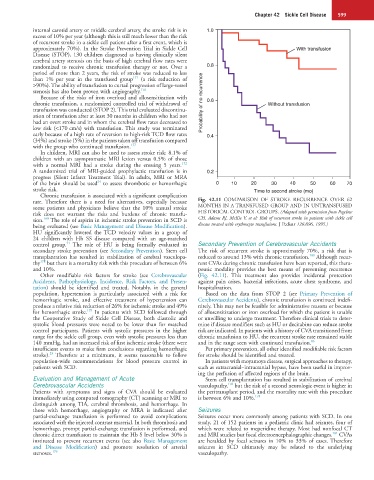
            rate.  Therefore  there  is  a  need  for  alternatives,  especially  because   Fig.  42.11  COMPARISON  OF  STROKE  RECURRENCE  OVER  62
            some  patients  and  physicians  believe  that  the  10%  annual  stroke   MONTHS IN A TRANSFUSED GROUP AND IN UNTRANSFUSED
            risk  does  not  warrant  the  risks  and  burdens  of  chronic  transfu-  HISTORICAL CONTROL GROUPS. (Adapted with permission from Pegelow
               160
            sion.  The role of aspirin in ischemic stroke prevention in SCD is   CH, Adams RJ, McKie V, et al: Risk of recurrent stroke in patients with sickle cell
            being evaluated (see Basic Management and Disease Modification).   disease treated with erythrocyte transfusions. J Pediatr 126:896, 1995.)
            HU  significantly  lowered  the  TCD  velocity  values  in  a  group  of
            24  children  with  Hb  SS  disease  compared  with  an  age-matched
                       51
            control  group.   The  role  of  HU  is  being  formally  evaluated  in   Secondary Prevention of Cerebrovascular Accidents
            secondary  stroke  prevention  (see  Secondary  Prevention).  Stem  cell   The  risk  of  recurrent  stroke  is  approximately  70%,  a  risk  that  is
                                                                                                      180
            transplantation  has  resulted  in  stabilization  of  cerebral  vasculopa-  reduced to around 13% with chronic transfusion.  Although recur-
              178
            thy  but there is a mortality risk with this procedure of between 6%   rent CVAs during chronic transfusion have been reported, this thera-
            and 10%.                                              peutic  modality  provides  the  best  means  of  preventing  recurrence
              Other  modifiable  risk  factors  for  stroke  (see  Cerebrovascular     (Fig.  42.11).  This  treatment  also  provides  incidental  protection
            Accidents,  Pathophysiology,  Incidence,  Risk  Factors,  and  Presen-  against pain crises, bacterial infections, acute chest syndrome, and
            tation)  should  be  identified  and  treated.  Notably,  in  the  general   hospitalization.
            population,  hypertension  is  particularly  associated  with  a  risk  for   Based  on  the  data  from  STOP  2  (see  Primary  Prevention  of
            hemorrhagic  stroke,  and  effective  treatment  of  hypertension  can   Cerebrovascular Accidents), chronic transfusion is continued indefi-
            produce a relative risk reduction of 26% for ischemic stroke and 49%   nitely. This may not be feasible for administrative reasons or because
                              179
            for hemorrhagic stroke.  In patients with SCD followed through   of allosensitization or iron overload for which the patient is unable
            the  Cooperative  Study  of  Sickle  Cell  Disease,  both  diastolic  and   or unwilling to undergo treatment. Therefore clinical trials to deter-
            systolic  blood  pressures  were  noted  to  be  lower  than  for  matched   mine if disease modifiers such as HU or decitabine can reduce stroke
            control  participants.  Patients  with  systolic  pressures  in  the  higher   risk are indicated. In patients with a history of CVA transitioned from
            range for the sickle cell group, even with systolic pressures less than   chronic transfusion to HU, the recurrent stroke rate remained stable
            140 mmHg, had an increased risk of first ischemic stroke (there were   and in the range seen with continued transfusion. 86
            insufficient events to make firm conclusions regarding hemorrhagic   Per primary prevention, all other identified modifiable risk factors
                 23
            stroke).   Therefore  at  a  minimum,  it  seems  reasonable  to  follow   for stroke should be identified and treated.
            population-wide  recommendations  for  blood  pressure  control  in   In patients with moyamoya disease, surgical approaches to therapy,
            patients with SCD.                                    such as extracranial–intracranial bypass, have been useful in improv-
                                                                  ing the perfusion of affected regions of the brain.
            Evaluation and Management of Acute                      Stem cell transplantation has resulted in stabilization of cerebral
            Cerebrovascular Accidents                             vasculopathy,  but the risk of a second neurologic event is higher in
                                                                            178
            Patients  with  symptoms  and  signs  of  CVA  should  be  evaluated   the peritransplant period, and the mortality rate with this procedure
            immediately using computed tomography (CT) scanning or MRI to   is between 6% and 10%. 178
            distinguish  among TIA,  cerebral  thrombosis,  and  hemorrhage.  In
            those  with  hemorrhage,  angiography  or  MRA  is  indicated  after   Seizures
            partial-exchange  transfusion  is  performed  to  avoid  complications   Seizures occur more commonly among patients with SCD. In one
            associated with the injected contrast material. In both thrombosis and   study, 21 of 152 patients in a pediatric clinic had seizures, four of
            hemorrhage, prompt partial-exchange transfusion is performed, and   which were related to meperidine therapy. Most had nonfocal CT
                                                                                                              181
            chronic direct transfusion to maintain the Hb S level below 30% is   and MRI studies but focal electroencephalographic changes.  CVAs
            instituted  to  prevent  recurrent  events  (see  also  Basic  Management    are  heralded  by  focal  seizures  in  10%  to  33%  of  cases. Therefore
            and  Disease  Modification)  and  promote  resolution  of  arterial   seizures  in  SCD  ultimately  may  be  related  to  the  underlying
            stenoses. 176                                         vasculopathy.

