


Page 736 - Hematology_ Basic Principles and Practice ( PDFDrive )
P. 736
Chapter 44  Red Blood Cell Enzymopathies  623


                                                  O 2


                                                              2+
                                                            Fe  deoxyhemoglobin
                             2+
                           Fe  oxyhemoglobin
                                                         NAD                     NADP

                                                        b5R                       Methylene blue
                                                  ROS
                                                       NADH                      NADPH
                           Endogenous and
                           exogenous ROS                                             Treatment of acute
                                                                                     methemoglobinemia
                                                              3+
                                                            Fe  methemoglobin
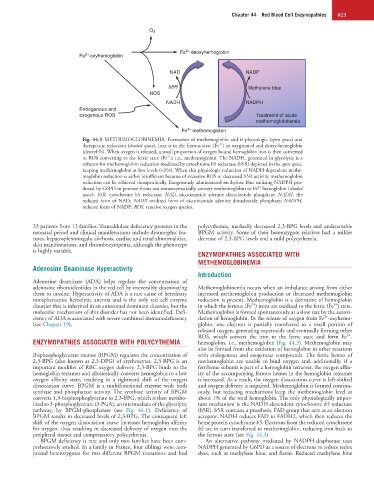
                            Fig. 44.3  METHEMOGLOBINEMIA. Formation of methemoglobin and it physiologic (open space) and
                                                                         2+
                            therapeutic reduction (shaded space). Iron is in the ferrous state (Fe ) in oxygenated and deoxy-hemoglobin
                            (deoxyHb). When oxygen is released, a small proportion of oxygen bound hemoglobin iron is then converted
                                                        3+
                            to ROS converting to the ferric state (Fe ); i.e., methemoglobin. The NADH, generated in glycolysis is a
                            cofactor for methemoglobin reduction mediated by cytochrome b5 reductase (b5R) depicted in the open space,
                            keeping methemoglobin at low levels (<1%). When this physiologic reduction of NADH-dependent methe-
                            moglobin reduction is either insufficient because of excessive ROS or decreased b5R activity, methemoglobin
                            reduction can be achieved therapeutically. Exogenously administered methylene blue utilizing NADPH pro-
                                                                                     2+
                            duced by G6PD in pentose shunt can nonenzymatically convert methemoglobin to Fe  hemoglobin (shaded
                            space).  b5R,  cytochrome  b5  reductase;  NAD,  nicotinamide  adenine  dinucleotide  phosphate;  NADH,  the
                            reduced  form  of  NAD;  NADP,  oxidized  form  of  nicotinamide  adenine  dinucleotide  phosphate;  NADPH,
                            reduced form of NADP; ROS, reactive oxygen species.


            23 patients from 13 families. Transaldolase deficiency presents in the   polycythemia, markedly decreased 2,3-BPG levels and undetectable
            neonatal period and clinical manifestations include dysmorphic fea-  BPGM  activity.  Some  of  their  heterozygote  relatives  had  a  milder
            tures, hepatosplenomegaly, cirrhosis, cardiac and renal abnormalities,   decrease of 2,3-BPG levels and a mild polycythemia.
            skin manifestations, and thrombocytopenia, although the phenotype
            is highly variable.
                                                                  ENZYMOPATHIES ASSOCIATED WITH
                                                                  METHEMOGLOBINEMIA
            Adenosine Deaminase Hyperactivity
                                                                  Introduction
            Adenosine  deaminase  (ADA)  helps  regulate  the  concentration  of
            adenosine ribonucleotides in the red cell by irreversibly deaminating   Methemoglobinemia occurs when an imbalance arising from either
            them to inosine. Hyperactivity of ADA is a rare cause of hereditary   increased methemoglobin production or decreased methemoglobin
            nonspherocytic  hemolytic  anemia  and  is  the  only  red  cell  enzyme   reduction is present. Methemoglobin is a derivative of hemoglobin
                                                                                   2+
                                                                                                              3+
            disorder that is inherited in an autosomal dominant disorder, but the   in which the ferrous (Fe ) irons are oxidized to the ferric (Fe ) state.
            molecular mechanism of this disorder has not been identified. Defi-  Methemoglobin is formed spontaneously at a slow rate by the autoxi-
                                                                                                           2+
            ciency of ADA is associated with severe combined immunodeficiency   dation of hemoglobin. In the release of oxygen from Fe -oxyhemo-
            (see Chapter 19).                                     globin,  one  electron  is  partially  transferred  to  a  small  portion  of
                                                                  released oxygen, generating superoxide and eventually forming other
                                                                                                                  3+
                                                                  ROS,  which  convert  the  iron  to  the  ferric  state  and  form  Fe -
            ENZYMOPATHIES ASSOCIATED WITH POLYCYTHEMIA            hemoglobin, i.e., methemoglobin (Fig. 44.3). Methemoglobin may
                                                                  also be formed from the oxidation of hemoglobin in other reactions
            Bisphosphoglycerate mutase (BPGM) regulates the concentration of   with  endogenous  and  exogenous  compounds. The  ferric  hemes  of
            2,3-BPG (also known as 2,3-DPG) of erythrocytes. 2,3-BPG is an   methemoglobin  are  unable  to  bind  oxygen  and,  additionally,  if  a
            important modifier of RBC oxygen delivery. 2,3-BPG binds to the   ferriheme subunit is part of a hemoglobin tetramer, the oxygen affin-
            hemoglobin tetramer and allosterically converts hemoglobin to a low   ity of the accompanying ferrous hemes in the hemoglobin tetramer
            oxygen  affinity  state,  resulting  in  a  rightward  shift  of  the  oxygen   is increased. As a result, the oxygen dissociation curve is left-shifted
            dissociation  curve.  BPGM  is  a  multifunctional  enzyme  with  both   and oxygen delivery is impaired. Methemoglobin is formed continu-
            synthase and phosphatase activity. The synthase activity of BPGM   ously,  but  reducing  mechanisms  keep  the  methemoglobin  level  at
            converts 1,3-bisphosphoglycerate to 2,3-BPG, which is then metabo-  about 1% of the total hemoglobin. The only physiologically impor-
            lized to 3-phosphoglycerate (3-PGA), an intermediate of the glycolytic   tant mechanism is the NADH-dependent cytochrome b5 reductase
            pathway,  by  BPGM-phosphatase  (see  Fig.  44.1).  Deficiency  of   (b5R). b5R contains a prosthetic FAD group that acts as an electron
            BPGM results in decreased levels of 2,3-BPG. The consequent left   acceptor. NADH reduces FAD to FADH2, which then reduces the
            shift of the oxygen dissociation curve increases hemoglobin affinity   heme protein cytochrome b5. Electrons from the reduced cytochrome
            for oxygen, thus resulting in decreased delivery of oxygen into the   b5 are in turn transferred to methemoglobin, reducing iron back to
            peripheral tissues and compensatory polycythemia.     the ferrous state (see Fig. 44.3)
              BPGM deficiency is rare and only two families have been com-  An  alternative  pathway  mediated  by  NADPH-diaphorase  uses
            prehensively studied. In a family in France, four siblings were com-  NADPH generated by G6PD as a source of electrons to reduce redox
            pound  heterozygotes  for  two  different  BPGM  mutations  and  had   dyes, such as methylene blue, and flavin. Reduced methylene blue

