


Page 741 - Hematology_ Basic Principles and Practice ( PDFDrive )
P. 741
628    Part V  Red Blood Cells


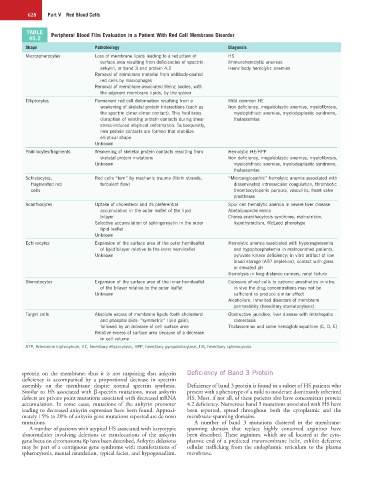
          TABLE   Peripheral Blood Film Evaluation in a Patient With Red Cell Membrane Disorder
          45.2
         Shape                  Pathobiology                                Diagnosis
         Microspherocytes       Loss of membrane lipids leading to a reduction of   HS
                                  surface area resulting from deficiencies of spectrin,   Immunohemolytic anemias
                                  ankyrin, or band 3 and protein 4.2        Heinz body hemolytic anemias
                                Removal of membrane material from antibody-coated
                                  red cells by macrophages
                                Removal of membrane-associated Heinz bodies, with
                                  the adjacent membrane lipids, by the spleen
         Elliptocytes           Permanent red cell deformation resulting from a   Mild common HE
                                  weakening of skeletal protein interactions (such as   Iron deficiency, megaloblastic anemias, myelofibrosis,
                                  the spectrin dimer-dimer contact). This facilitates   myelophthisic anemias, myelodysplastic syndrome,
                                  disruption of existing protein contacts during shear   thalassemias
                                  stress-induced elliptical deformation. Subsequently,
                                  new protein contacts are formed that stabilize
                                  elliptical shape
                                Unknown
         Poikilocytes/fragments  Weakening of skeletal protein contacts resulting from   Hemolytic HE/HPP
                                  skeletal protein mutations                Iron deficiency, megaloblastic anemias, myelofibrosis,
                                Unknown                                      myelophthisic anemias, myelodysplastic syndrome,
                                                                             thalassemias
         Schistocytes,          Red cells “torn” by mechanic trauma (fibrin strands,   “Microangiopathic” hemolytic anemia associated with
           fragmented red         turbulent flow)                            disseminated intravascular coagulation, thrombotic
           cells                                                             thrombocytopenic purpura, vasculitis, heart valve
                                                                             prostheses
         Acanthocytes           Uptake of cholesterol and its preferential   Spur cell hemolytic anemia in severe liver disease
                                  accumulation in the outer leaflet of the lipid   Abetalipoproteinemia
                                  bilayer                                   Chorea-acanthocytosis syndrome, malnutrition,
                                Selective accumulation of sphingomyelin in the outer   hypothyroidism, McLeod phenotype
                                  lipid leaflet
                                Unknown
         Echinocytes            Expansion of the surface area of the outer hemileaflet   Hemolytic anemia associated with hypomagnesemia
                                  of lipid bilayer relative to the inner hemileaflet  and hypophosphatemia in malnourished patients,
                                Unknown                                      pyruvate kinase deficiency; in vitro artifact of low
                                                                             blood storage (ATP depletion), contact with glass
                                                                             or elevated pH
                                                                            Hemolysis in long-distance runners, renal failure
         Stomatocytes           Expansion of the surface area of the inner hemileaflet   Exposure of red cells to cationic anesthetics in vitro;
                                  of the bilayer relative to the outer leaflet  in vivo the drug concentrations may not be
                                Unknown                                      sufficient to produce similar effect
                                                                            Alcoholism, inherited disorders of membrane
                                                                             permeability (hereditary stomatocytosis)
         Target cells           Absolute excess of membrane lipids (both cholesterol   Obstructive jaundice, liver disease with intrahepatic
                                  and phospholipids: “symmetric” lipid gain),   cholestasis
                                  followed by an increase of cell surface area  Thalassemias and some hemoglobinopathies (C, D, E)
                                Relative excess of surface area because of a decrease
                                  in cell volume
         ATP, Adenosine triphosphate; HE, hereditary elliptocytosis; HPP, hereditary pyropoikilocytosis; HS, hereditary spherocytosis.


        spectrin  on  the  membrane;  thus  it  is  not  surprising  that  ankyrin   Deficiency of Band 3 Protein
        deficiency  is  accompanied  by  a  proportional  decrease  in  spectrin
        assembly  on  the  membrane  despite  normal  spectrin  synthesis.   Deficiency of band 3 protein is found in a subset of HS patients who
        Similar to HS associated with β-spectrin mutations, most ankyrin   present with a phenotype of a mild to moderate dominantly inherited
        defects are private point mutations associated with decreased mRNA   HS. Most, if not all, of these patients also have concomitant protein
        accumulation.  In  some  cases,  mutations  of  the  ankyrin  promoter   4.2 deficiency. Numerous band 3 mutations associated with HS have
        leading to decreased ankyrin expression have been found. Approxi-  been  reported,  spread  throughout  both  the  cytoplasmic  and  the
        mately 15% to 20% of ankyrin gene mutations reported are de novo     membrane-spanning domains.
        mutations.                                               A  number  of  band  3  mutations  clustered  in  the  membrane-
           A number of patients with atypical HS associated with karyotypic   spanning  domain  that  replace  highly  conserved  arginines  have
        abnormalities  involving  deletions  or  translocations  of  the  ankyrin   been described. These arginines, which are all located at the cyto-
        gene locus on chromosome 8p have been described. Ankyrin deletions   plasmic  end  of  a  predicted  transmembrane  helix,  exhibit  defective
        may be part of a contiguous gene syndrome with manifestations of   cellular  trafficking  from  the  endoplasmic  reticulum  to  the  plasma
        spherocytosis, mental retardation, typical facies, and hypogonadism.  membrane.

