


Page 740 - Hematology_ Basic Principles and Practice ( PDFDrive )
P. 740
Chapter 45  Red Blood Cell Membrane Disorders  627


                               Glycophorin A                  Glycophorin B  Glycophorin A  Glycophorin C/D


                                                                          Band 3  Band 3
                                  Band 3   Band 3
                                                       Rh RhAG LW                               p55
                                                 CD47
                                              4.2                                  Dematin
                                      Ankyrin-1
                                                                                           4.1R
                                                                                   Actin
                                                                       β-Spectrin               Adducin
                                                                                        4.1R
                               α-Spectrin


                                                                                             Tropomyosin
                                                                             Tropomodulin
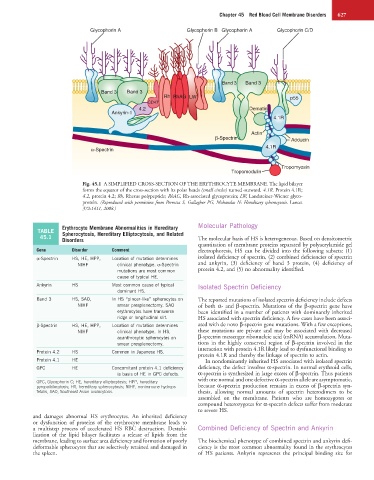
                            Fig. 45.1  A SIMPLIFIED CROSS-SECTION OF THE ERYTHROCYTE MEMBRANE. The lipid bilayer
                            forms the equator of the cross-section with its polar heads (small circles) turned outward. 4.1R, Protein 4.1R;
                            4.2, protein 4.2; Rh, Rhesus polypeptide; RhAG, Rh-associated glycoprotein; LW, Landsteiner-Wiener glyco-
                            protein. (Reproduced with permission from Perrotta S, Gallagher PG, Mohandas N: Hereditary spherocytosis. Lancet
                            372:1411, 2008.)


                     Erythrocyte Membrane Abnormalities in Hereditary   Molecular Pathology
             TABLE   Spherocytosis, Hereditary Elliptocytosis, and Related
              45.1
                     Disorders                                    The molecular basis of HS is heterogeneous. Based on densitometric
                                                                  quantitation of membrane proteins separated by polyacrylamide gel
             Gene        Disorder     Comment                     electrophoresis,  HS  can  be  divided  into  the  following  subsets:  (1)
             α-Spectrin  HS, HE, HPP,   Location of mutation determines   isolated deficiency of spectrin, (2) combined deficiencies of spectrin
                          NIHF         clinical phenotype. α-Spectrin   and  ankyrin,  (3)  deficiency  of  band  3  protein,  (4)  deficiency  of
                                       mutations are most common   protein 4.2, and (5) no abnormality identified.
                                       cause of typical HE.
             Ankyrin     HS           Most common cause of typical   Isolated Spectrin Deficiency
                                       dominant HS.
             Band 3      HS, SAO,     In HS “pincer-like” spherocytes on   The reported mutations of isolated spectrin deficiency include defects
                          NIHF         smear presplenectomy. SAO   of both α- and β-spectrin. Mutations of the β-spectrin gene have
                                       erythrocytes have transverse   been identified in a number of patients with dominantly inherited
                                       ridge or longitudinal slit.  HS associated with spectrin deficiency. A few cases have been associ-
             β-Spectrin  HS, HE, HPP,   Location of mutation determines   ated with de novo β-spectrin gene mutations. With a few exceptions,
                          NIHF         clinical phenotype. In HS,   these  mutations  are  private  and  may  be  associated  with  decreased
                                       acanthrocytic spherocytes on   β-spectrin messenger ribonucleic acid (mRNA) accumulation. Muta-
                                       smear presplenectomy.      tions  in  the  highly  conserved  region  of  β-spectrin  involved in the
                                                                  interaction with protein 4.1R likely lead to dysfunctional binding to
             Protein 4.2  HS          Common in Japanese HS.      protein 4.1R and thereby the linkage of spectrin to actin.
             Protein 4.1  HE                                        In nondominantly inherited HS associated with isolated spectrin
             GPC         HE           Concomitant protein 4.1 deficiency   deficiency, the defect involves α-spectrin. In normal erythroid cells,
                                       is basis of HE in GPC defects.  α-spectrin is synthesized in large excess of β-spectrin. Thus patients
                                                                  with one normal and one defective α-spectrin allele are asymptomatic,
             GPC, Glycophorin C; HE, hereditary elliptocytosis; HPP, hereditary
             pyropoikilocytosis; HS, hereditary spherocytosis; NIHF, nonimmune hydrops   because α-spectrin production remains in excess of β-spectrin syn-
             fetalis, SAO, Southeast Asian ovalocytosis.          thesis,  allowing  normal  amounts  of  spectrin  heterodimers  to  be
                                                                  assembled  on  the  membrane.  Patients  who  are  homozygotes  or
                                                                  compound heterozygotes for α-spectrin defects suffer from moderate
                                                                  to severe HS.
            and  damages  abnormal  HS  erythrocytes.  An  inherited  deficiency
            or  dysfunction  of  proteins  of  the  erythrocyte  membrane  leads  to
            a  multistep  process  of  accelerated  HS  RBC  destruction.  Destabi-  Combined Deficiency of Spectrin and Ankyrin
            lization  of  the  lipid  bilayer  facilitates  a  release  of  lipids  from  the
            membrane, leading to surface area deficiency and formation of poorly   The biochemical phenotype of combined spectrin and ankyrin defi-
            deformable spherocytes that are selectively retained and damaged in    ciency is the most common abnormality found in the erythrocytes
            the spleen.                                           of  HS  patients.  Ankyrin  represents  the  principal  binding  site  for

