


Page 751 - Hematology_ Basic Principles and Practice ( PDFDrive )
P. 751
638    Part V  Red Blood Cells


        simple heterozygote versus homozygote or double heterozygote) or
        the presence of other genetic defects such as the presence, in trans,   Laboratory Manifestations
        of a defect leading to a reduced α-spectrin synthesis in some patients
        with HPP.                                             Blood Film and Laboratory Evidence of Hemolysis
           The low-expression α-spectrin allele α LELY  is the best-characterized
        abnormality affecting spectrin content and clinical severity. Initially   A careful blood smear evaluation is essential for the diagnosis of HE
        a  polymorphism  of  the  αV  domain,  α V/41 ,  was  identified  in  HE   and for the classification of the disorder into the three major subtypes
        patients who, when they inherited α V/41  in trans, had more severe HE   outlined  previously.  In  patients  in  whom  elliptocytosis  is  the  only
        than expected. Subsequently an amino acid substitution of exon 46,   morphologic abnormality, hemolysis is characteristically minimal or
        Leu1857Val,  and  partial  skipping  of  exon  46,  linked  to  the  α V/41    absent, with the exception of spherocytic elliptocytosis, in which the
        polymorphism,  were  identified  as  the  characteristics  of  the  α LELY    presence of round “fat” ovalocytes is associated with accelerated RBC
        allele.  These  abnormalities  are  located  within  the  site  at  which   destruction. In patients with hemolytic forms of common HE, poi-
        spectrin  monomers  assemble  into  heterodimers  (the  spectrin  het-  kilocytosis  is  characteristically  found  on  the  blood  film.  In  severe
        erodimer nucleation site). In vitro studies suggest that the inability   forms of HE, particularly in homozygous HE, many RBCs circulate
        of α-spectrin chains to assemble into the mature membrane skeleton   as cell fragments, producing a marked decrease in MCV. The finding
        is because of a combination of decreased αβ dimer-binding affinity   of RBC fragments together with a striking microspherocytosis and
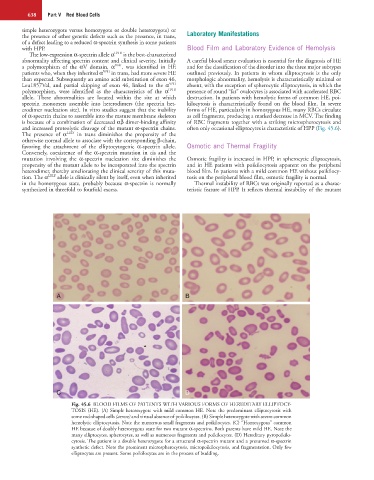
        and increased proteolytic cleavage of the mutant α-spectrin chains.   often only occasional elliptocytes is characteristic of HPP (Fig. 45.6).
        The  presence  of  α LELY   in  trans  diminishes  the  propensity  of  the
        otherwise normal allele to associate with the corresponding β-chain,
        favoring  the  attachment  of  the  elliptocytogenic  α-spectrin  allele.   Osmotic and Thermal Fragility
        Conversely,  coexistence  of  the  α-spectrin  mutation  in  cis  and  the
        mutation  involving  the  α-spectrin  nucleation  site  diminishes  the   Osmotic fragility is increased in HPP, in spherocytic elliptocytosis,
        propensity of the mutant allele to be incorporated into the spectrin   and in HE patients with poikilocytosis apparent on the peripheral
        heterodimer, thereby ameliorating the clinical severity of this muta-  blood film. In patients with a mild common HE without poikilocy-
        tion. The α LELY  allele is clinically silent by itself, even when inherited   tosis on the peripheral blood film, osmotic fragility is normal.
        in  the  homozygous  state,  probably  because  α-spectrin  is  normally   Thermal instability of RBCs was originally reported as a charac-
        synthesized in threefold to fourfold excess.          teristic feature of HPP. It reflects thermal instability of the mutant


                    A                                         B


                    C                                         D

                        Fig. 45.6  BLOOD FILMS OF PATIENTS WITH VARIOUS FORMS OF HEREDITARY ELLIPTOCY-
                        TOSIS (HE). (A) Simple heterozygote with mild common HE. Note the predominant elliptocytosis with
                        some rod-shaped cells (arrow) and virtual absence of poikilocytes. (B) Simple heterozygote with severe common
                        hemolytic elliptocytosis. Note the numerous small fragments and poikilocytes. (C) “Homozygous” common
                        HE because of doubly heterozygous state for two mutant α-spectrins. Both parents have mild HE. Note the
                        many elliptocytes, spherocytes, as well as numerous fragments and poikilocytes. (D) Hereditary pyropoikilo-
                        cytosis. The patient is a double heterozygote for a structural α-spectrin mutant and a presumed α-spectrin
                        synthetic defect. Note the prominent microspherocytosis, micropoikilocytosis, and fragmentation. Only few
                        elliptocytes are present. Some poikilocytes are in the process of budding.

