


Page 749 - Hematology_ Basic Principles and Practice ( PDFDrive )
P. 749
636    Part V  Red Blood Cells


                                                              sufficient to cause RBC fragmentation with hemolytic anemia under
                                                              conditions of normal circulatory shear stress.
                                   C                5            The  pathobiology  of  the  elliptocytic  shape  is  less  clear.  RBC
              C                5                         C    precursors in common HE are round and the cells become progres-
                                                              sively more elliptical as they age in vivo. RBCs subjected to shear
                 3        C            3       C              stress  in vitro, or  RBCs  flowing  through  microcirculation in  vivo,
                                                              have an elliptical or parachute-like shape, respectively. It is possible
                    3                     3                   that elliptocytes and poikilocytes are permanently stabilized in their
                                                              abnormal shape because the weakened spectrin heterodimer contacts
                      α                                       facilitate skeletal reorganization, which follows axial deformation of
                    3                     3
                        β                                     cells  resulting  from  application  of  a  prolonged  or  excessive  shear
                                                              stress. This reorganization is likely to involve breakage of the unidi-
                   5                    5                     rectionally stretched protein connections followed by the formation
                                                              of  new  protein  contacts  that  preclude  the  recovery  of  a  normal
                                                              biconcave shape. This process has been shown to account for perma-
               C          3         C           3             nent deformation of irreversibly sickled cells.
                                                                 In  HPP,  the  recessively  inherited  form  of  HE  characterized  by
                                                              severe  hemolysis,  RBCs  have  two  abnormalities.  They  contain  a
                                                              mutant spectrin that characteristically disrupts spectrin heterodimer
                       α             β                        self-association, and they are also partially deficient in spectrin, as
            C                                  C              evidenced by a decreased spectrin/band 3 ratio. In some HPP cases,
                       β             α                        this biochemical phenotype is a consequence of a double heterozygous
                                                              state for an elliptocytogenic α-spectrin mutation and a defect involv-
                                                              ing reduced α-spectrin synthesis. Such synthetic defect of α-spectrin
                                     Protein dysfunctions     is  fully  asymptomatic  in  the  heterozygous  carrier,  because  under
                                     HE, HPP SpD-SpD          normal conditions, the synthesis of α-spectrin is approximately three
                                     HE 4.1-SP
         Spectrin                                             to four times greater than that of β-spectrin.
                                         Protein deficiencies:   When present in conjunction with an elliptocytogenic mutation
                            Adducin                           of α-spectrin, such a synthetic defect augments the expression of the
                                         HE 4.1 and HE 4.1°
                            Tropomyosin  HE GPC°              mutant  spectrin.  Because  the  elliptocytogenic  α-spectrin  mutants
               C    Actin                                     are  often  unstable,  the  combination  of  the  two  defects  leads  to
                                               2.1    4.1     spectrin deficiency in the cells. Other HPP patients are homozygous
                                                              or  doubly  heterozygous  for  one  or  two  elliptocytogenic  spectrin
                                                              mutations,  respectively.  In  such  cases,  the  spectrin  deficiency  may
                                                              be a consequence of spectrin instability that reduces the amount of
                                                              spectrin  available  for  membrane  assembly.  Furthermore,  in  RBCs
                                                              containing  a  high  fraction  of  unassembled  dimeric  spectrin,  the
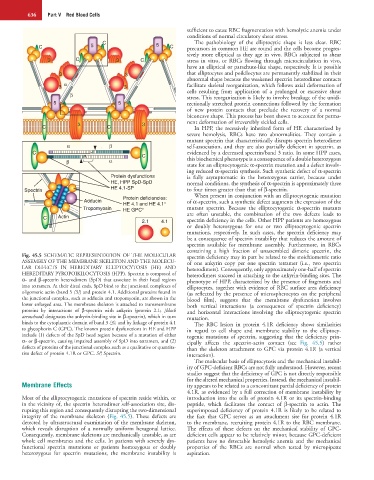
        Fig.  45.5  SCHEMATIC REPRESENTATION OF THE MOLECULAR   spectrin deficiency may in part be related to the stoichiometric ratio
        ASSEMBLY OF THE MEMBRANE SKELETON AND THE MOLECU-     of  one  ankyrin  copy  per  one  spectrin  tetramer  (i.e.,  two  spectrin
        LAR  DEFECTS  IN  HEREDITARY  ELLIPTOCYTOSIS  (HE)  AND   heterodimers). Consequently, only approximately one-half of spectrin
        HEREDITARY PYROPOIKILOCYTOSIS (HPP). Spectrin is composed of   heterodimers succeed in attaching to the ankyrin-binding sites. The
        α- and β-spectrin heterodimers (SpD) that associate in their head regions   phenotype of HPP, characterized by the presence of fragments and
        into tetramers. At their distal ends, SpD bind to the junctional complexes of   elliptocytes, together with evidence of RBC surface area deficiency
        oligomeric actin (band 5 [5]) and protein 4.1. Additional proteins found in   (as reflected by the presence of microspherocytes on the peripheral
        the junctional complex, such as adducin and tropomyosin, are shown in the   blood  film),  suggests  that  the  membrane  dysfunction  involves
        lower enlarged area. The membrane skeleton is attached to transmembrane   both  vertical  interactions  (a  consequence  of  spectrin  deficiency)
        proteins  by  interactions  of  β-spectrin  with  ankyrin  (protein  2.1;  [black   and  horizontal  interactions  involving  the  elliptocytogenic  spectrin
        arrowhead] designates the ankyrin-binding site in β-spectrin), which in turn   mutation.
        binds to the cytoplasmic domain of band 3 (3), and by linkage of protein 4.1   The  RBC  lesion  in  protein  4.1R  deficiency  shows  similarities
        to glycophorin C (GPC). The known protein dysfunctions in HE and HPP   in  regard  to  cell  shape  and  membrane  stability  to  the  elliptocy-
        include (1) defects of the SpD head region because of a mutation of either   togenic  mutations  of  spectrin,  suggesting  that  the  deficiency  prin-
        α- or β-spectrin, causing impaired assembly of SpD into tetramers, and (2)   cipally  affects  the  spectrin-actin  contact  (see  Fig.  45.5)  rather
        defects of proteins of the junctional complex such as a qualitative or quantita-  than the skeleton attachment to GPC via protein 4.1R (a vertical
        tive defect of protein 4.1R or GPC. SP, Spectrin.     interaction).
                                                                 The molecular basis of elliptocytosis and the mechanical instabil-
                                                              ity of GPC-deficient RBCs are not fully understood. However, recent
                                                              studies suggest that the deficiency of GPC is not directly responsible
                                                              for the altered mechanical properties. Instead, the mechanical instabil-
        Membrane Effects                                      ity appears to be related to a concomitant partial deficiency of protein
                                                              4.1R, as evidenced by a full correction of membrane instability by
        Most of the elliptocytogenic mutations of spectrin reside within, or   introduction  into  the  cells  of  protein  4.1R  or  its  spectrin-binding
        in the vicinity of, the spectrin heterodimer self-association site, dis-  peptide,  which  facilitates  the  contact  of  β-spectrin  to  actin.  The
        rupting this region and consequently disrupting the two-dimensional   superimposed  deficiency  of  protein  4.1R  is  likely  to  be  related  to
        integrity  of  the  membrane  skeleton  (Fig.  45.5). These  defects  are   the  fact  that  GPC  serves  as  an  attachment  site  for  protein  4.1R
        detected by ultrastructural examination of the membrane skeleton,   to the membrane, recruiting protein 4.1R to the RBC membrane.
        which  reveals  disruption  of  a  normally  uniform  hexagonal  lattice.   The  effects  of  these  defects  on  the  mechanical  stability  of  GPC-
        Consequently, membrane skeletons are mechanically unstable, as are   deficient cells appear to be relatively minor, because GPC-deficient
        whole cell membranes and the cells. In patients with severely dys-  patients  have  no  detectable  hemolytic  anemia  and  the  mechanical
        functional  spectrin  mutations  or  patients  homozygous  or  doubly   properties  of  the  RBCs  are  normal  when  tested  by  micropipette
        heterozygous  for  spectrin  mutations,  the  membrane  instability  is   aspiration.

