


Page 753 - Hematology_ Basic Principles and Practice ( PDFDrive )
P. 753
640    Part V  Red Blood Cells


        the band 3 protein, inability to transport sulfate anions, and a mark-  mutation is the first example of a defect of an integral membrane
        edly restricted lateral and rotational mobility of band 3 protein in the   protein leading to RBC membrane rigidity, an observation previously
        membrane.                                             attributed to properties of the membrane skeleton. The basis of the
                                                              increased rigidity is unclear.
                                                                 The molecular basis of malaria resistance of SAO RBCs is likely
        Laboratory Manifestations                             related to altered properties of the band 3 protein, which serves as
                                                              one of the malaria receptors, as evidenced by the inhibition of in vitro
        The finding of 30% or greater of oval RBCs on the peripheral blood   invasion  by  band  3-containing  liposomes.  In  normal  RBCs,  the
        film, some containing a central slit or a transverse ridge, in the context   invasion process is associated with a marked membrane remodeling
        of a notable absence of clinical and laboratory evidence of hemolysis   that involves redistribution of intramembrane particles that contain
        in a patient from the ethnic groups noted earlier is highly suggestive   band 3 protein. Such particles cluster at the site of parasite invasion,
        of the diagnosis. A useful screening test is the demonstration of the   forming a ring around the orifice through which the parasite enters
        resistance of ovalocytes or their ghosts to changes in shape produced   the  cell.  The  invaginated  RBC  membrane,  which  surrounds  the
        by treatments that produce spiculation in normal cells, such as meta-  invading  parasite,  is  free  of  intramembrane  particles. The  reduced
        bolic depletion or exposure of ghosts to salt solutions. In contrast to   lateral mobility of band 3 protein in SAO RBCs may preclude band
        normal RBCs, which form spicules in response to such stimuli, SAO   3 receptor clustering, thereby preventing the attachment of the para-
        RBCs  or  ghosts  do  not  change  shape  after  these  treatments. The   sites  to  the  cells.  Decreased  exchange  of  anions  across  the  RBC
        mechanism of this resistance to changes in shape is not clear, and it   membrane has also been proposed to contribute to the resistance of
        may reflect the high rigidity of the RBC membrane.    ovalocytes to malaria invasion. In addition, SAO RBCs consume ATP
           Because the underlying cause of SAO is the deletion of 27 bases   at a higher rate than normal cells, and the partial depletion of ATP
        from  the  band  3  gene,  isolation  of  genomic  DNA  or  reticulocyte   levels in ovalocytes has been suggested to account, at least in part, for
        cDNA  with  subsequent  amplification  of  the  deletion-containing   the resistance of these cells to malaria invasion in vitro.
        region appears to be the most specific test for establishing the diag-
        nosis of SAO. A single, severely affected homozygous SAO individual
        who was transfusion dependent has been described.     Acanthocytosis and Related Disorders
        Molecular Basis of Southeast Asian Ovalocytosis       Acanthocytes  (from  the  Greek  acantha,  “thorn”)  or  spur  cells  are
                                                              RBCs  with  prominent  thorn-like  surface  protrusions  that  vary  in
        Membrane Rigidity and Malaria Resistance              width,  length,  and  surface  distribution.  Spur  cells  must  be  distin-
                                                              guished from echinocytes (Greek echinos, “sea urchin”) or burr cells,
        The RBCs of SAO are unique among axially deformed cells in that   characterized by multiple small projections that are uniformly distrib-
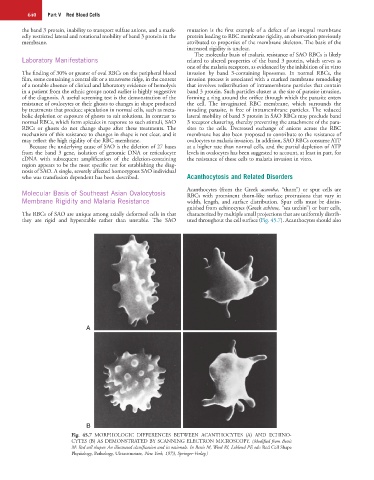
        they  are  rigid  and  hyperstable  rather  than  unstable.  The  SAO   uted throughout the cell surface (Fig. 45.7). Acanthocytes should also


                             A


                             B
                        Fig.  45.7  MORPHOLOGIC  DIFFERENCES  BETWEEN  ACANTHOCYTES  (A)  AND  ECHINO-
                        CYTES (B) AS DEMONSTRATED BY SCANNING ELECTRON MICROSCOPY. (Modified from Bessis
                        M: Red cell shapes: An illustrated classification and its rationale. In Bessis M, Weed RI, Leblond PF, eds: Red Cell Shape
                        Physiology, Pathology, Ultrastructure, New York, 1973, Springer-Verlag.)

