


Page 754 - Hematology_ Basic Principles and Practice ( PDFDrive )
P. 754
Chapter 45  Red Blood Cell Membrane Disorders  641


            be  distinguished  from  keratocytes  (“horn”  red  cells)  that  have  few   often markedly enlarged because of passive congestion as a result of
            massive protuberances.                                underlying  portal  hypertension.  Cholesterol  also  alters  membrane
              Acanthocytosis was first described in cases of abetalipoproteinemia   permeability and interacts with several membrane skeletal proteins,
            and  subsequently  in  severe  liver  disease,  the  chorea-acanthocytosis   but the role of these changes in spur cell lesions is unclear.
            syndrome,  the  McLeod  blood  group  phenotype,  and  other  condi-
            tions.  The  molecular  mechanisms  leading  to  acanthocytosis  in
            abetalipoproteinemia and severe liver disease have been extensively   Clinical Manifestations
            studied  and  have  been  attributed  to  changes  in  composition  of
            membrane  lipids  and  their  altered  distribution  between  the  two   Most  patients  with  chronic  liver  disease  have  a  mild  to  moderate
            hemileaflets of the lipid bilayer.                    anemia  related  to  gastrointestinal  blood  loss,  iron  and  folic  acid
                                                                  deficiencies, or hemodilution or as a direct effect of alcohol on RBC
                                                                  precursors. Peripheral blood smears from these patients often reveal
            Spur Cell Hemolytic Anemia of Severe Liver Disease    target cells that are particularly prominent in obstructive jaundice.
                                                                    In some patients, particularly those with end-stage liver disease,
            Spur cell hemolytic anemia is an uncommon ominous complication   anemia rapidly worsens and spur cells appear in high percentage in
            of severe liver disease that is manifested by rapidly progressive hemo-  the peripheral blood. This is accompanied by worsening jaundice,
            lytic anemia and acanthocytes on the peripheral blood smear.  rapid  deterioration  of  liver  function,  hepatic  encephalopathy,  and
                                                                  hemorrhagic diatheses. A similar clinical syndrome has been described
                                                                  in patients with advanced metastatic liver disease, cardiac cirrhosis,
            Pathobiology                                          Wilson  disease,  fulminant  hepatitis,  and  infantile  cholestatic  liver
                                                                  disease. The development of spur cell hemolytic anemia is an ominous
            The human RBC membrane contains nearly equal amounts of free   sign in most patients, predicting a survival seldom exceeding weeks
            (unesterified) cholesterol and phospholipids. The free cholesterol in   to months. In theory, splenectomy could provide a marked improve-
            the plasma readily equilibrates with the RBC membrane cholesterol   ment, because the spleen is the major sequestration site of nonde-
            pool. This is in contrast to esterified cholesterol, which cannot be   formable acanthocytes; in reality, splenectomy is seldom considered
            transferred  from  plasma  into  the  RBC  membrane. The  plasma  of   because of severity of the underlying liver disease.
            patients with severe liver disease contains abnormal lipoproteins that
            have a high free cholesterol/phospholipid ratio. The excess free cho-
            lesterol  readily  partitions  into  the  RBC  membrane,  leading  to  a   Abetalipoproteinemia
            marked increase in free cholesterol in the cells. Consequently, normal
            cells can develop a spur cell shape after their transfusion into a patient   Bassen and Kornzweig first described an association of acanthocytosis
            with  severe  liver  disease  or  after  incubation  with  the  liver  disease   with  atypical  retinitis  pigmentosa,  progressive  ataxic  neurologic
            patient’s plasma or cholesterol-enriched liposomes.   disease, and a “celiac disease” later attributed to fat malabsorption.
              Spur cell formation involves two steps. The first step is evident in   Subsequently several investigators reported a congenital absence of
            RBCs of splenectomized patients with spur cell hemolytic anemia:   β-lipoprotein,  accounting  for  the  diverse  manifestations  of  the
            RBCs  have  an  expanded  surface  area  with  irregular  contour  and   disorder.
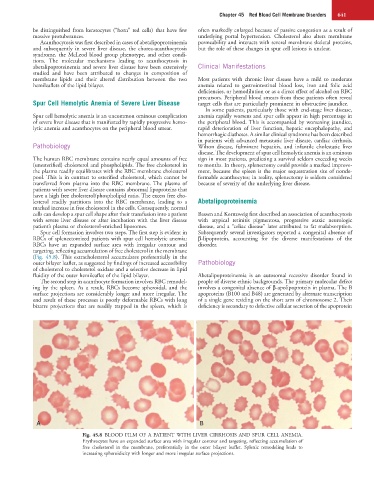
            targeting, reflecting accumulation of free cholesterol in the membrane
            (Fig.  45.8). This  extracholesterol  accumulates  preferentially  in  the
            outer bilayer leaflet, as suggested by findings of increased accessibility   Pathobiology
            of cholesterol to cholesterol oxidase and a selective decrease in lipid
            fluidity of the outer hemileaflet of the lipid bilayer.  Abetalipoproteinemia  is  an  autosomal  recessive  disorder  found  in
              The second step in acanthocyte formation involves RBC remodel-  people of diverse ethnic backgrounds. The primary molecular defect
            ing  by  the  spleen.  As  a  result,  RBCs  become  spheroidal,  and  the   involves a congenital absence of β-apolipoprotein in plasma. The B
            surface projections are considerably longer and more irregular. The   apoproteins (B100 and B48) are generated by alternate transcription
            end result of these processes is poorly deformable RBCs with long   of a single gene residing on the short arm of chromosome 2. Their
            bizarre projections that are readily trapped in the spleen, which is   deficiency is secondary to defective cellular secretion of the apoprotein


             A                                                    B
                            Fig. 45.8  BLOOD FILM OF A PATIENT WITH LIVER CIRRHOSIS AND SPUR CELL ANEMIA.
                            Erythrocytes have an expanded surface area with irregular contour and targeting, reflecting accumulation of
                            free  cholesterol  in  the  membrane,  preferentially  in  the  outer  bilayer  leaflet.  Splenic  remodeling  leads  to
                            increasing spheroidicity with longer and more irregular surface projections.

