


Page 757 - Hematology_ Basic Principles and Practice ( PDFDrive )
P. 757
644    Part V  Red Blood Cells


        LCAT deficiency should be distinguished from an acquired deficiency   preferentially intercalate into the inner half of the asymmetric lipid
        of this enzyme, which is found in patients with severe liver disease.  bilayer, expanding its surface area relative to that of the outer half of
                                                              the bilayer.
        Stomatocytosis and Related Disorders
                                                              Hereditary Stomatocytosis-Hydrocytosis
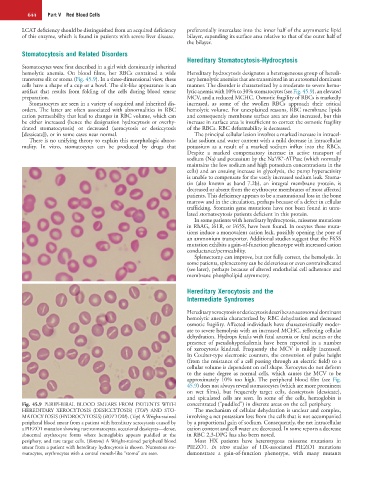
        Stomatocytes were first described in a girl with dominantly inherited
        hemolytic  anemia.  On  blood  films,  her  RBCs  contained  a  wide   Hereditary hydrocytosis designates a heterogeneous group of heredi-
        transverse slit or stoma (Fig. 45.9). In a three-dimensional view, these   tary hemolytic anemias that are transmitted in an autosomal dominant
        cells have a shape of a cup or a bowl. The slit-like appearance is an   manner. The disorder is characterized by a moderate to severe hemo-
        artifact  that  results  from  folding  of  the  cells  during  blood  smear   lytic anemia with 10% to 30% stomatocytes (see Fig. 45.9), an elevated
        preparation.                                          MCV, and a reduced MCHC. Osmotic fragility of RBCs is markedly
           Stomatocytes are seen in a variety of acquired and inherited dis-  increased,  as  some  of  the  swollen  RBCs  approach  their  critical
        orders. The  latter  are  often  associated  with  abnormalities  in  RBC   hemolytic volume. For unexplained reasons, RBC membrane lipids
        cation permeability that lead to changes in RBC volume, which can   and consequently membrane surface area are also increased, but this
        be either increased (hence the designation hydrocytosis or overhy-  increase in surface area is insufficient to correct the osmotic fragility
        drated  stomatocytosis)  or  decreased  (xerocytosis  or  desiccytosis   of the RBCs. RBC deformability is decreased.
        [dessicate]), or in some cases near normal.              The principal cellular lesion involves a marked increase in intracel-
           There is no unifying theory to explain this morphologic abnor-  lular sodium and water content with a mild decrease in intracellular
        mality.  In  vitro,  stomatocytes  can  be  produced  by  drugs  that   potassium  as  a  result  of  a  marked  sodium  influx  into  the  RBCs.
                                                              Despite  a  marked  compensatory  increase  in  active  transport  of
                                                                                           +
                                                                                             +
                                                              sodium (Na) and potassium by the Na /K -ATPase (which normally
                                                              maintains the low sodium and high potassium concentrations in the
                                                              cells) and an ensuing increase in glycolysis, the pump hyperactivity
                                                              is unable to compensate for the vastly increased sodium leak. Stoma-
                                                              tin  (also  known  as  band  7.2b),  an  integral  membrane  protein,  is
                                                              decreased or absent from the erythrocyte membranes of most affected
                                                              patients. This deficiency appears to be a maturational loss in the bone
                                                              marrow and in the circulation, perhaps because of a defect in cellular
                                                              trafficking. Stomatin gene mutations have not been found in unre-
                                                              lated stomatocytosis patients deficient in this protein.
                                                                 In some patients with hereditary hydrocytosis, missense mutations
                                                              in RhAG, I61R, or F65S, have been found. In oocytes these muta-
                                                              tions induce a monovalent cation leak, possibly opening the pore of
                                                              an ammonium transporter. Additional studies suggest that the F65S
                                                              mutation exhibits a gain-of-function phenotype with increased cation
                                                              conductance/permeability.
                                                                 Splenectomy can improve, but not fully correct, the hemolysis. In
                                                              some patients, splenectomy can be deleterious or even contraindicated
                                                              (see later), perhaps because of altered endothelial cell adherence and
                                                              membrane phospholipid asymmetry.
                                                              Hereditary Xerocytosis and the
                                                              Intermediate Syndromes

                                                              Hereditary xerocytosis or desiccytosis describes an autosomal dominant
                                                              hemolytic anemia characterized by RBC dehydration and decreased
                                                              osmotic fragility. Affected individuals have characteristically moder-
                                                              ate to severe hemolysis with an increased MCHC, reflecting cellular
                                                              dehydration. Hydrops fetalis with fetal anemia or fetal ascites or the
                                                              presence  of  pseudohyperkalemia  have  been  reported  in  a  number
                                                              of  xerocytosis  kindred.  Frequently  the  MCV  is  mildly  increased.
                                                              In Coulter-type electronic counters, the conversion of pulse height
                                                              (from the resistance of a cell passing through an electric field) to a
                                                              cellular volume is dependent on cell shape. Xerocytes do not deform
                                                              to  the  same  degree  as  normal  cells,  which  causes  the  MCV  to  be
                                                              approximately  10%  too  high. The  peripheral  blood  film  (see  Fig.
                                                              45.9) does not always reveal stomatocytes (which are more prominent
                                                              on  wet  films),  but  frequently  target  cells,  dessicytosis  (dessicate),
                                                              and  spiculated  cells  are  seen.  In  some  of  the  cells,  hemoglobin  is
        Fig.  45.9  PERIPHERAL  BLOOD  SMEARS  FROM  PATIENTS WITH   concentrated (“puddled”) in discrete areas on the cell periphery.
        HEREDITARY  XEROCYTOSIS  (DESICCYTOSIS)  (TOP)  AND  STO-  The mechanism of cellular dehydration is unclear and complex,
        MATOCYTOSIS (HYDROCYTOSIS) (BOTTOM). (Top) A Wright-stained   involving a net potassium loss from the cells that is not accompanied
        peripheral blood smear from a patient with hereditary xerocytosis caused by   by a proportional gain of sodium. Consequently, the net intracellular
        a PIEZO1 mutation showing rare stomatocytes, occasional dessicytes—dense,   cation content and cell water are decreased. In some reports a decrease
        abnormal  erythrocyte  forms  where  hemoglobin  appears  puddled  at  the   in RBC 2,3-DPG has also been noted.
        periphery, and rare target cells. (Bottom) A Wright-stained peripheral blood   Most  HX  patients  have  heterozygous  missense  mutations  in
        smear from a patient with hereditary hydrocytosis is shown. Numerous sto-  PIEZO1.  In  vitro  studies  of  HX-associated  PIEZO1  mutations
        matocytes, erythrocytes with a central mouth-like “stoma” are seen.   demonstrate  a  gain-of-function  phenotype,  with  many  mutants

