


Page 784 - Hematology_ Basic Principles and Practice ( PDFDrive )
P. 784
670    Part V  Red Blood Cells


        is occupational exposure. Symptoms are predominantly neurologic   ITPA  activity  and  accumulation  of  inosine  triphosphate  in  red
        and  nephrologic,  with  variable  degrees  of  anemia,  which  may  be   blood cells. The mechanism of this protective effect is not yet fully
        caused by a production defect combined with hemolysis. Relatively   understood.  The  anemia  in  patients  treated  with  ribavirin  may
        acute poisoning occurs when lead inadvertently finds its way into a   be  exacerbated  by  concomitant  treatment  with  pegylated  IFN,
        food source or is consumed as part of an exotic medication. Subacute   which  suppresses  hematopoiesis,  and  may  also  be  associated  with
        lead poisoning leads to central nervous system symptoms, hepatitis,   autoimmune  hemolytic  anemia.  Anemia  may  also  be  exacerbated
        nephrotoxicity, hypertension, and abdominal colic along with seizures   when ribavirin and IFN are used in combination with the protease
                                                                     25
        and severe hemolytic anemia. Physical examination may reveal a lead   inhibitor,  a regimen that is efficacious in the treatment of genotype
        line on the gums. Peripheral smear shows extensive coarse basophilic   1 disease.
        stippling and reticulocytosis; however, RBC morphology is not oth-
        erwise  characteristic.  Some  researchers  state  that  intravascular
        destruction occurs, but no proof has been provided. Bilirubin levels   DRUG-INDUCED OXIDATIVE HEMOLYSIS
        are not significantly elevated.
           The  diagnosis  of  lead-related  hemolysis  can  be  made  from  the   General Concepts
        history and findings on physical examination, which include a lead
        line on the gingiva and coarse basophilic stippling on RBCs, which   The potential for normal RBCs to undergo auto-oxidative destruc-
        reflects  the  pathologic  aggregation  of  ribosomes.  The  diagnosis  is   tion is great because the cell is loaded with 20-mM hemoglobin, most
        confirmed  by  measuring  blood  and  urine  lead  levels. The  level  of   of which is bonded to oxygen at the iron(II) atom in heme. The bond
        acuity determines the therapy.                        that allows the reversible association and dissociation of oxygen from
           The cause of the anemia is complex. Lead interferes with several   the heme moiety of hemoglobin involves partial transfer of an electron
        steps in heme synthesis, particularly those involving heme synthetase   from  iron(II)  to  oxygen. That  oxygen  then  has  an  extra  electron,
        and δ-aminolevulinic acid dehydratase (see Chapter 38). The inhibi-  which makes it a superoxide radical. Ordinarily, when oxygen leaves
        tion of heme synthetase probably accounts for the elevation in free   hemoglobin, it returns the electron. If it does not, a highly reactive
        erythrocyte  protoporphyrin,  which  provides  a  useful  corroborative   superoxide ion is released, leaving behind it an iron(III) moiety called
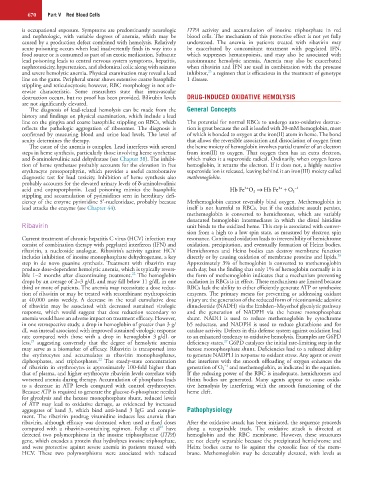
        diagnostic  test  for  lead  toxicity.  Inhibition  of  heme  synthesis  also   methemoglobin.
        probably accounts for the elevated urinary levels of δ-aminolevulinic
                                                                                 2+
                                                                                            3+
        acid  and  coproporphyrin.  Lead  poisoning  mimics  the  basophilic   Hb Fe O 2 → Hb Fe +  O 2 − 1
        stippling and accumulation of pyrimidines seen in hereditary defi-
        ciency of the enzyme pyrimidine 5′-nucleotidase, probably because   Methemoglobin cannot reversibly bind oxygen. Methemoglobin in
        lead attacks the enzyme (see Chapter 44).             itself is not harmful to RBCs, but if the oxidative assault persists,
                                                              methemoglobin  is  converted  to  hemichromes,  which  are  variably
                                                              denatured  hemoglobin  intermediates  in  which  the  distal  histidine
        Ribavirin                                             unit binds to the oxidized heme. This step is associated with conver-
                                                              sion from a high to a low spin state, as measured by electron spin
        Current treatment of chronic hepatitis C virus (HCV) infection may   resonance. Continued oxidation leads to irreversibility of hemichrome
        consist of combination therapy with pegylated interferon (IFN) and   oxidation, precipitation, and eventually formation of Heinz bodies.
        ribavirin,  a  nucleoside  analogue.  Ribavirin’s  activity  against  HCV   Hemichromes  and  Heinz  bodies  can  destroy  membrane  function
                                                                                                               26
        includes inhibition of inosine monophosphate dehydrogenase, a key   directly or by causing oxidation of membrane proteins and lipids.
        step  in  de  novo  guanine  synthesis.  Treatment  with  ribavirin  may   Approximately 3% of hemoglobin is converted to methemoglobin
        produce dose-dependent hemolytic anemia, which is typically revers-  each day, but the finding that only 1% of hemoglobin normally is in
                                            22
        ible  1–2  months  after  discontinuing  treatment.  The  hemoglobin   the form of methemoglobin indicates that a mechanism preventing
        drops by an average of 2–3 g/dL and may fall below 11 g/dL in one   oxidation in RBCs is in effect. These mechanisms are limited because
        third or more of patients. The anemia may necessitate a dose reduc-  RBCs lack the ability to either efficiently generate ATP or synthesize
        tion of ribavirin or may be treated with recombinant erythropoietin   enzymes. The primary means for preventing or addressing oxidant
        at  40,000  units  weekly.  A  decrease  in  the  total  cumulative  dose   injury are the generation of the reduced form of nicotinamide adenine
        of  ribavirin  may  be  associated  with  decreased  sustained  virologic   dinucleotide (NADH) via the Embden–Meyerhof glycolytic pathway
        response,  which  would  suggest  that  dose  reduction  secondary  to   and  the  generation  of  NADPH  via  the  hexose  monophosphate
        anemia would have an adverse impact on treatment efficacy. However,   shunt.  NADH  is  used  to  reduce  methemoglobin  by  cytochrome
        in one retrospective study, a drop in hemoglobin of greater than 3 g/  b5  reductase,  and  NADPH  is  used  to  reduce  glutathione  and  for
        dL was instead associated with improved sustained virologic response   catalase activity. Defects in this defense system against oxidation lead
        rate  compared  with  those  with  a  drop  in  hemoglobin  3 g/dL  or   to an enhanced tendency to oxidative hemolysis. Examples are G6PD
           23
                                                                          27
        less,   suggesting  conversely  that  the  degree  of  hemolytic  anemia   deficiency states.  G6PD catalyzes the initial rate-limiting step in the
        may serve as a biomarker of efficacy. Ribavirin is transported into   hexose monophosphate shunt. Deficiencies lead to a reduced ability
        the  erythrocytes  and  accumulates  as  ribavirin  monophosphates,   to generate NADPH in response to oxidant stress. Any agent or event
                                 22
        diphosphates,  and  triphosphates.   The  steady-state  concentration   that interferes with the smooth offloading of oxygen enhances the
                                                                          −1
        of  ribavirin  in  erythrocytes  is  approximately  100-fold  higher  than   generation of O 2  and methemoglobin, as indicated in the equation.
        that of plasma, and higher erythrocyte ribavirin levels correlate with   If the reducing power of the RBC is inadequate, hemichromes and
        worsened anemia during therapy. Accumulation of phosphates leads   Heinz  bodies  are  generated.  Many  agents  appear  to  cause  oxida-
        to  a  decrease  in  ATP  levels  compared  with  control  erythrocytes.   tive  hemolysis  by  interfering  with  the  smooth  functioning  of  the
        Because ATP is required to generate the glucose-6-phosphate needed   heme cleft.
        for glycolysis and the hexose monophosphate shunt, reduced levels
        of  ATP  may  lead  to  oxidative  damage,  as  evidenced  by  increased
        aggregates  of  band  3,  which  bind  anti-band  3  IgG  and  comple-  Pathophysiology
        ment. The  ribavirin  prodrug  viramidine  induces  less  anemia  than
        ribavirin, although efficacy was decreased when used at fixed doses   After the oxidative attack has been initiated, the sequence proceeds
                                                     24
        compared  with  a  ribavirin-containing  regimen.  Fellay  et al   have   along  a  recognizable  track.  The  oxidative  attack  is  directed  at
        detected  two  polymorphisms in  the  inosine triphosphatase  (ITPA)   hemoglobin  and  the  RBC  membrane.  However,  these  structures
        gene, which encodes a protein that hydrolyzes inosine triphosphate,   are not clearly separable because the precipitated hemichrome and
        and  were  protective  against  severe  anemia  in  patients  treated  with   Heinz  bodies  come  to  lie  against  the  cytosolic  face  of  the  mem-
        HCV.  These  two  polymorphisms  were  associated  with  reduced   brane.  Methemoglobin  may  be  detectably  elevated,  with  levels  as

