


Page 779 - Hematology_ Basic Principles and Practice ( PDFDrive )
P. 779
Chapter 47  Extrinsic Nonimmune Hemolytic Anemias  665


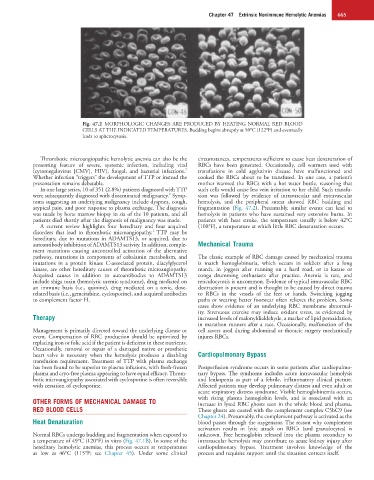
                            Fig. 47.2  MORPHOLOGIC CHANGES ARE PRODUCED BY HEATING NORMAL RED BLOOD
                            CELLS AT THE INDICATED TEMPERATURES. Budding begins abruptly at 50°C (122°F) and eventually
                            leads to spherocytosis.


              Thrombotic microangiopathic hemolytic anemia can also be the   circumstances, temperatures sufficient to cause heat denaturation of
            presenting  feature  of  severe,  systemic  infection,  including  viral   RBCs  have  been  generated.  Occasionally,  cell  warmers  used  with
                                                              7
            (cytomegalovirus  [CMV],  HIV),  fungal,  and  bacterial  infections.    transfusions  in  cold  agglutinin  disease  have  malfunctioned  and
            Whether infection “triggers” the development of TTP or instead the   cooked  the  RBCs  about  to  be  transfused.  In  one  case,  a  patient’s
            presentation remains debatable.                       mother warmed the RBCs with a hot water bottle, reasoning that
              In one large series, 10 of 351 (2.8%) patients diagnosed with TTP   such cells would cause less vein irritation to her child. Such transfu-
                                                        8
            were subsequently diagnosed with disseminated malignancy.  Symp-  sion  was  followed  by  evidence  of  intravascular  and  extravascular
            toms suggesting an underlying malignancy include dyspnea, cough,   hemolysis,  and  the  peripheral  smear  showed  RBC  budding  and
            atypical pain, and poor response to plasma exchange. The diagnosis   fragmentation  (Fig.  47.2).  Presumably,  similar  events  can  lead  to
            was made by bone marrow biopsy in six of the 10 patients, and all   hemolysis  in  patients  who  have  sustained  very  extensive  burns.  In
            patients died shortly after the diagnosis of malignancy was made.  patients  with  heat  stroke,  the  temperature  usually  is  below  42°C
              A  current  review  highlights  four  hereditary  and  four  acquired   (108°F), a temperature at which little RBC denaturation occurs.
                                                   2
            disorders  that  lead  to  thrombotic  microangiopathy.  TTP  may  be
            hereditary,  due  to  mutations  in  ADAMTS13,  or  acquired,  due  to
            autoantibody inhibition of ADAMTS13 activity. In addition, comple-  Mechanical Trauma
            ment  mutations  causing  uncontrolled  activation  of  the  alternative
            pathway, mutations in components of cobalamin metabolism, and   The classic example of RBC damage caused by mechanical trauma
            mutations  in  a  protein  kinase  C-associated  protein,  diacylglycerol   is  march  hemoglobinuria,  which  occurs  in  soldiers  after  a  long
            kinase, are other hereditary causes of thrombotic microangiopathy.   march,  in  joggers  after  running  on  a  hard  road,  or  in  karate  or
            Acquired  causes  in  addition  to  autoantibodies  to  ADAMTS13   conga  drumming  enthusiasts  after  practice.  Anemia  is  rare,  and
            include shiga toxin (hemolytic uremic syndrome), drug mediated on   reticulocytosis is uncommon. Evidence of typical intravascular RBC
            an  immune  basis  (i.e.,  quinine),  drug  mediated  on  a  toxic,  dose-  destruction is present and is thought to be caused by direct trauma
            related basis (i.e., gemcitabine, cyclosporine), and acquired antibodies   to  RBCs  in  the  vessels  of  the  feet  or  hands.  Switching  jogging
            to complement factor H.                               paths or wearing better footwear often relieves the problem. Some
                                                                  cases  show  evidence  of  an  underlying  RBC  membrane  abnormal-
                                                                  ity.  Strenuous  exercise  may  induce  oxidant  stress,  as  evidenced  by
            Therapy                                               increased levels of malonyldialdehyde, a marker of lipid peroxidation,
                                                                  in marathon runners after a race. Occasionally, malfunction of the
            Management is primarily directed toward the underlying disease or   cell savers used during abdominal or thoracic surgery mechanically
            event. Compensation of RBC production should be optimized by   injures RBCs.
            replacing iron or folic acid if the patient is deficient in these nutrients.
            Occasionally,  removal  or  repair  of  a  damaged  native  or  prosthetic
            heart  valve  is  necessary  when  the  hemolysis  produces  a  disabling   Cardiopulmonary Bypass
            transfusion  requirement. Treatment  of TTP  with  plasma  exchange
            has been found to be superior to plasma infusions, with fresh-frozen   Postperfusion syndrome occurs in some patients after cardiopulmo-
            plasma and cryo-free plasma appearing to have equal efficacy. Throm-  nary  bypass. The  syndrome  includes  acute  intravascular  hemolysis
            botic microangiopathy associated with cyclosporine is often reversible   and  leukopenia  as  part  of  a  febrile,  inflammatory  clinical  picture.
            with cessation of cyclosporine.                       Affected patients may develop pulmonary distress and even adult or
                                                                  acute respiratory distress syndrome. Visible hemoglobinemia occurs,
            OTHER FORMS OF MECHANICAL DAMAGE TO                   with  rising  plasma  hemoglobin  levels,  and  is  associated  with  an
                                                                  increase in lysed RBC ghosts seen in the whole blood and plasma.
            RED BLOOD CELLS                                       These ghosts are coated with the complement complex C5bC9 (see
                                                                  Chapter 24). Presumably, the complement pathway is activated as the
            Heat Denaturation                                     blood passes through the oxygenator. The reason why complement
                                                                  activation  results  in  lytic  attack  on  RBCs  (and  granulocytes)  is
            Normal RBCs undergo budding and fragmentation when exposed to   unknown.  Free  hemoglobin  released  into  the  plasma  secondary  to
            a temperature of 49°C (120°F) in vitro (Fig. 47.1B). In some of the   intravascular hemolysis may contribute to acute kidney injury after
            hereditary  hemolytic  anemias,  this  process  occurs  at  temperatures    cardiopulmonary  bypass.  Treatment  involves  knowledge  of  the
            as  low  as  46°C  (115°F;  see  Chapter  45).  Under  some  clinical   process and requisite support until the situation corrects itself.

