


Page 781 - Hematology_ Basic Principles and Practice ( PDFDrive )
P. 781
Chapter 47  Extrinsic Nonimmune Hemolytic Anemias  667


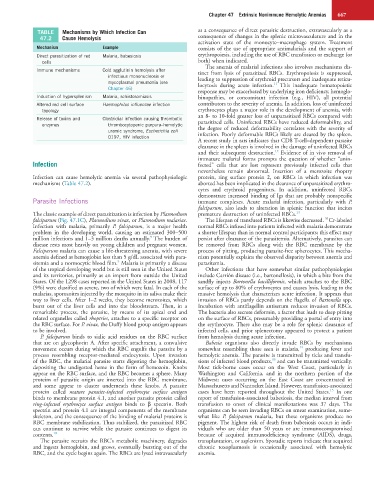
             TABLE   Mechanisms by Which Infection Can            as a consequence of direct parasitic destruction, extravascularly as a
              47.2   Cause Hemolysis                              consequence of changes in the splenic microvasculature and in the
                                                                  activation  state  of  the  monocyte–macrophage  system.  Treatment
             Mechanism             Example                        consists of the use of appropriate antimalarials and the support of
             Direct parasitization of red   Malaria, babesiosis   erythropoiesis, including the use of RBC transfusion or exchange (or
               cells                                              both) when indicated.
                                                                    The anemia of malarial infections also involves mechanisms dis-
             Immune mechanisms     Cold agglutinin hemolysis after   tinct  from  lysis  of  parasitized  RBCs.  Erythropoiesis  is  suppressed,
                                    infectious mononucleosis or   leading to suppression of erythroid precursors and inadequate reticu-
                                    mycoplasmal pneumonia (see    locytosis  during  acute  infection.   This  inadequate  hematopoietic
                                                                                           11
                                    Chapter 46)
                                                                  response may be exacerbated by underlying iron deficiency, hemoglo-
             Induction of hypersplenism  Malaria, schistosomiasis  binopathies,  or  concomitant  infection  (e.g.,  HIV),  all  potential
             Altered red cell surface   Haemophilus influenzae infection  contributors to the severity of anemia. In addition, loss of uninfected
               topology                                           erythrocytes plays a major role in the development of anemia, with
                                                                  an 8- to 10-fold greater loss of unparasitized RBCs compared with
             Release of toxins and   Clostridial infection causing thrombotic   parasitized cells. Uninfected RBCs have reduced deformability, and
               enzymes              thrombocytopenic purpura–hemolytic   the degree of reduced deformability correlates with the severity of
                                    uremic syndrome, Escherichia coli   infection. Poorly deformable RBCs likely are cleared by the spleen.
                                    0197, HIV infection
                                                                  A recent study in rats indicates that CD8 T-cell–dependent parasite
                                                                  clearance in the spleen is involved in the damage of uninfected RBCs
                                                                                           12
                                                                  and their subsequent destruction.  Evidence of in vivo removal of
                                                                  immature  malarial  forms  prompts  the  question  of  whether  “unin-
            Infection                                             fected”  cells  that  are  lost  represent  previously  infected  cells  that
                                                                  nevertheless  remain  abnormal.  Insertion  of  a  merozoite  rhoptry
            Infection  can  cause  hemolytic  anemia  via  several  pathophysiologic   protein,  ring  surface  protein  2,  on  RBCs  in  which  infection  was
            mechanisms (Table 47.2).                              aborted has been implicated in the clearance of unparasitized erythro-
                                                                  cytes  and  erythroid  progenitors.  In  addition,  uninfected  RBCs
                                                                  demonstrate increased binding of Igs that are probably nonspecific
            Parasite Infections                                   immune  complexes.  Acute  malarial  infection,  particularly  with  P.
                                                                  falciparum,  also  leads  to  alteration  in  splenic  function  that  incites
            The classic example of direct parasitization is infection by Plasmodium   premature destruction of uninfected RBCs. 13
                                                                                                           51
            falciparum (Fig. 47.1C), Plasmodium vivax, or Plasmodium malariae.   The lifespan of transfused RBCs is likewise decreased.  Cr-labeled
            Infection  with  malaria,  primarily  P.  falciparum,  is  a  major  health   normal RBCs infused into patients infected with malaria demonstrate
            problem  in  the  developing  world,  causing  an  estimated  300–500   a shorter lifespan than in normal control participants; this effect may
                                                  9
            million infections and 1–3 million deaths annually.  The burden of   persist after clearance of the parasitemia. Alternatively, parasites can
            disease rests most heavily on young children and pregnant women.   be  removed  from  RBCs  along  with  the  RBC  membrane  by  the
            Falciparum malaria can cause a life-threatening anemia, with severe   process of pitting, producing parasite-free spherocytes. This mecha-
            anemia defined as hemoglobin less than 5 g/dL associated with para-  nism potentially explains the observed disparity between anemia and
                                       9
            sitemia and a normocytic blood film.  Malaria is primarily a disease   parasitemia.
            of the tropical developing world but is still seen in the United States   Other  infections  that  have  somewhat  similar  pathophysiologies
            and its territories, primarily as an import from outside the United   include Carrión disease (i.e., bartonellosis), in which a bite from the
            States. Of the 1298 cases reported in the United States in 2008, 117   sandfly  injects  Bartonella  bacilliformis,  which  attaches  to  the  RBC
            (9%) were classified as severe, two of which were fatal. In each of the   surface of up to 80% of erythrocytes and causes lysis, leading to the
            malarias, sporozoites injected by the mosquito in its saliva make their   massive hemolysis that characterizes acute infection. It appears that
            way to liver cells. After 1–2 weeks, they become merozoites, which   invasion of RBCs partly depends on the flagella of Bartonella spp.
            burst  out  of  the  liver  cells  and  into  the  bloodstream. Then,  in  a   Incubation  with antiflagellin antiserum reduces  invasion  of RBCs.
            remarkable  process,  the  parasite,  by  means  of  its  apical  end  and   The bacteria also secrete deformin, a factor that leads to deep pitting
            related organelles called rhoptries, attaches to a specific receptor on   on the surface of RBCs, presumably providing a portal of entry into
            the RBC surface. For P. vivax, the Duffy blood group antigen appears   the  erythrocyte. There  also  may  be  a  role  for  splenic  clearance  of
            to be involved.                                       infected cells, and prior splenectomy appeared to protect a patient
              P.  falciparum  binds  to  sialic  acid  residues  on  the  RBC  surface   from hemolysis during acute infection.
            that are  on  glycophorin A.  After  specific  attachment, a  convulsive   Babesia  organisms  also  directly  invade  RBCs  by  mechanisms
                                                                                                   14
            movement occurs during which the RBC engulfs the parasite by a   somewhat  resembling  those  seen  is  malaria,   producing  fever  and
            process  resembling  receptor-mediated  endocytosis.  Upon  invasion   hemolytic anemia. The parasite is transmitted by ticks and transfu-
                                                                                          15
            of the RBC, the malarial parasite starts digesting the hemoglobin,   sions of infected blood products,  and can be transmitted vertically.
            depositing  the  undigested  heme  in  the  form  of  hemozoin.  Knobs   Most  tick-borne  cases  occur  on  the  West  Coast,  particularly  in
            appear on the RBC surface, and the RBC becomes a sphere. Many   Washington  and  California,  and  in  the  northern  portion  of  the
            proteins  of  parasitic  origin  are  inserted  into  the  RBC  membrane,   Midwest;  cases  occurring  on  the  East  Coast  are  concentrated  in
            and  some  appear  to  cluster  underneath  these  knobs.  A  parasite   Massachusetts and Nantucket Island. However, transfusion-associated
                                                                                                             15
            protein  called  mature  parasite-infected  erythrocyte  surface  antigen   cases  have  been  reported  throughout  the  United  States.   In  one
            binds to membrane protein 4.1, and another parasite protein called   report of transfusion-associated babesiosis, the median interval from
            ring-infected  erythrocyte  surface  antigen  binds  to  β  spectrin.  Both   transfusion  to  onset  of  clinical  manifestations  was  37  days.  The
            spectrin and protein 4.1 are integral components of the membrane   organisms can be seen invading RBCs on smear examination, some-
            skeleton, and the consequence of the binding of malarial proteins is   what  like  P.  falciparum  malaria,  but  these  organisms  produce  no
            RBC membrane stabilization. Thus stabilized, the parasitized RBC   pigment. The highest risk of death from babesiosis occurs in indi-
            can  continue  to  survive  while  the  parasite  continues  to  digest  its     viduals  who  are  older  than  50  years  or  are  immunocompromised
            contents. 10                                          because  of  acquired  immunodeficiency  syndrome  (AIDS),  drugs,
              The  parasite  recruits  the  RBC’s  metabolic  machinery,  degrades   transplantation, or asplenism. Sporadic reports indicate that acquired
            and ingests hemoglobin, and grows, eventually bursting out of the   chronic  toxoplasmosis  is  occasionally  associated  with  hemolytic
            RBC, and the cycle begins again. The RBCs are lysed intravascularly   anemia.

