


Page 780 - Hematology_ Basic Principles and Practice ( PDFDrive )
P. 780
666    Part V  Red Blood Cells

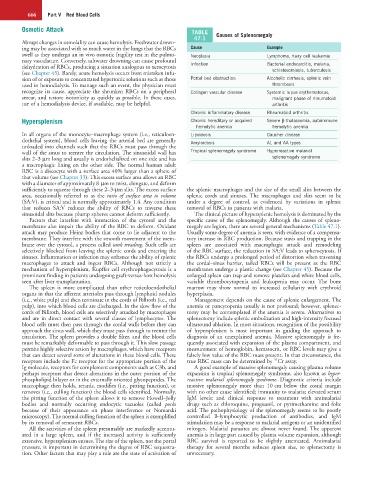
        Osmotic Attack                                          TABLE
                                                                47.1    Causes of Splenomegaly
        Abrupt changes in osmolality can cause hemolysis. Freshwater drown-
        ing may be associated with so much water in the lungs that the RBCs   Cause     Example
        swell as they undergo an in vivo osmotic fragility test in the pulmo-  Neoplasia  Lymphoma, hairy cell leukemia
        nary vasculature. Conversely, saltwater drowning can cause profound
        dehydration of RBCs, producing a situation analogous to xerocytosis   Infection  Bacterial endocarditis, malaria,
        (see Chapter 45). Rarely, acute hemolysis occurs from mistaken infu-              schistosomiasis, tuberculosis
        sion of or exposure to concentrated hypertonic solutions such as those   Portal bed obstruction  Alcoholic cirrhosis, splenic vein
        used in hemodialysis. To manage such an event, the physician must                 thrombosis
        recognize its cause, appreciate the shrunken RBCs on a peripheral   Collagen vascular disease  Systemic lupus erythematosus,
        smear, and restore isotonicity as quickly as possible. In these cases,            malignant phase of rheumatoid
        use of a hemodialysis device, if available, may be helpful.                       arthritis
                                                               Chronic inflammatory disease  Rheumatoid arthritis
        Hypersplenism                                          Chronic hereditary or acquired   Severe β-thalassemia, autoimmune
                                                                 hemolytic anemia         hemolytic anemia
        In all organs of the monocyte–macrophage system (i.e., reticuloen-  Lipoidosis  Gaucher disease
        dothelial system), blood  cells leaving the  arterial bed are  generally   Amyloidosis  AL and AA types
        unloaded into channels such that the RBCs must pass through the
        wall of the sinus to reenter the circulation. The sinusoidal wall has   Tropical splenomegaly syndrome  Hyperreactive malarial
        slits 2–3 µm long and usually is endothelialized on one side and has              splenomegaly syndrome
        a macrophagic lining on the other side. The normal human adult
        RBC is a discocyte with a surface area 40% larger than a sphere of
        that volume (see Chapter 33). This excess surface area allows an RBC
        with a diameter of approximately 8 µm to twist, elongate, and deform
        sufficiently to squeeze through these 2–3-µm slits. The excess surface   the splenic macrophages and the size of the small slits between the
        area,  occasionally  referred  to  as  the  ratio  of  surface  area  to  volume   splenic  cords  and  sinuses.  The  macrophages  and  slits  seem  to  be
        (SA:V), is critical and is normally approximately 1.4. Any condition   under  a  degree  of  control,  as  evidenced  by  variations  in  splenic
        that  reduces  SA:V  reduces  the  ability  of  RBCs  to  traverse  these   removal of RBCs in patients with malaria.
        sinusoidal slits because plump spheres cannot deform sufficiently.  The clinical picture of hypersplenic hemolysis is dominated by the
           Factors  that  interfere  with  interaction  of  the  cytosol  and  the   specific cause of the splenomegaly. Although the causes of spleno-
        membrane also impair the ability of the RBC to deform. Oxidant   megaly are legion, there are several general mechanisms (Table 47.1).
        attack may produce Heinz bodies that come to lie adjacent to the   Usually some degree of anemia is seen, with evidence of a compensa-
        membrane. They interfere with the smooth movement of the mem-  tory increase in RBC production. Because stasis and trapping in the
        brane over the cytosol, a process called tank treading. Such cells are   spleen  are  associated  with  macrophagic  attack  and  remodeling
        selectively blocked from leaving the splenic cords and entering the   of the RBC surface, the reduction in SA:V leads to spherocytosis. If
        sinuses. Inflammation or infection may enhance the ability of splenic   the RBCs undergo a prolonged period of distortion when traversing
        macrophages  to  attack  and  ingest  RBCs.  Although  not  strictly  a   the  cordal–sinus  barrier,  tailed  RBCs  will  be  present  as  the  RBC
        mechanism of hypersplenism, Kupffer cell erythrophagocytosis is a   membranes undergo a plastic change (see Chapter 45). Because the
        prominent finding in patients undergoing graft-versus-host hemolysis   enlarged spleen can trap and remove platelets and white blood cells,
        seen after liver transplantation.                     variable  thrombocytopenia  and  leukopenia  may  occur.  The  bone
           The  spleen  is  more  complicated  than  other  reticuloendothelial   marrow  may  show  normal  to  increased  cellularity  with  erythroid
        organs in that the afferent arterioles pass through lymphoid nodules   hyperplasia.
        (i.e., white pulp) and then terminate in the cords of Billroth (i.e., red   Management depends on the cause of splenic enlargement. The
        pulp), into which blood cells are discharged. In the slow flow of the   anemia or pancytopenia usually is not profound; however, splenec-
        cords of Billroth, blood cells are selectively attacked by macrophages   tomy may be contemplated if the anemia is severe. Alternatives to
        and  are  in  direct  contact  with  several  classes  of  lymphocytes. The   splenectomy include splenic embolization and high-intensity focused
        blood cells must then pass through the cordal walls before they can   ultrasound ablation. In most situations, recognition of the possibility
        approach the sinus wall, which they must pass through to reenter the   of  hypersplenism  is  most  important  in  guiding  the  approach  to
        circulation. The spleen provides a double filter, and the blood cells   diagnosis  of  an  unexplained  anemia.  Massive  splenomegaly  is  fre-
        must be remarkably deformable to pass through it. This slow passage   quently associated with expansion of the plasma compartment, and
        permits highly selective action by macrophages, which have receptors   measurement of hemoglobin, hematocrit, or RBC levels may give a
        that can detect several sorts of alterations in these blood cells. These   falsely low value of the RBC mass present. In that circumstance, the
                                                                                           51
        receptors include the Fc receptor for the appropriate portion of the   true RBC mass can be determined by  Cr assay.
        Ig molecule, receptors for complement components such as C3b, and   A good example of massive splenomegaly causing plasma volume
        perhaps receptors that detect alterations in the outer portion of the   expansion is tropical splenomegaly syndrome, also known as hyper-
        phospholipid bilayer or in the externally oriented glycopeptides. The   reactive  malarial  splenomegaly  syndrome.  Diagnostic  criteria  include
        macrophage then holds, retards, modifies (i.e., pitting function), or   massive  splenomegaly  more  than  10 cm  below  the  costal  margin
        removes (i.e., culling function) the blood cells identified. Normally,   with no other cause identified; immunity to malaria; elevated serum
        the pitting function of the spleen allows it to remove Howell–Jolly   IgM  levels;  and  clinical  response  to  treatment  with  antimalarial
        bodies  and  normally  occurring  endocytic  vacuoles  (called  pocks   drugs  such  as  chloroquine,  proguanil,  or  pyrimethamine  and  folic
        because  of  their  appearance  on  phase  interference  or  Nomarski   acid. The pathophysiology of the splenomegaly seems to be poorly
        microscopy). The normal culling function of the spleen is exemplified   controlled  B-lymphocytic  production  of  antibodies,  and  IgM
        by its removal of senescent RBCs.                     stimulation may be a response to malarial antigens or an unidentified
           All the activities of the spleen presumably are markedly accentu-  mitogen.  Malarial  parasites  are  almost  never  found. The  apparent
        ated  in  a  large  spleen,  and  if  the  increased  activity  is  sufficiently   anemia is in large part caused by plasma volume expansion, although
        extensive, hypersplenism ensues. The size of the spleen, not the portal   RBC  survival  is  reported  to  be  slightly  attenuated.  Antimalarial
        pressure, is important in determining the degree of RBC sequestra-  therapy  for  several  months  reduces  spleen  size,  so  splenectomy  is
        tion. Other factors that may play a role are the state of activation of   unnecessary.

