


Page 82 - Hematology_ Basic Principles and Practice ( PDFDrive )
P. 82
54    Part I  Molecular and Cellular Basis of Hematology


        concomitant release of the GPI signal peptide. The GPI attachment   the CNX/CRT chaperone system. In a number of cases retrotranslo-
        promotes membrane association.                        cation  appears  to  require  reduction  of  disulfide  bridges  by  PDI.
                                                              Similarly, BiP association with substrates (e.g., unassembled immu-
        Destruction of Misfolded or Misassembled              noglobulin  light  chains)  can  direct  them  to  ERAD.  If  a  protein
        Proteins: Endoplasmic-Reticulum Associated            remains in its unfolded state for an extended period of time, trim-
                                                              ming of the Man 8GlcNac 2 also occurs. This processing is catalyzed
        Degradation (ERAD)                                    by ER-degradation enhancer mannosidase α-like proteins EDEM1,
                                                              EDEM2, EDEM3 (Htm1p in yeast). The current model postulates
        In the ER, proteins undergo a so-called quality control, which ensures   that N-glycan structure generated by extensive demannosylation is
        that only correctly folded proteins exit the ER. Consequently, mis-  the  signal  for  glycoprotein  degradation.  ER-resident  lectins  (OS-9
        folded proteins are extracted from the ER folding environment for   and XTP3-B) bind to the remaining mannose residues and assist the
        disposal.  This  mode  of  degradation  is  referred  to  as  endoplasmic   retrotranslocation.
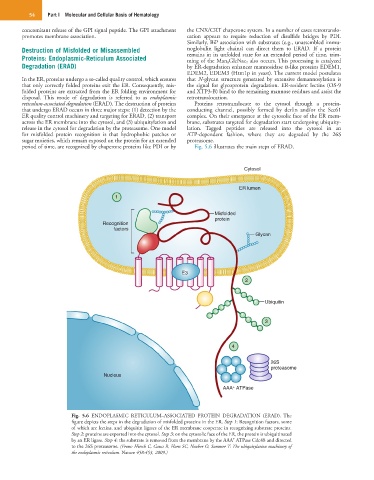
        reticulum-associated degradation (ERAD). The destruction of proteins   Proteins  retrotranslocate  to  the  cytosol  through  a  protein-
        that undergo ERAD occurs in three major steps: (1) detection by the   conducting  channel,  possibly  formed  by  derlin  and/or  the  Sec61
        ER quality control machinery and targeting for ERAD, (2) transport   complex. On their emergence at the cytosolic face of the ER mem-
        across the ER membrane into the cytosol, and (3) ubiquitylation and   brane, substrates targeted for degradation start undergoing ubiquity-
        release in the cytosol for degradation by the proteasome. One model   lation.  Tagged  peptides  are  released  into  the  cytosol  in  an
        for  misfolded  protein  recognition  is  that  hydrophobic  patches  or   ATP-dependent  fashion,  where  they  are  degraded  by  the  26S
        sugar moieties, which remain exposed on the protein for an extended   proteasome.
        period of time, are recognized by chaperone proteins like PDI or by   Fig. 5.6 illustrates the main steps of ERAD.


                                                                                 Cytosol


                                                                               ER lumen
                                       1

                                                                       Misfolded
                                                                       protein
                                   Recognition
                                      factors
                                                                                     Glycan


                                                            E3
                                                                                 2


                                                                                        Ubiquitin


                                                                                        3


                                                                             4

                                                                                          26S
                                                                                          proteasome
                                   Nucleus
                                                                             +
                                                                          AAA  ATPase


                        Fig.  5.6  ENDOPLASMIC  RETICULUM–ASSOCIATED  PROTEIN  DEGRADATION  (ERAD).  The
                        figure depicts the steps in the degradation of misfolded proteins in the ER. Step 1: Recognition factors, some
                        of which are lectins, and ubiquitin ligases of the ER membrane cooperate in recognizing substrate proteins.
                        Step 2: proteins are exported into the cytosol. Step 3: on the cytosolic face of the ER, the protein is ubiquitinated
                                                                             +
                        by an ER ligase. Step 4: the substrate is removed from the membrane by the AAA  ATPase Cdc48 and directed
                        to the 26S proteasome. (From: Hirsch C, Gauss R, Horn SC, Neuber O, Sommer T: The ubiquitylation machinery of
                        the endoplasmic reticulum. Nature 458:453, 2009.)

