


Page 79 - Hematology_ Basic Principles and Practice ( PDFDrive )
P. 79
Chapter 5  Protein Synthesis, Processing, and Trafficking  51


            COTRANSLATIONAL PROTEIN TRANSLOCATION INTO            to the cell surface. In contrast, proteins that have specific targeting
                                                                  signals may be localized to the lumen of the ER, the Golgi compart-
            THE ENDOPLASMIC RETICULUM                             ment, or lysosomes. Other proteins that reside in membranes of the
                                                                  cell contain topologic sequences called transmembrane domains that
            The ER is an extensive membranous network that is continuous with   consist of ~20 largely apolar amino acids. When a transmembrane
            the outer nuclear membrane and is the site for the synthesis of the   domain  enters  the  translocon,  the  polypeptide  is  released  laterally
            massive amounts of lipid and protein used to build the membranes   from the Sec61 channel into the lipid bilayer. Membrane proteins
            of most cellular organelles. The ER comprises three interconnected   can assume different topologies according to the number and type of
            domains: rough ER, smooth ER, and ER exit sites. The rough ER is   TM domains.
            so called because it is studded with bound ribosomes that are actively
            synthesizing proteins. Cells specialized in protein secretion, such as
            cells of the exocrine glands and plasma cells are rich in rough ER.   PROTEIN TRAFFICKING WITHIN THE
            The smooth ER lacks ribosomes, is not very abundant in most cells   SECRETORY PATHWAY
            (except hepatocytes), and is thought to be the site of lipid biosynthesis
            and of cytochrome P450–mediated detoxification reactions. Finally,   Proteins  that  enter  the  ER  are  transported  towards  the  plasma
            ER exit sites are specialized areas of the ER membrane where transport   membrane through the secretory pathway (Fig. 5.4). Specific signals
            cargo  is  packaged  into  transport  vesicles  en  route  to  the  Golgi   cause resident proteins to be retained in the ER, Golgi or plasma
            apparatus.                                            membrane. Proteins may also be targeted from the Golgi compart-
              Nascent  secretory  proteins  are  marked  for  translocation  into   ment to lysosomes or from the plasma membrane to endosomes (see
            the ER by the presence of an amino-terminal signal sequence (see   Fig. 5.4, pathways 8 and 9). Initially the study of this complex protein
            Table 5.1). This sequence has a length of about 15–30 amino acids   trafficking  took  advantage  of  the  use  of  yeast  genetics  to  isolate
            and  displays  no  conservation  of  amino  acid  sequence,  although  it   temperature-sensitive  mutants  (sec)  that  were  defective  at  different
            contains a hydrophobic core flanked by polar residues that prefer-  stages of the secretory pathway. The subsequent characterization of
            entially have a short side chain in proximity to the cleavage site. As   SEC genes, thanks to the advent of DNA recombinant techniques,
            the signal sequence emerges from the ribosome, it is recognized by   made possible the isolation of the counterparts in mammalian cells
            the signal recognition particle (SRP), a ribonucleoprotein, and this   and  the  beginning  of  molecular  and  biochemical  investigation  of
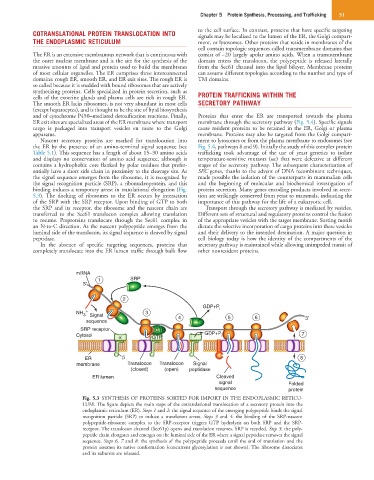
            binding induces a temporary arrest in translational elongation (Fig.   protein secretion. Many genes encoding products involved in secre-
            5.3).  The  docking  of  ribosomes  to  the  ER  occurs  by  interaction   tion are strikingly conserved from yeast to mammals, indicating the
            of the SRP with the SRP receptor. Upon binding of GTP to both   importance of this pathway for the life of a eukaryotic cell.
            the  SRP  and  its  receptor,  the  ribosome  and  the  nascent  chain  are   Transport through the secretory pathway is mediated by vesicles.
            transferred  to  the  Sec61  translocon  complex  allowing  translation   Different sets of structural and regulatory proteins control the fusion
            to  resume.  Preproteins  translocate  through  the  Sec61  complex  in   of the appropriate vesicles with the target membrane. Sorting motifs
            an N-to-C direction. As the nascent polypeptide emerges from the   dictate the selective incorporation of cargo proteins into these vesicles
            luminal side of the translocon, its signal sequence is cleaved by signal     and their delivery to the intended destination. A major question in
            peptidase.                                            cell biology today is how the identity of the compartments of the
              In  the  absence  of  specific  targeting  sequences,  proteins  that   secretory pathway is maintained while allowing unimpeded transit of
            completely translocate into the ER lumen traffic through bulk flow   other nonresident proteins.


                          mRNA
                                 1          SRP
                            5′

                                         2
                                                                   GDP+P i
                             +
                          NH 3 Signal            3
                             sequence                      4                5       6                3′
                           SRP receptor             GTP
                          Cytosol       α          GTP              GDP+P i                         7


                             ER          β                                                         8
                          membrane         Translocon  Translocon  Signal
                                            (closed)   (open)  peptidase
                               ER lumen                                 Cleaved
                                                                         signal                Folded
                                                                       sequence                protein
                            Fig. 5.3  SYNTHESIS OF PROTEINS SORTED FOR IMPORT IN THE ENDOPLASMIC RETICU-
                            LUM. The figure depicts the main steps of the cotranslational translocation of a secretory protein into the
                            endoplasmic reticulum (ER). Steps 1 and 2: the signal sequence of the emerging polypeptide binds the signal
                            recognition  particle  (SRP)  to  induce  a  translation  arrest.  Steps  3  and  4:  the  binding  of  the  SRP-nascent
                            polypeptide-ribosome  complex  to  the  SRP-receptor  triggers  GTP  hydrolysis  on  both  SRP  and  the  SRP-
                            receptor. The translocon channel (Sec61p) opens and translation resumes. SRP is recycled. Step 5: the poly-
                            peptide chain elongates and emerges on the luminal side of the ER where a signal peptidase removes the signal
                            sequence. Steps 6, 7 and 8: the synthesis of the polypeptide proceeds until the end of translation and the
                            protein assumes its native conformation (concurrent glycosylation is not shown). The ribosome dissociates
                            and its subunits are released.

