


Page 77 - Hematology_ Basic Principles and Practice ( PDFDrive )
P. 77
Chapter 5  Protein Synthesis, Processing, and Trafficking  49


                                                                            Outer nuclear
                                                                               membrane
                                                  Ribosomes                 Inner nuclear
                                     mRNA                                     membrane                Nucleus
                                                                               Nuclear
                                                                                  pore
                                       1                          5
                   mRNA
                                                   Cytosol
                                  ER signal                                              8
                                  sequence
                          2                                               6                              Membrane
                                                         Cytosolic                            9
                                                           protein          Targeting                    Matrix
                                                                            sequence
                                     Rough ER                                                    Peroxisome
                                                                   Intermembrane
                                                         Outer        space           7
                                                      membrane
                                                      Matrix
                                                       Inner
                       3                           membrane
                                                                  Mitochondrion


                                    Golgi apparatus


                      4a                        4b

                   Plasma membrane           Lysosome

                               Secretory pathway
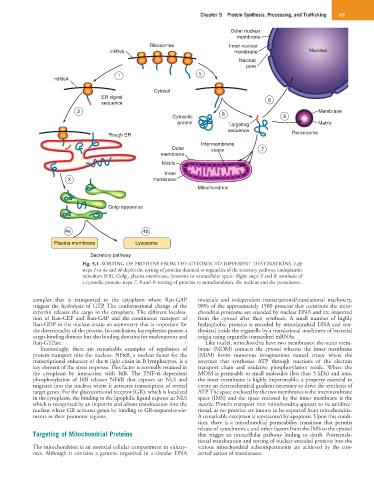
                            Fig. 5.1  SORTING OF PROTEINS FROM THE CYTOSOL TO DIFFERENT DESTINATIONS. Left:
                            steps 1 to 4a and 4b depict the sorting of proteins destined to organelles of the secretory pathway, endoplasmic
                            reticulum (ER), Golgi, plasma membrane, lysosome or extracellular space. Right: steps 5 and 6: synthesis of
                            a cytosolic protein; steps 7, 8 and 9: sorting of proteins to mitochondrion, the nucleus and the peroxisome.

            complex  that  is  transported  to  the  cytoplasm  where  Ran-GAP   molecule  and  independent  transcriptional/translational  machinery,
            triggers  the  hydrolysis  of  GTP. The  conformational  change  of  the   98% of the approximately 1500 proteins that constitute the mito-
            exportin releases the cargo in the cytoplasm. The different localiza-  chondrial proteome are encoded by nuclear DNA and are imported
            tion  of  Ran-GEF  and  Ran-GAP  and  the  continuous  transport  of   from  the  cytosol  after  their  synthesis.  A  small  number  of  highly
            Ran-GDP in the nucleus create an asymmetry that is important for   hydrophobic proteins is encoded by mitochondrial DNA and syn-
            the directionality of the process. In conclusion, karyopherins possess a   thesized inside the organelle by a translational machinery of bacterial
            cargo-binding domain but also binding domains for nucleoporins and     origin using organelle-transcribed mRNAs.
            Ran-GTPase.                                             Like nuclei, mitochondria have two membranes: the outer mem-
              Interestingly,  there  are  remarkable  examples  of  regulation  of   brane  (MOM)  contacts  the  cytosol  whereas  the  inner  membrane
            protein transport into the nucleus. NFκB, a nuclear factor for the   (MIM)  forms  numerous  invaginations  named  cristae  where  the
            transcriptional enhancer of the κ light chain in B lymphocytes, is a   enzymes  that  synthesize  ATP  through  reactions  of  the  electron
            key element of the stress response. This factor is normally retained in   transport  chain  and  oxidative  phosphorylation  reside.  Where  the
            the  cytoplasm  by  interaction  with  IκB.  The  TNF-α  dependent   MOM is permeable to small molecules (less than 5 kDa) and ions,
            phosphorylation  of  IκB  releases  NFκB  that  exposes  an  NLS  and   the inner membrane is highly impermeable, a property essential to
            migrates into the nucleus where it activates transcription of several   create an electrochemical gradient necessary to drive the synthesis of
            target genes. For the glucocorticoid receptor (GR), which is localized   ATP. The space enclosed by the two membranes is the intermembrane
            in the cytoplasm, the binding to the lipophilic ligand exposes an NLS   space (IMS) and the space enclosed by the inner membrane is the
            which is recognized by an importin and allows translocation into the   matrix. Protein transport into mitochondria appears to be unidirec-
            nucleus where GR activates genes by binding to GR-responsive-ele-  tional, as no proteins are known to be exported from mitochondria.
            ments in their promoter regions.                      A remarkable exception is represented by apoptosis. Upon this condi-
                                                                  tion,  there  is  a  mitochondrial  permeability  transition  that  permits
                                                                  release of cytochrome c and other factors from the IMS to the cytosol
            Targeting of Mitochondrial Proteins                   that  trigger  an  intracellular  pathway  leading  to  death.  Posttransla-
                                                                  tional translocation and sorting of nuclear-encoded proteins into the
            The mitochondrion is an essential cellular compartment in eukary-  various  mitochondrial  subcompartments  are  achieved  by  the  con-
            otes. Although it contains a genome organized in a circular DNA   certed action of translocases.

