


Page 826 - Hematology_ Basic Principles and Practice ( PDFDrive )
P. 826
712    Part VI  Non-Malignant Leukocytes


                             Bone marrow                           Spleen/lymph node


                                              BTK
                                    RAG1      IGM          Marginal zone  sIgM
                                    RAG2    CD79A/B                      Foll-B
                                              IGLL                             sIgD
                                      Pre-BCR     sIgM
                       HSC    Pro-B     Pre-B     immB              CD40-      Follicular
                                                                    CD40L ActB  zone      CD40L
                                                                                          CD40
                                                                    CD4 IL-21             AID
                                                                                          UNG
                                                                     sIgG
                                                                              sIgA  CSR
                                                 sIgM                             SHM

                                                immB
                                                             sIgM               sIgE         sIgA
                                                                                         sIgG
                                                             MZ-B
                                                                                                sIgE
                                                                     memB                  PC


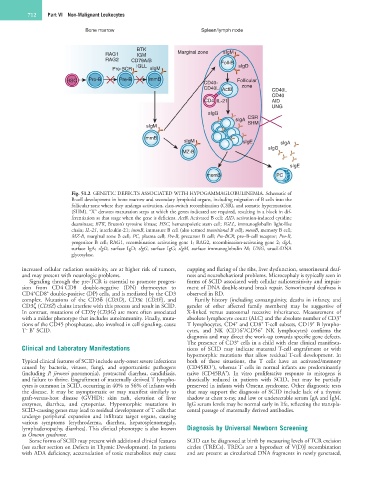
                        Fig. 51.2  GENETIC DEFECTS ASSOCIATED WITH HYPOGAMMAGLOBULINEMIA. Schematic of
                        B-cell development in bone marrow and secondary lymphoid organs, including migration of B cells into the
                        follicular zone where they undergo activation, class-switch recombination (CSR), and somatic hypermutation
                        (SHM). “X” denotes maturation steps at which the genes indicated are required, resulting in a block in dif-
                        ferentiation at that stage when the gene is deficient. ActB, Activated B cell; AID, activation-induced cytidine
                        deaminase; BTK, Bruton’s tyrosine kinase; HSC, hematopoietic stem cell; IGLL, immunoglobulin light-like
                        chain; IL-21, interleukin-21; immB, immature B cell (also termed transitional B cell); memB, memory B cell;
                        MZ-B, marginal zone B cell; PC, plasma cell; Pre-B, precursor B cell; Pre-BCR, pre–B-cell receptor; Pro-B,
                        progenitor B cell; RAG1, recombination activating gene 1; RAG2, recombination-activating gene 2; sIgA,
                        surface  IgA;  sIgD,  surface  IgD;  sIgG,  surface  IgG;  sIgM,  surface  immunoglobulin  M;  UNG,  uracil-DNA
                        glycosylase.

        increased cellular radiation sensitivity, are at higher risk of tumors,   cupping and flaring of the ribs, liver dysfunction, sensorineural deaf-
        and may present with neurologic problems.             ness and neurobehavioral problems. Microcephaly is typically seen in
           Signaling through the pre-TCR is essential to promote progres-  forms of SCID associated with cellular radiosensitivity and impair-
                      –
                          –
        sion  from  CD4 CD8   double-negative  (DN)  thymocytes  to   ment of DNA double-strand break repair. Sensorineural deafness is
                +
            +
        CD4 CD8  double-positive (DP) cells, and is mediated by the CD3   observed in RD.
        complex.  Mutations  of  the  CD3δ  (CD3D),  CD3ε  (CD3E),  and   Family history (including consanguinity, deaths in infancy, and
        CD3ζ (CD3Z) chains interfere with this process and result in SCID.   gender  of  other  affected  family  members)  may  be  suggestive  of
        In contrast, mutations of CD3γ (CD3G) are more often associated   X-linked  versus  autosomal  recessive  inheritance.  Measurement  of
                                                                                                                +
        with a milder phenotype that includes autoimmunity. Finally, muta-  absolute lymphocyte count (ALC) and the absolute number of CD3
                                                                              +
                                                                                      +
                                                                                                       +
        tions of the CD45 phosphatase, also involved in cell signaling, cause   T lymphocytes, CD4  and CD8  T-cell subsets, CD19  B lympho-
                                                                                +
            +
                                                                                      +
         –
        T  B  SCID.                                           cytes,  and  NK  (CD16 /CD56   NK  lymphocytes)  confirms  the
                                                              diagnosis and may direct the work-up towards specific gene defects.
                                                                              +
                                                              The presence of CD3  cells in a child with clear clinical manifesta-
        Clinical and Laboratory Manifestations                tions  of  SCID  may  indicate  maternal  T-cell  engraftment  or  with
                                                              hypomorphic mutations that allow residual T-cell development. In
        Typical clinical features of SCID include early-onset severe infections   both  of  these  situations,  the  T  cells  have  an  activated/memory
                                                                      +
        caused  by  bacteria,  viruses,  fungi,  and  opportunistic  pathogens   (CD45RO ), whereas T cells in normal infants are predominantly
                                                                           +
        (including  P.  jiroveci  pneumonia),  protracted  diarrhea,  candidiasis,   naive  (CD45RA ).  In  vitro  proliferative  response  to  mitogens  is
        and failure to thrive. Engraftment of maternally derived T lympho-  drastically  reduced  in  patients  with  SCID,  but  may  be  partially
        cytes is common in SCID, occurring in 40% to 56% of infants with   preserved in infants with Omenn syndrome. Other diagnostic tests
        the  disease.  It  may  be  asymptomatic  or  may  manifest  similarly  to   that may support the diagnosis of SCID include lack of a thymic
        graft-versus-host  disease  (GVHD):  skin  rash,  elevation  of  liver   shadow at chest x-ray, and low or undetectable serum IgA and IgM.
        enzymes,  diarrhea,  and  cytopenias.  Hypomorphic  mutations  in   IgG serum levels may be normal early in life, reflecting the transpla-
        SCID-causing genes may lead to residual development of T cells that   cental passage of maternally derived antibodies.
        undergo  peripheral  expansion  and  infiltrate  target  organs,  causing
        various  symptoms  (erythroderma,  diarrhea,  hepatosplenomegaly,
        lymphadenopathy, diarrhea). This clinical phenotype is also known   Diagnosis by Universal Newborn Screening
        as Omenn syndrome.
           Some forms of SCID may present with additional clinical features   SCID can be diagnosed at birth by measuring levels of TCR excision
        (see earlier section on Defects in Thymic Development). In patients   circles (TRECs). TRECs are a byproduct of V(D)J recombination
        with ADA deficiency, accumulation of toxic metabolites may cause   and are present as circularized DNA fragments in newly generated,

