


Page 825 - Hematology_ Basic Principles and Practice ( PDFDrive )
P. 825
Chapter 51  Congenital Disorders of Lymphocyte Function  711


                                                ADA, PNP   γc, IL7R, JAK3
                                                                                           NK
                                                        NKp


                                                         Thymus
                                                                    CD3δ,ε,ζ
                                              T/NKp               TRAC, CD45    CD4            CD4
                                    AK2


                              HSC       CLP               DN            DP


                                                                                CD8            CD8

                                                                      FOXN1

                                              Bp                                                B


                                       Myeloid           RAG1/2, Artemis, DNA-PKcs
                                      progenitor             LIG4, Cernunnos
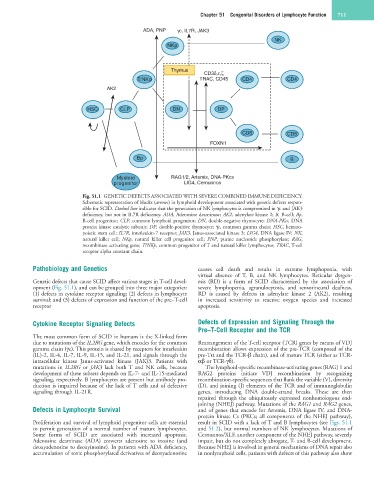
                            Fig. 51.1  GENETIC DEFECTS ASSOCIATED WITH SEVERE COMBINED IMMUNE DEFICIENCY.
                            Schematic representation of blocks (arrows) in lymphoid development associated with genetic defects respon-
                            sible for SCID. Dashed line indicates that the generation of NK lymphocytes is compromised in γc and JAK3
                            deficiency, but not in IL7R deficiency. ADA, Adenosine deaminase; AK2, adenylate kinase 2; B, B-cell; Bp,
                            B-cell progenitor; CLP, common lymphoid progenitor; DN, double-negative thymocyte; DNA-PKcs, DNA
                            protein kinase catalytic subunit; DP, double-positive thymocyte; γc, common gamma chain; HSC, hemato-
                            poietic stem cell; IL7R, interleukin-7 receptor; JAK3, Janus-associated kinase 3; LIG4, DNA ligase IV; NK,
                            natural  killer  cell;  NKp,  natural  killer  cell  progenitor  cell;  PNP,  purine  nucleoside  phosphorylase;  RAG,
                            recombinase activating gene; T/NKp, common progenitor of T and natural killer lymphocytes; TRAC, T-cell
                            receptor alpha constant chain.

            Pathobiology and Genetics                             causes  cell  death  and  results  in  extreme  lymphopenia,  with
                                                                  virtual  absence  of  T,  B,  and  NK  lymphocytes.  Reticular  dysgen-
            Genetic defects that cause SCID affect various stages in T-cell devel-  esis  (RD)  is  a  form  of  SCID  characterized  by  the  association  of
            opment (Fig. 51.1), and can be grouped into three major categories:   severe  lymphopenia,  agranulocytosis,  and  sensorineural  deafness.
            (1) defects in cytokine receptor signaling; (2) defects in lymphocyte   RD  is  caused  by  defects  in  adenylate  kinase  2  (AK2),  resulting
            survival; and (3) defects of expression and function of the pre–T-cell   in  increased  sensitivity  to  reactive  oxygen  species  and  increased
            receptor                                              apoptosis.

            Cytokine Receptor Signaling Defects                   Defects of Expression and Signaling Through the
                                                                  Pre–T-Cell Receptor and the TCR
            The most common form of SCID in humans is the X-linked form
            due to mutations of the IL2RG gene, which encodes for the common   Rearrangement of the T-cell receptor (TCR) genes by means of VDJ
            gamma chain (γc). This protein is shared by receptors for interleukin   recombination allows expression of the pre-TCR (composed of the
            (IL)-2, IL-4, IL-7, IL-9, IL-15, and IL-21, and signals through the   pre-Tα and the TCR-β chain), and of mature TCR (either as TCR-
            intracellular  kinase  Janus-activated  kinase  (JAK)3.  Patients  with   αβ or TCR-γδ).
            mutations  in  IL2RG  or  JAK3  lack  both T  and  NK  cells,  because   The lymphoid-specific recombinase-activating genes (RAG) 1 and
            development of these subsets depends on IL-7- and IL-15-mediated   RAG2  proteins  initiate  VDJ  recombination  by  recognizing
            signaling, respectively. B lymphocytes are present but antibody pro-  recombination-specific sequences that flank the variable (V), diversity
            duction is impaired because of the lack of T cells and of defective   (D), and joining (J) elements of the TCR and of immunoglobulin
            signaling through IL-21R.                             genes,  introducing  DNA  double-strand  breaks.  These  are  then
                                                                  repaired  through  the  ubiquitously  expressed  nonhomologous  end-
                                                                  joining (NHEJ) pathway. Mutations of the RAG1 and RAG2 genes,
            Defects in Lymphocyte Survival                        and of genes that encode for Artemis, DNA ligase IV, and DNA-
                                                                  protein kinase Cs (PKCs; all components of the NHEJ pathway),
            Proliferation and survival of lymphoid progenitor cells are essential   result in SCID with a lack of T and B lymphocytes (see Figs. 51.1
            to permit generation of a normal number of mature lymphocytes.   and 51.2), but normal numbers of NK lymphocytes. Mutations of
            Some  forms  of  SCID  are  associated  with  increased  apoptosis.   Cernunnos/XLF, another component of the NHEJ pathway, severely
            Adenosine  deaminase  (ADA)  converts  adenosine  to  inosine  (and   impair, but do not completely abrogate, T- and B-cell development.
            deoxyadenosine to deoxyinosine). In patients with ADA deficiency,   Because NHEJ is involved in general mechanisms of DNA repair also
            accumulation of toxic phosphorylated derivatives of deoxyadenosine   in nonlymphoid cells, patients with defects of this pathway also show

