


Page 827 - Hematology_ Basic Principles and Practice ( PDFDrive )
P. 827
Chapter 51  Congenital Disorders of Lymphocyte Function  713


                                                                    Ultimately,  infants  with  SCID  should  be  evaluated  for  specific
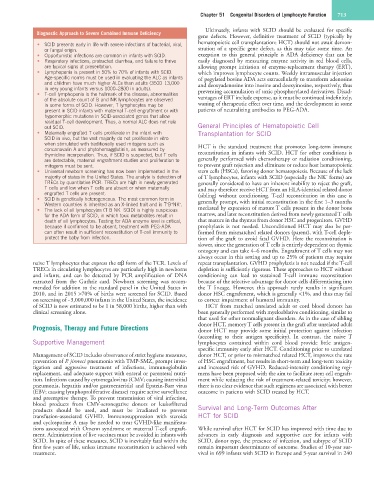
             Diagnostic Approach to Severe Combined Immune Deficiency
                                                                  gene  defects.  However,  definitive  treatment  of  SCID  (typically  by
             •  SCID presents early in life with severe infections of bacterial, viral,   hematopoietic cell transplantation; HCT) should not await demon-
                or fungal origin.                                 stration  of  a  specific  gene  defect, as  this  may take some  time. An
             •  Opportunistic infections are common in infants with SCID.  exception  to  this  general  principle  is  ADA  deficiency  that  can  be
             •  Respiratory infections, protracted diarrhea, and failure to thrive   easily  diagnosed  by  measuring  enzyme  activity  in  red  blood  cells,
                are typical signs at presentation.                allowing  prompt  initiation  of  enzyme-replacement  therapy  (ERT),
             •  Lymphopenia is present in 50% to 70% of infants with SCID.   which improves lymphocyte counts. Weekly intramuscular injection
                Age-specific norms must be used in evaluating the ALC as infants   of pegylated bovine ADA acts extracellularly to transform adenosine
                and children have much higher ALCs than adults (3500–13,000   and deoxyadenosine into inosine and deoxyinosine, respectively, thus
                in very young infants versus 1000–2800 in adults).  preventing accumulation of toxic phosphorylated derivatives. Disad-
             •  T-cell lymphopenia is the hallmark of the disease; abnormalities
                of the absolute count of B and NK lymphocytes are observed   vantages of ERT include expense, as it must be continued indefinitely,
                in some forms of SCID. However, T lymphocytes may be   waning of therapeutic effect over time, and the development in some
                present in SCID infants with maternal T-cell engraftment or with   patients of neutralizing antibodies to PEG-ADA.
                hypomorphic mutations in SCID-associated genes that allow
                residual T-cell development. Thus, a normal ALC does not rule
                out SCID.                                         General Principles of Hematopoietic Cell
             •  Maternally engrafted T cells proliferate in the infant with   Transplantation for SCID
                SCID in vivo, but the vast majority do not proliferate in vitro
                when stimulated with traditionally used mitogens such as   HCT  is  the  standard  treatment  that  promotes  long-term  immune
                concanavalin A and phytohemagglutinin, as measured by
                thymidine incorporation. Thus, if SCID is suspected, but T cells   reconstitution in infants with SCID. HCT for other conditions is
                are detectable, maternal engraftment studies and proliferation to   generally performed with chemotherapy or radiation conditioning,
                mitogens must be sent.                            to prevent graft rejection and eliminate or reduce host hematopoietic
             •  Universal newborn screening has now been implemented in the   stem cells (HSCs), favoring donor hematopoiesis. Because of the lack
                                                                                                            –
                majority of states in the United States. The analyte is detection of   of T lymphocytes, infants with SCID (especially the NK  forms) are
                TRECs by quantitative PCR. TRECs are high in newly generated   generally considered to have an inherent inability to reject the graft,
                T cells and low when T cells are absent or when maternally   and may therefore receive HCT from an HLA-identical related donor
                engrafted T cells are present.                    (sibling)  without  conditioning. T-cell  reconstitution  in  this  case  is
             •  SCID is genetically heterogeneous. The most common form in   generally prompt, with initial reconstitution in the first 1–3 months
                                                         +
                                                        –
                Western countries is inherited as an X-linked trait and is T B NK . –
             •  The lack of all lymphocytes (T B NK  SCID) is highly suspicious   mediated by expansion of mature T cells present in the donor bone
                                      –
                                        –
                                    –
                for the ADA form of SCID, in which toxic metabolites result in   marrow, and later reconstitution derived from newly generated T cells
                death of all lymphocytes. Testing for ADA enzyme level is critical,   that mature in the thymus from donor HSC and progenitors. GVHD
                because if confirmed to be absent, treatment with PEG-ADA   prophylaxis  is  not  needed.  Unconditioned  HCT  may  also  be  per-
                can often result in sufficient reconstitution of T-cell immunity to   formed from mismatched related donors (parent), with T-cell deple-
                protect the baby from infection.                  tion of the graft to avoid fatal GVHD. Here the reconstitution is
                                                                  slower, since the generation of T cells is entirely dependent on thymic
                                                                  ontogeny and can take 4–6 months. Engraftment of T cells may not
                                                                  always occur in this setting and up to 25% of patients may require
            naive T lymphocytes that express the αβ form of the TCR. Levels of   repeat transplantation. GVHD prophylaxis is not needed if the T-cell
            TRECs in circulating lymphocytes are particularly high in newborns   depletion is sufficiently rigorous. These approaches to HCT without
            and  infants,  and  can  be  detected  by  PCR  amplification  of  DNA   conditioning  can  lead  to  sustained  T-cell  immune  reconstitution
            extracted  from  the  Guthrie  card.  Newborn  screening  was  recom-  because of the selective advantage for donor cells differentiating into
            mended for addition to the standard panel in the United States in   the T  lineage.  However,  this  approach  rarely  results  in  significant
            2010, and in 2015 >70% of births were screened for SCID. Based   donor HSC engraftment, which is generally <1%, and thus may fail
            on screening of ~3,000,000 infants in the United States, the incidence   to correct impairment of humoral immunity.
            of SCID is now estimated to be 1 in 58,000 births, higher than with   HCT  from  matched  unrelated  adult  or  cord  blood  donors  has
            clinical screening alone.                             been generally performed with myeloablative conditioning, similar to
                                                                  that used for other nonmalignant disorders. As in the case of sibling
            Prognosis, Therapy and Future Directions              donor HCT, memory T cells present in the graft after unrelated adult
                                                                  donor HCT may provide some initial protection against infection
                                                                  (according  to  their  antigen  specificity).  In  contrast,  the  naive  T
            Supportive Management                                 lymphocytes  contained  within  cord  blood  provide  little  antigen-
                                                                  specific immunity early after HCT. Conditioning prior to unrelated
            Management of SCID includes observance of strict hygiene measures,   donor HCT, or prior to mismatched related HCT, improves the rate
            prevention of P. jiroveci pneumonia with TMP-SMZ, prompt inves-  of HSC engraftment, but results in short-term and long-term toxicity
            tigation  and  aggressive  treatment  of  infections,  immunoglobulin   and increased risk of GVHD. Reduced-intensity conditioning regi-
            replacement, and adequate support with enteral or parenteral nutri-  mens have been proposed with the aim to facilitate stem cell engraft-
            tion. Infections caused by cytomegalovirus (CMV; causing interstitial   ment while reducing the risk of treatment-related toxicity; however,
            pneumonia, hepatitis and/or gastroenteritis) and Epstein-Barr virus   there is no clear evidence that such regimens are associated with better
            (EBV; causing lymphoproliferative disease) require active surveillance   outcome in patients with SCID treated by HCT.
            and preemptive therapy. To prevent transmission of viral infection,
            blood  products  from  CMV-seronegative  donors  or  leukofiltered
            products  should  be  used,  and  must  be  irradiated  to  prevent   Survival and Long-Term Outcomes After
            transfusion-associated  GVHD.  Immunosuppression  with  steroids   HCT for SCID
            and cyclosporine A may be needed to treat GVHD-like manifesta-
            tions associated with Omenn syndrome or maternal T-cell engraft-  While survival after HCT for SCID has improved with time due to
            ment. Administration of live vaccines must be avoided in infants with   advances  in  early  diagnosis  and  supportive  care  for  infants  with
            SCID. In spite of these measures, SCID is inevitably fatal within the   SCID, donor type, the presence of infection, and subtype of SCID
            first few years of life, unless immune reconstitution is achieved with   remain important determinants of outcome. Studies of 10-year sur-
            treatment.                                            vival in 699 infants with SCID in Europe and 5-year survival in 240

