


Page 828 - Hematology_ Basic Principles and Practice ( PDFDrive )
P. 828
714    Part VI  Non-Malignant Leukocytes


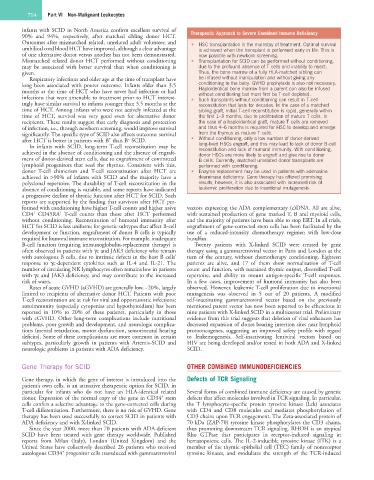
        infants with SCID in North America confirm excellent survival of   Therapeutic Approach to Severe Combined Immune Deficiency
        90%  and  94%,  respectively,  after  matched  sibling  donor  HCT.
        Outcomes after mismatched related, unrelated adult volunteer, and   •  HSC transplantation is the mainstay of treatment. Optimal survival
        umbilical cord blood HCT have improved, although a clear advantage   is achieved when the transplant is performed early in life. This is
        of one alternative donor versus another has not been demonstrated.   now possible with newborn screening.
        Mismatched  related  donor  HCT  performed  without  conditioning   •  Transplantation for SCID can be performed without conditioning,
        may  be  associated  with  better  survival  than  when  conditioning  is   due to the profound absence of T cells and inability to reject.
        given.                                                    Thus, the bone marrow of a fully HLA-matched sibling can
           Respiratory infections and older age at the time of transplant have   be infused without manipulation and without giving any
        long  been  associated  with  poorer  outcome.  Infants  older  than  3.5   conditioning to the baby. GVHD prophylaxis is also not necessary.
        months at the time of HCT who have never had infection or had   Haploidentical bone marrow from a parent can also be infused
                                                                  without conditioning but must first be T-cell depleted.
        infections that were amenable to treatment prior to HCT interest-  •  Such transplants without conditioning can result in T-cell
        ingly have similar survival to infants younger than 3.5 months at the   reconstitution that lasts for decades. In the case of a matched
        time of HCT. Among infants who were not actively infected at the   sibling graft, initial T-cell reconstitution is rapid, generally within
        time  of  HCT,  survival  was  very  good  even  for  alternative  donor   the first 1–3 months, due to proliferation of mature T cells. In
        recipients. These results suggest that early diagnosis and protection   the case of a haploidentical graft, mature T cells are removed
        of infection, i.e., through newborn screening, would improve survival   and thus 4–6 months is required for HSC to develop and emerge
        significantly. The specific type of SCID also affects outcome: survival   from the thymus as mature T cells.
                                     +
                                           –
        after HCT is better in patients with B  than B  SCID.   •  Without conditioning, only a low number of donor-derived
           In  infants  with  SCID,  long-term  T-cell  reconstitution  may  be   long-lived HSCs engraft, and this may lead to lack of donor B-cell
        achieved in the absence of conditioning and the absence of engraft-  reconstitution and lack of humoral immunity. With conditioning,
                                                                  donor HSCs are more likely to engraft and give rise to donor
        ment of donor-derived stem cells, due to engraftment of committed   B cells. Currently, matched unrelated donor transplants are
        lymphoid  progenitors  that  seed  the  thymus.  Consistent  with  this,   performed with conditioning.
        donor  T-cell  chimerism  and  T-cell  reconstitution  after  HCT  are   •  Enzyme replacement may be used in patients with adenosine
        achieved  in  >90%  of  infants  with  SCID  and  the  majority  have  a   deaminase deficiency. Gene therapy has offered promising
        polyclonal repertoire. The durability of T-cell reconstitution in the   results; however, it is also associated with increased risk of
        absence of conditioning is variable, and some reports have indicated   leukemic proliferation due to insertional mutagenesis.
        a progressive decline of thymic function after HCT for SCID. Such
        reports are supported by the finding that survivors after HCT per-
        formed with conditioning have higher T-cell counts and higher naive   vectors expressing the ADA complementary (c)DNA. All are alive,
            +
                     +
        CD4   CD45RA   T-cell  counts  than  those  after  HCT  performed   with sustained production of gene marked T, B and myeloid cells,
        without  conditioning.  Reconstitution  of  humoral  immunity  after   and the majority of patients have been able to stop ERT. In all trials,
        HCT for SCID is less uniform; for genetic subtypes that affect B-cell   engraftment of gene-corrected stem cells has been facilitated by the
        development or function, engraftment of donor B cells is typically   use  of  a  reduced-intensity  chemotherapy  regimen  with  low-dose
        required for humoral immune reconstitution. For example, inadequate   busulfan.
        B-cell function (requiring immunoglobulin-replacement therapy) is   Twenty  patients  with  X-linked  SCID  were  treated  by  gene
        often observed in patients with γc and JAK3 deficiency who remain   therapy using a gammaretroviral vector in Paris and London at the
        with autologous B cells, due to intrinsic defects in the host B cells’   turn of the century, without chemotherapy conditioning. Eighteen
        response  to  γc-dependent  cytokines  such  as  IL-4  and  IL-21.  The   patients  are  alive,  and  17  of  them  show  normalization  of  T-cell
        number of circulating NK lymphocytes often remains low in patients   count and function, with sustained thymic output, diversified T-cell
        with γc and JAK3 deficiency, and may contribute to the increased   repertoire,  and  ability  to  mount  antigen-specific  T-cell  responses.
        risk of warts.                                        In  a  few  cases,  improvement  of  humoral  immunity  has  also  been
           Rates of acute GVHD (aGVHD) are generally low, ~20%, largely   observed. However, leukemic T-cell proliferation due to insertional
        limited to recipients of alternative donor HCT. Patients with poor   mutagenesis  was  observed  in  5  out  of  20  patients.  A  modified
        T-cell reconstitution are at risk for viral and opportunistic infections;   self-inactivating  gammaretroviral  vector  based  on  the  previously
        autoimmunity (especially cytopenias and hypothyroidism) has been   mentioned parent vector has now been reported to be efficacious in
        reported  in  10%  to  20%  of  these  patients,  particularly  in  those   nine patients with X-linked SCID in a multicenter trial. Preliminary
        with  cGVHD.  Other  long-term  complications  include  nutritional   evidence from this trial suggests that deletion of viral enhancers has
        problems, poor growth and development, and neurologic complica-  decreased expansion of clones bearing insertion sites near lymphoid
        tions (mental retardation, motor dysfunction, sensorineural hearing   protooncogenes,  suggesting  an  improved  safety  profile  with  regard
        deficits). Some of these complications are more common in certain   to  leukemogenesis.  Self-inactivating  lentiviral  vectors  based  on
        subtypes,  particularly  growth  in  patients  with  Artemis-SCID  and   HIV are being developed and/or tested in both ADA and X-linked
        neurologic problems in patients with ADA deficiency.  SCID.


        Gene Therapy for SCID                                 OTHER COMBINED IMMUNODEFICIENCIES

        Gene therapy, in which the gene of interest is introduced into the   Defects of TCR Signaling
        patient’s own cells, is an attractive therapeutic option for SCID, in
        particular  for  infants  who  do  not  have  an  HLA-identical  related   Several forms of combined immune deficiency are caused by genetic
                                                      +
        donor. Expression of the normal copy of the gene in CD34  stem   defects that affect molecules involved in TCR signaling. In particular,
        cells confers a selective advantage to the gene-corrected cells during   the T  lymphocyte-specific  protein  tyrosine  kinase  (Lck)  associates
        T-cell differentiation. Furthermore, there is no risk of GVHD. Gene   with  CD4  and  CD8  molecules  and  mediates  phosphorylation  of
        therapy has been used successfully to correct SCID in patients with   CD3 chains upon TCR engagement. The Zeta-associated protein of
        ADA deficiency and with X-linked SCID.                70 kDa (ZAP-70) tyrosine kinase phosphorylates the CD3 chains,
           Since the year 2000, more than 70 patients with ADA-deficient   thus promoting downstream TCR signaling. RHOH is an atypical
        SCID  have  been  treated  with  gene  therapy  worldwide.  Published   Rho  GTPase  that  participates  in  receptor-induced  signaling  in
        reports  from  Milan  (Italy),  London  (United  Kingdom)  and  the   hematopoietic  cells. The  IL-2-inducible  tyrosine  kinase  (ITK)  is  a
        United  States  have  collectively  described  26  patients  who  received   member of the thymic epithelial cell (TEC) family of nonreceptor
                     +
        autologous CD34  progenitor cells transduced with gammaretroviral   tyrosine  kinases,  and  modulates  the  strength  of  the TCR-induced

