


Page 881 - Hematology_ Basic Principles and Practice ( PDFDrive )
P. 881
764    Part VII  Hematologic Malignancies


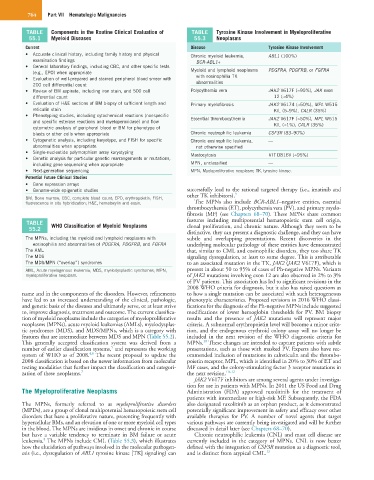
          TABLE   Components in the Routine Clinical Evaluation of   TABLE   Tyrosine Kinase Involvement in Myeloproliferative
          55.1    Myeloid Diseases                              55.3    Neoplasms
         Current                                               Disease                   Tyrosine Kinase Involvement
         •  Accurate clinical history, including family history and physical   Chronic myeloid leukemia,   ABL1 (100%)
            examination findings                                 BCR-ABL1+
         •  General laboratory findings, including CBC, and other specific tests
            (e.g., EPO) when appropriate                       Myeloid and lymphoid neoplasms   PDGFRA, PDGFRB, or FGFRA
         •  Evaluation of well-prepared and stained peripheral blood smear with   with eosinophilia TK
            200 cell differential count                          abnormalities
         •  Review of BM aspirate, including iron stain, and 500 cell   Polycythemia vera  JAK2 V617F (≈95%), JAK exon
            differential count                                                             12 (≈4%)
         •  Evaluation of H&E sections of BM biopsy of sufficient length and   Primary myelofibrosis  JAK2 V6174 (≈50%), MPL W515
            reticulin stain                                                                K/L (5–9%), CALR (35%)
         •  Phenotyping studies, including cytochemical reactions (nonspecific   Essential thrombocythemia  JAK2 V617F (≈50%), MPL W515
            and specific esterase reactions and myeloperoxidase) and flow                  K/L (≈1%), CALR (35%)
            cytometric analysis of peripheral blood or BM for phenotype of
            blasts or other cells when appropriate             Chronic neutrophilic leukemia  CSF3R (83–90%)
         •  Cytogenetic analysis, including karyotype, and FISH for specific   Chronic eosinophilic leukemia,   —
            abnormalities when appropriate                       not otherwise specified
         •  Single-nucleotide polymorphism array karyotyping   Mastocytosis              KIT D816V (≈95%)
         •  Genetic analysis for particular genetic rearrangements or mutations,
            including gene sequencing when appropriate         MPN, unclassified         —
         •  Next-generation sequencing                         MPN, Myeloproliferative neoplasm; TK, tyrosine kinase.
         Potential Future Clinical Studies
         •  Gene expression arrays
         •  Genome-wide epigenetic studies                    successfully lead to the rational targeted therapy (i.e., imatinib and
                                                              other TK inhibitors). 9
         BM, Bone marrow; CBC, complete blood count; EPO, erythropoietin; FISH,
         fluorescence in situ hybridization; H&E, hematoxylin and eosin.  The  MPNs  also  include  BCR-ABL1–negative  entities,  essential
                                                              thrombocythemia (ET), polycythemia vera (PV), and primary myelo-
                                                              fibrosis  (MF)  (see  Chapters  68–70). These  MPNs  share  common
          TABLE   WHO Classification of Myeloid Neoplasms     features  including  multipotential  hematopoietic  stem  cell  origin,
          55.2                                                clonal proliferation, and chronic nature. Although they seem to be
                                                              distinctive, they can present a diagnostic challenge, and they can have
         The MPNs, including the myeloid and lymphoid neoplasms with   subtle  and  overlapping  presentations.  Recent  discoveries  in  the
            eosinophilia and abnormalities of PDGFRA, PDGFRB, and FGFRA  underlying molecular pathology of these entities have demonstrated
         The AML                                              that, similar to CML and eosinophilic disorders, they too share TK
         The MDS                                              signaling dysregulation, at least to some degree. This is attributable
         The MDS/MPN (“overlap”) syndromes                    to an associated mutation in the TK, JAK2 (JAK2 V617F), which is
         AML, Acute myelogenous leukemia; MDS, myelodysplastic syndromes; MPN,   present in about 50 to 95% of cases of Ph-negative MPNs. Variants
         myeloproliferative neoplasm.                         of JAK2 mutations involving exon 12 are also observed in 2% to 3%
                                                              of PV patients. This association has led to significant revisions in the
                                                              2008 WHO criteria for diagnosis, but it also has raised questions as
        name and in the components of the disorders. However, refinements   to how a single mutation can be associated with such heterogeneous
        have led to an increased understanding of the clinical, pathologic,   phenotypic characteristics. Proposed revisions in 2016 WHO classi-
        and genetic basis of the diseases and ultimately serve, or at least strive   fications for the diagnosis of the Ph-negative MPNs include suggested
        to, improve diagnosis, treatment and outcome. The current classifica-  modifications  of  lower  hemoglobin  thresholds  for  PV.  BM  biopsy
        tion of myeloid neoplasms include the categories of myeloproliferative   results  and  the  presence  of  JAK2  mutations  will  represent  major
        neoplasms (MPNs), acute myeloid leukemias (AMLs), myelodysplas-  criteria. A subnormal erythropoietin level will become a minor crite-
        tic syndromes (MDS), and MDS/MPNs, which is a category with   rion, and the endogenous erythroid colony assay will no longer be
        features that are intermediate between MDS and MPN (Table 55.2).   included  in  the  next  revision  of  the  WHO  diagnostic  criteria  for
                                                                    10
        This  generally  accepted  classification  system  was  derived  from  a   MPNs.  These changes are intended to capture patients with subtle
                                     5
        number of earlier classification systems,  and represents the working   presentations, such as those with masked PV. Experts also have rec-
                              4,6
        system of WHO as of 2008.  The recent proposal to update the   ommended inclusion of mutations in calreticulin and the thrombo-
        2008 classification is based on the newer information from molecular   poietin receptor, MPL, which is identified in 20% to 30% of ET and
        testing modalities that further impact the classification and categori-  MF cases, and the colony-stimulating factor 3 receptor mutations in
        zation of these neoplasms. 7                          the next revision. 10–12
                                                                 JAK2 V617F inhibitors are among several agents under investiga-
                                                              tion for use in patients with MPNs. In 2011 the US Food and Drug
        The Myeloproliferative Neoplasms                      Administration  (FDA)  approved  ruxolitinib  for  the  treatment  of
                                                              patients with intermediate or high-risk MF. Subsequently, the FDA
        The  MPNs,  formerly  referred  to  as  myeloproliferative  disorders   also designated ruxolitinib as an orphan product, as it demonstrated
        (MPDs), are a group of clonal multipotential hematopoietic stem cell   potentially significant improvement in safety and efficacy over other
        disorders that have a proliferative nature, presenting frequently with   available  therapies  for  PV.  A  number  of  novel  agents  that  target
        hypercellular BMs, and an elevation of one or more myeloid cell types   various pathways are currently being investigated and will be further
        in the blood. The MPNs are insidious in onset and chronic in course   discussed in detail later (see Chapters 68–70).
        but  have  a  variable  tendency  to  terminate  in  BM  failure  or  acute   Chronic neutrophilic leukemia (CNL) and mast cell disease are
               8
        leukemia.  The MPNs include CML (Table 55.3), which illustrates   currently  included  in  the  category  of  MPNs.  CNL  is  now  better
        how the elucidation of pathways involved in the molecular pathogen-  defined with the integration of CSF3R mutation as a diagnostic tool,
        esis (i.e., dysregulation of ABL1 tyrosine kinase [TK] signaling) can   and is distinct from atypical CML. 13

