


Page 885 - Hematology_ Basic Principles and Practice ( PDFDrive )
P. 885
768    Part VII  Hematologic Malignancies


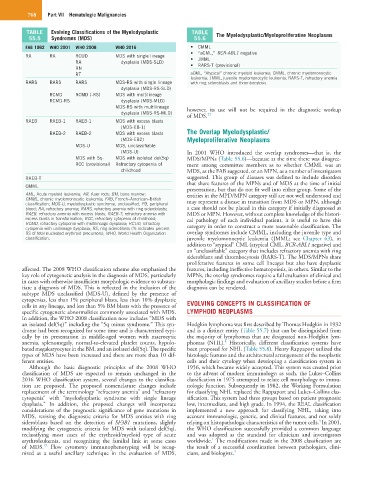
          TABLE   Evolving Classifications of the Myelodysplastic   TABLE   The Myelodysplastic/Myeloproliferative Neoplasms
          55.5    Syndromes (MDS)                               55.6
         FAB 1982  WHO 2001  WHO 2008  WHO 2016                •  CMML
                                                               •  “aCML,” BCR-ABL1 negative
         RA      RA       RCUD         MDS with single lineage   •  JMML
                          RA             dysplasia (MDS-SLD)   •  RARS-T (provisional)
                          RN
                          RT                                   aCML, “Atypical” chronic myeloid leukemia; CMML, chronic myelomonocytic
                                                               leukemia; JMML, juvenile myelomonocytic leukemia; RARS-T, refractory anemia
         RARS    RARS     RARS         MDS-RS with single lineage   with ring sideroblasts and thrombocytosis.
                                         dysplasia (MDS-RS-SLD)
                 RCMD     RCMD (-RS)   MDS with multilineage
                 RCMD-RS                 dysplasia (MDS-MLD)
                                       MDS-RS with multilineage   however,  its  use  will  not  be  required  in  the  diagnostic  workup
                                         dysplasia (MDS-RS-MLD)      22
                                                              of MDS.
         RAEB    RAEB-1   RAEB-1       MDS with excess blasts
                                         (MDS-EB-1)
                 RAEB-2   RAEB-2       MDS with excess blasts   The Overlap Myelodysplastic/
                                         (MDS-EB2)            Myeloproliferative Neoplasms
                          MDS-U        MDS, unclassifiable
                                         (MDS-U)              In  2001  WHO  introduced  the  overlap  syndromes—that  is,  the
                          MDS with 5q-  MDS with isolated del(5q)  MDS/MPNs (Table 55.6)—because at the time there was disagree-
                          RCC (provisional)  Refractory cytopenia of   ment  among  committee  members  as  to  whether  CMML  was  an
                                         childhood            MDS, as the FAB suggested, or an MPN, as a number of investigators
         RAEB-T                                               suggested. This group of diseases was defined to include disorders
                                                              that share features of the MPNs and of MDS at the time of initial
         CMML
                                                              presentation, but that do not fit well into either group. Some of the
         AML, Acute myeloid leukemia; AR, Auer rods; BM, bone marrow;   entities in the MPD/MPN category still are not well understood and
         CMML, chronic myelomonocytic leukemia; FAB, French–American–British   may represent a disease in transition from MDS or MPN, although
         classification; MDS-U, myelodysplastic syndrome, unclassified; PB, peripheral
         blood; RA, refractory anemia; RARS, refractory anemia with ring sideroblasts;   a case should not be placed in this category if initially diagnosed as
         RAEB, refractory anemia with excess blasts; RAEB-T, refractory anemia with   MDS or MPN. However, without complete knowledge of the histori-
         excess blasts in transformation; RCC, refractory cytopenia of childhood;   cal  pathology  of  each  individual  patient,  it  is  useful  to  have  this
         RCMD, refractory cytopenia with multilineage dysplasia; RCUD, refractory   category in order to construct a more reasonable classification. The
         cytopenia with unilineage dysplasia; RS, ring sideroblasts (% indicates percent
         RS of total nucleated erythroid precursors); WHO, World Health Organization   overlap syndromes include CMML, including the juvenile type and
         classification.                                      juvenile  myelomonocytic  leukemia  (JMML;  see  Chapter  63),  in
                                                              addition to “atypical” CML (atypical CML, BCR-ABL1 negative) and
                                                              an “unclassifiable” category that includes refractory anemia with ring
                                                              sideroblasts and thrombocytosis (RARS-T). The MDS/MPNs share
                                                              proliferative  features  in  some  cell  lineages  but  also  have  dysplastic
        affected. The 2008 WHO classification scheme also emphasized the   features, including ineffective hematopoiesis, in others. Similar to the
        key role of cytogenetic analysis in the diagnosis of MDS, particularly   MPNs, the overlap syndromes require a full evaluation of clinical and
        in cases with otherwise insufficient morphologic evidence to substan-  morphologic findings and evaluation of ancillary studies before a firm
        tiate a diagnosis of MDS. This is reflected in the inclusion of the   diagnosis can be rendered.
        subtype  MDS  unclassified  (MDS-U),  defined  by  the  presence  of
        cytopenias, less than 1% peripheral blasts, less than 10% dysplastic
        cells in any lineage, and less than 5% BM blasts with the presence of   EVOLVING CONCEPTS IN CLASSIFICATION OF
        specific cytogenetic abnormalities commonly associated with MDS.   LYMPHOID NEOPLASMS
        In addition, the WHO 2008 classification now includes “MDS with
        an isolated del(5q)” including the “5q minus syndrome.” This syn-  Hodgkin lymphoma was first described by Thomas Hodgkin in 1932
        drome had been recognized for some time and is characterized typi-  and is a distinct entity (Table 55.7) that can be distinguished from
        cally  by  its  presentation  in  middle-aged  women  with  macrocytic   the majority of lymphomas that are designated non-Hodgkin lym-
                                                                           4
        anemia,  splenomegaly,  normal-to-elevated  platelet  counts,  hypolo-  phomas  (NHL).   Historically,  different  classification  systems  have
        bated megakaryocytes in the BM, and an isolated del(5q). The specific   been proposed for NHL (Table 55.8). Henry Rappaport utilized the
        types of MDS have been increased and there are more than 10 dif-  histologic features and the architectural arrangement of the neoplastic
        ferent entities.                                      cells and their cytology when developing a classification system in
           Although  the  basic  diagnostic  principles  of  the  2008  WHO   1956, which became widely accepted. This system was created prior
        classification  of  MDS  are  expected  to  remain  unchanged  in  the   to the advent of modern immunology; as such, the Lukes–Collins
        2016 WHO classification system, several changes to the classifica-  classification in 1975 attempted to relate cell morphology to immu-
        tion  are  proposed.  The  proposed  nomenclature  changes  include   nologic function. Subsequently in 1982, the Working Formulation
        replacement of the terminology “refractory anemia” and “refractory   for classifying NHL replaced the Rappaport and Lukes–Collins clas-
        cytopenia”  with  “myelodysplastic  syndrome  with  single  lineage   sification. This system had three groups based on patient prognosis:
        dysplasia.”  In  addition,  the  proposed  changes  will  incorporate   low, intermediate, and high grade. In 1994, the REAL classification
        considerations  of  the  prognostic  significance  of  gene  mutations  in   implemented  a  new  approach  for  classifying  NHL,  taking  into
        MDS,  revising  the  diagnostic  criteria  for  MDS  entities  with  ring   account immunologic, genetic, and clinical features, and not solely
                                                                                                         3
        sideroblasts  based  on  the  detection  of  SF3B1  mutations,  slightly   relying on histopathologic characteristics of the tumor cells.  In 2001,
        modifying  the  cytogenetic  criteria  for  MDS  with  isolated  del(5q),   the WHO  classification  successfully  provided  a  common  language
        reclassifying  most  cases  of  the  erythroid/myeloid  type  of  acute   and  was  adopted  as  the  standard  for  clinicians  and  investigators
                                                                      1
        erythroleukemia,  and  recognizing  the  familial  link  in  some  cases   worldwide.  The modifications made in the 2008 classification are
               22
        of  MDS.   Flow  cytometry  immunophenotyping  will  be  recog-  the  result  of  a  successful  coordination  between  pathologists,  clini-
        nized  as  a  useful  ancillary  technique  in  the  evaluation  of  MDS,   cians, and biologists. 4

