


Page 884 - Hematology_ Basic Principles and Practice ( PDFDrive )
P. 884
Chapter 55  Progress in the Classification of Hematopoietic and Lymphoid Neoplasms  767


            accompanied  cryptic  deletions  of  antigen  receptors,  particularly   BM  (Table  55.5).  As  noted  earlier,  in  the  FAB  scheme  AML  was
            immunoglobulin heavy chain (IGH) gene rearrangement; this was   defined by the presence of 30% or more blasts in the blood or BM.
            recently shown to be specific for de novo disease. 20,21  This update is   The FAB included CMML in the MDS category, although it was
            also anticipated to include new and revised mutations subgroups. For   recognized that CMML differed in that it had a proliferative compo-
            example, AML with RUNX1 mutations will include only de novo   nent  with  increased  numbers  of  circulating  monocytes.  At  times,
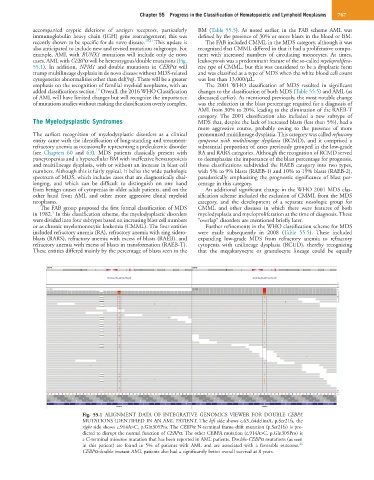
            cases. AML with CEBPα will be heterozygous/double mutations (Fig.   leukocytosis was a predominant feature of the so-called myeloprolifera-
            55.1).  In  addition,  NPM1  and  double  mutations  in  CEBPα  will   tive type of CMML, but this was considered to be a dysplastic form
            trump multilineage dysplasia in de novo disease without MDS-related   and was classified as a type of MDS when the white blood cell count
            cytogenetics abnormalities other than del(9q). There will be a greater   was less than 13,000/µL.
            emphasis on the recognition of familial myeloid neoplasms, with an   The  2001  WHO  classification  of  MDS  resulted  in  significant
                                19
            added classifications section.  Overall, the 2016 WHO Classification   changes to the classification of both MDS (Table 55.5) and AML (as
            of AML will have limited changes but will recognize the importance   discussed earlier). As mentioned previously, the most notable change
            of mutations studies without making the classification overly complex.  was the reduction in the blast percentage required for a diagnosis of
                                                                  AML from 30% to 20%, leading to the elimination of the RAEB-T
                                                                  category.  The  2001  classification  also  included  a  new  subtype  of
            The Myelodysplastic Syndromes                         MDS that, despite the lack of increased blasts (less than 5%), had a
                                                                  more  aggressive  course,  probably  owing  to  the  presence  of  more
            The  earliest  recognition  of  myelodysplastic  disorders  as  a  clinical   pronounced multilineage dysplasia. This category was called refractory
            entity came with the identification of long-standing and treatment-  cytopenia  with  multilineage  dysplasia  (RCMD),  and  it  comprised  a
            refractory anemia as occasionally representing a preleukemic disorder   substantial proportion of cases previously grouped in the low-grade
            (see  Chapters  60  and  63).  MDS  patients  classically  present  with   RA and RARS categories. Although the recognition of RCMD served
            pancytopenias and a hypercellular BM with ineffective hematopoiesis   to deemphasize the importance of the blast percentage for prognosis,
            and multilineage dysplasia, with or without an increase in blast cell   these classifications subdivided the RAEB category into two types,
            numbers. Although this is fairly typical, it belies the wide pathologic   with 5% to 9% blasts (RAEB-1) and 10% to 19% blasts (RAEB-2),
            spectrum of MDS, which includes cases that are diagnostically chal-  paradoxically  emphasizing  the  prognostic  significance  of  blast  per-
            lenging,  and  which  can  be  difficult  to  distinguish  on  one  hand   centage in this category.
            from benign causes of cytopenias in older adult patients, and on the   An additional significant change in the WHO 2001 MDS clas-
            other  hand  from  AML  and  other  more  aggressive  clonal  myeloid   sification scheme included the exclusion of CMML from the MDS
            neoplasms.                                            category,  and  the  development  of  a  separate  nosologic  group  for
              The FAB group proposed the first formal classification of MDS   CMML  and  other  diseases  in  which  there  were  features  of  both
                  5
            in 1982.  In this classification scheme, the myelodysplastic disorders   myelodysplasia and myeloproliferation at the time of diagnosis. These
            were divided into four subtypes based on increasing blast cell numbers   “overlap” disorders are mentioned briefly later.
            or as chronic myelomonocytic leukemia (CMML). The four entities   Further refinements in the WHO classification scheme for MDS
            included refractory anemia (RA), refractory anemia with ring sidero-  were  made  subsequently  in  2008  (Table  55.5).  These  included
            blasts (RARS), refractory anemia with excess of blasts (RAEB), and   expanding  low-grade  MDS  from  refractory  anemia  to  refractory
            refractory anemia with excess of blasts in transformation (RAEB-T).   cytopenia  with  unilineage  dysplasia  (RCUD),  thereby  recognizing
            These entities differed mainly by the percentage of blasts seen in the   that  the  megakaryocyte  or  granulocyte  lineage  could  be  equally


                            Fig.  55.1  ALIGNMENT  DATA  OF  INTEGRATIVE  GENOMICS  VIEWER  FOR  DOUBLE  CEBPA
                            MUTATIONS IDENTIFIED IN AN AML PATIENT. The left side shows c.63_64delinsA, p.Ser21fs, the
                            right side shows c.914A>C, p.Gln305Pro. The CEBPα N-terminal frame-shift mutation (p.Ser21fs) is pre-
                            dicted to disrupt the normal function of CEBPα. The other CEBPA mutation (c.914A>C, p.Gln305Pro) is
                            a C-terminal missense mutation that has been reported in AML patients. Double-CEBPα mutations (as seen
                                                                                                   44
                            in  this  patient)  are  found  in  5%  of  patients  with  AML  and  are  associated  with  a  favorable  outcome.
                            CEBPα-double mutant AML patients also had a significantly better overall survival at 8 years.

